
Improved Radiographic Alignment Associated With Patient-Specific Instrumentation in Total Ankle Arthroplasty
Introduction
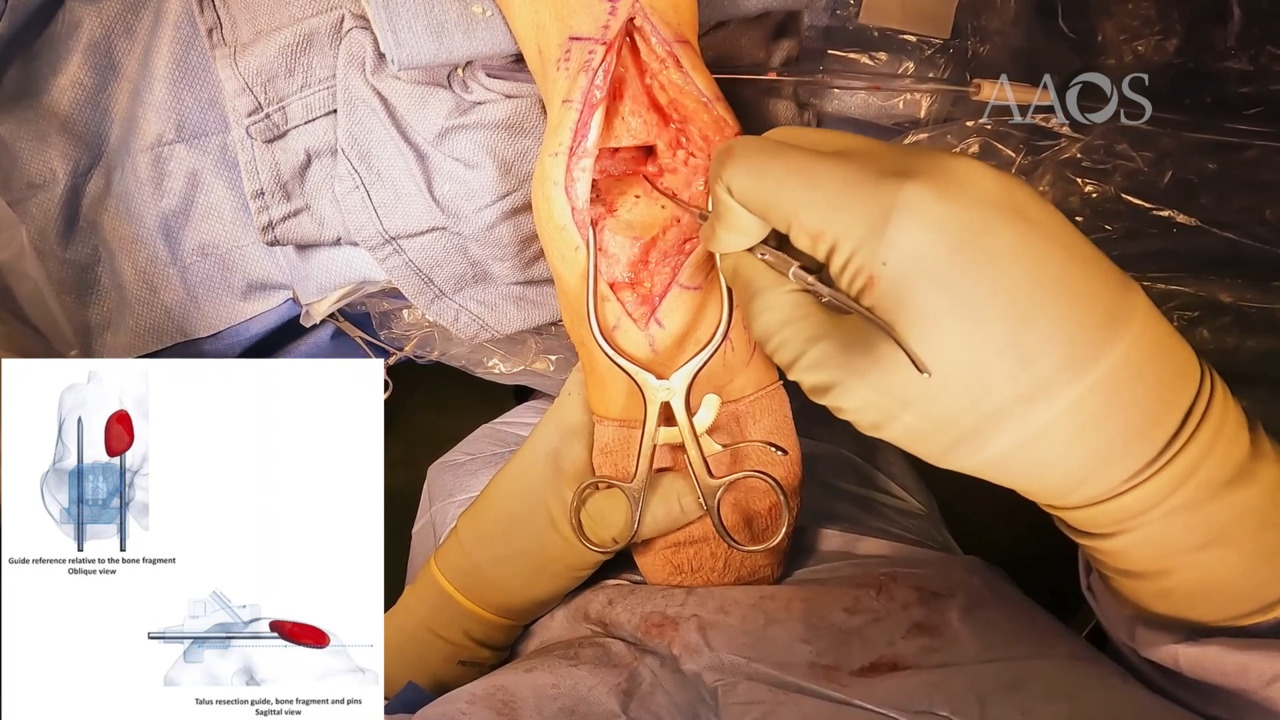
The rate of total ankle arthroplasty (TAA) is projected to continue to increase globally over the next several decades. Although the most important predictor of complications after TAA is implant malalignment, intraoperative evaluation of malalignment may be technically challenging. Patient-specific instrumentation (PSI) was designed to improve the accuracy of implant positioning in TAA. The goal of this video is to demonstrate our technique for TAA with the use of PSI and to compare radiographic alignment and postoperative function in patients who underwent TAA with or without PSI guides.
Methods
We retrospectively reviewed 35 ankles in which TAA was performed with the use of PSI with a minimum follow-up of 1 year. These ankles were compared with 81 ankles in which TAA was performed without PSI with a minimum follow-up of 5 years (historical controls). Demographics, including patient age (P = 0.07), patient sex (P = 0.31), patient body mass index (P = 0.63), laterality (P = 0.49), and preoperative diagnosis (P = 0.30), were similar between the groups. Patients in the PSI cohort had better preoperative plantar flexion (mean, 32.12°; range, 10° to 45°) compared with the patients in the control cohort (mean, 26.53°; range, 10° to 50°; P = 0.002). Patients in the PSI cohort had better preoperative total range of motion (mean, 40.76°; range, 10° to 60°) compared with the patients in the control cohort (mean, 35.27°; range, 5° to 65°; P = 0.04); however, preoperative dorsiflexion in the PSI cohort (mean, 8.64°; range, -5° to 20°) was similar to that in the control cohort (mean, 8.73°; range, -5° to 20°; P = 0.94). Patients in the PSI cohort had more preoperative talar tilt (mean, 8.45°; range, 0° to 33°) than the patients in the control cohort (mean, 4.67°; range, 0° to 22.3°; P = 0.004); however, the preoperative coronal angle in the PSI cohort (mean, 0.83°; range, -27.9° to 25°) was similar to that in the control cohort (mean, 0.36°; range, -19.6° to 27.2°; P = 0.83), and sagittal translation in the PSI cohort (mean, 2.1°; range, -5.6° to 17.5°) was similar to that in the control cohort (mean, 1.75°; range, -13° to 14°; P = 0.78).
Results
At minimum follow-up of 1 year, the postoperative coronal angle (mean, -0.58°; range, -5.42° to 3.41°) and the sagittal angle (mean, -2.58°; range, -9.19° to 3.8°) were more accurate and had a narrower range in the PSI cohort compared with postoperative coronal angle (mean, 2.3°; range, -3.4° to 9.8°; P < 0.001) and the sagittal angle (mean, 5.92°; range, -1° to 16°; P < 0.001) in the control cohort.
Postoperative range of motion between the PSI and control cohorts was similar, including dorsiflexion (mean, 10.08°; range, 0° to 20°; versus mean, 10.79°; range, 0° to 20°; P = 0.61, respectively); plantarflexion (mean, 30.52°; range, 12.5° to 40°; versus mean, 29.07°; range, 10° to 40°; P = 0.39, respectively); and total range of motion (mean, 40.6°; range, 17.5° to 55°; versus mean, 39.86°; range, 15° to 60°; P = 0.77, respectively).
Patients in the PSI cohort had decreased American Orthopaedic Foot and Ankle Society (AOFAS) pain scores (mean, 27.58; range, 0 to 40) compared with the patients in the control cohort (mean, 31.51; range, 20 to 40; P = 0.03); however, the PSI and control cohorts had similar AOFAS function (mean, 39.82; range, 10 to 50; versus mean, 38.79; range, 4 to 50; P = 0.63, respectively); AOFAS alignment (mean, 9.55; range, 5 to 10; versus mean, 8.89; range, 0 to 10; P = 0.13, respectively); and AOFAS total scores (mean, 76.94; range, 40 to 97; versus mean, 79.19; range, 24 to 100; P = 0.51, respectively).
No difference was reported in the number of TAA implants that required revision surgery in the PSI and control cohorts (3 [8.57%] versus 6 [7.41%]; P = 1.00).
Conclusion
PSI is associated with more accurate postoperative coronal and sagittal alignment compared with manual TAA. Although patients who underwent TAA with PSI had decreased AOFAS pain scores, both cohorts had similar postoperative range of motion and overall AOFAS scores. Although a similar number of revision procedures were reported in each cohort, this retrospective review was limited to shorter term follow-up. Additional research is necessary to determine if the improved alignment associated with the use of PSI is associated with better long-term implant survival.