
Arthroscopic Repair of Midsubstance Posterior Cruciate Ligament Tears
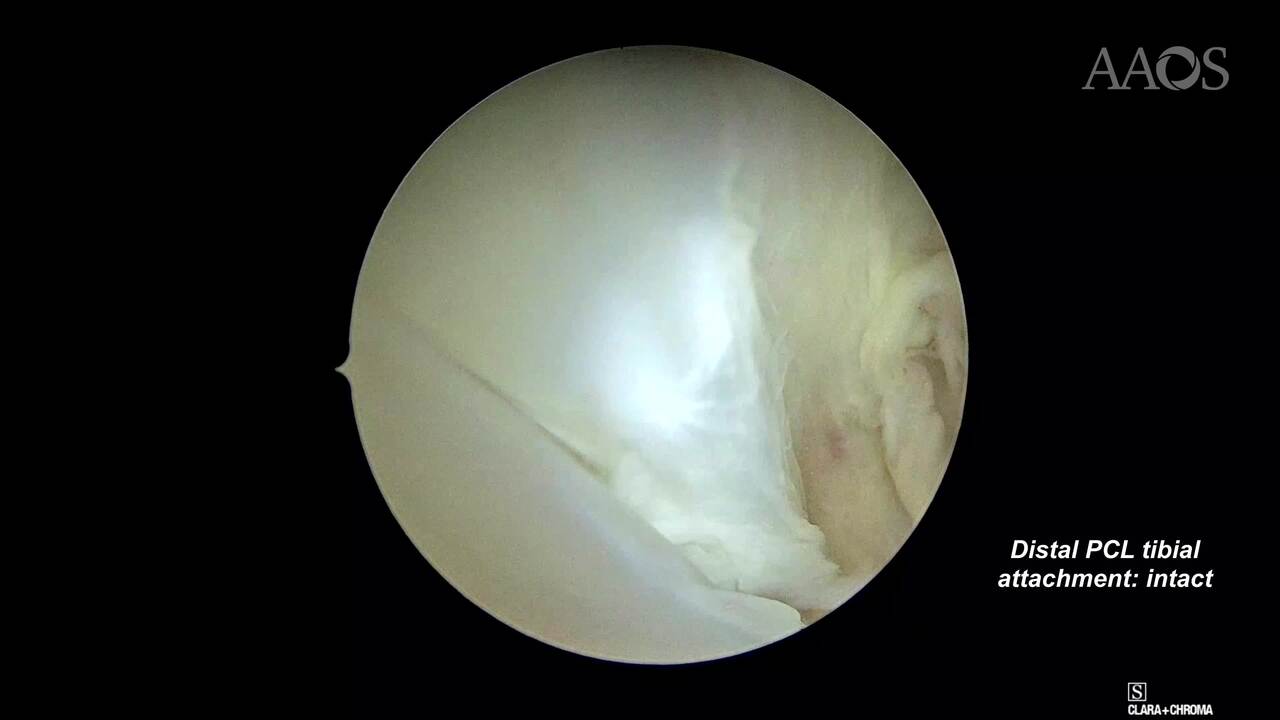
Summary: Posterior cruciate ligament (PCL) tears can result in persistent laxity, instability, activity tolerance, and articular damages such as meniscus tears and degenerative changes. PCL has an inherent capacity to heal, but persistent laxity can lead to chronic symptoms. Conservative treatment is typically successful in lower-grade PCL injuries. However, in highly active patients with high-grade PCL tears, and in patients with persistent laxity-related symptoms post conservative treatment, surgical treatment is a reasonable option. Repair was the main surgical approach for PCL tears in the 1980s-90s, but became less favored due to its subpar long-term results compared to reconstruction. With refinement in surgical techniques and rehabilitation strategies, there is a renewed interest in PCL repair, to take advantage of PCL's unique healing potential, minimize invasiveness, and potentially accelerate recovery. New implant technology has also facilitated new techniques, such as indirect repair with suture tape stabilization. In literature, recent reported outcomes of PCL repair are generally favorable, with multiple case series and cohort studies demonstrating an overall failure rate of 5.6%, and satisfactory postoperative Lysholm, IKDC, and Tegner scores. Currently, proximal and distal avulsion PCL tears are commonly repaired, with multiple open and arthroscopic techniques and clinical outcomes reported in literature for tears in these locations. However, though midsubstance is the most common PCL tear pattern (40-69% overall), reports of midsubstance repairs are rare, and comprised exclusively of indirect repairs via suture tape stabilization. This is likely due to the technical challenges unique to the tear location: visualization, access, and tissue suturing are all highly challenged, even with an arthroscopic approach. We developed an arthroscopic midsubstance PCL repair technique, with new suture implants that directly address the location-specific technical challenges. Borrowing principles, techniques, and new implants from arthroscopic anterior cruciate ligament repair and minimal-incision Achilles tendon repair, our technique secures the two portions of a torn PCL with one luggage-tagged ring suture per side, and each ring connected to an adjustable length loop suture (ALLD). With the suspensory ALLDs pulling both halves of the torn PCL toward each other, the torn PCL is reduced centrally. The entire construct is also supported with independently tensioned suture tape that serves as check rein. In cadaveric biomechanical testing, we demonstrated that, in a PCL-deficient state, our novel midsubstance PCL repair construct normalizes the posterior translation back to intact-PCL levels, and the normalization is further enhanced by suture tape support. However, suture tape stabilization alone does not reduce the posterior translation back to intact level, suggesting that the tape serves as a check rein, and not a de facto "synthetic ligament." Early outcomes of our small midsubstance PCL repair cohort are encouraging so far, with satisfactory postoperative IKDC (92±7.9%) and Tegner (7.7±1.5) scores at mean 18 month follow up. One 27-yo patient was able to return to a semi-professional soccer career at 15 months post repair. Another 49-yo patient returned to downhill skiing by 5 months, and trained for and completed a half-Ironman triathlon by 8 months post repair. In summary, technological and arthroscopic advances have spurred a renewed interest in PCL tear repair, but unique technical barriers remain for midsubstance tears. We have developed, biomechanically validated, and performed a novel arthroscopic midsubstance PCL repair technique, with early promising results in a small series. The new repair may help overcome technical challenges, add to our treatment options, and improve treatment outcome for this common pattern of PCL injury.