
Biportal Endoscopic Lumbar Interbody Fusion
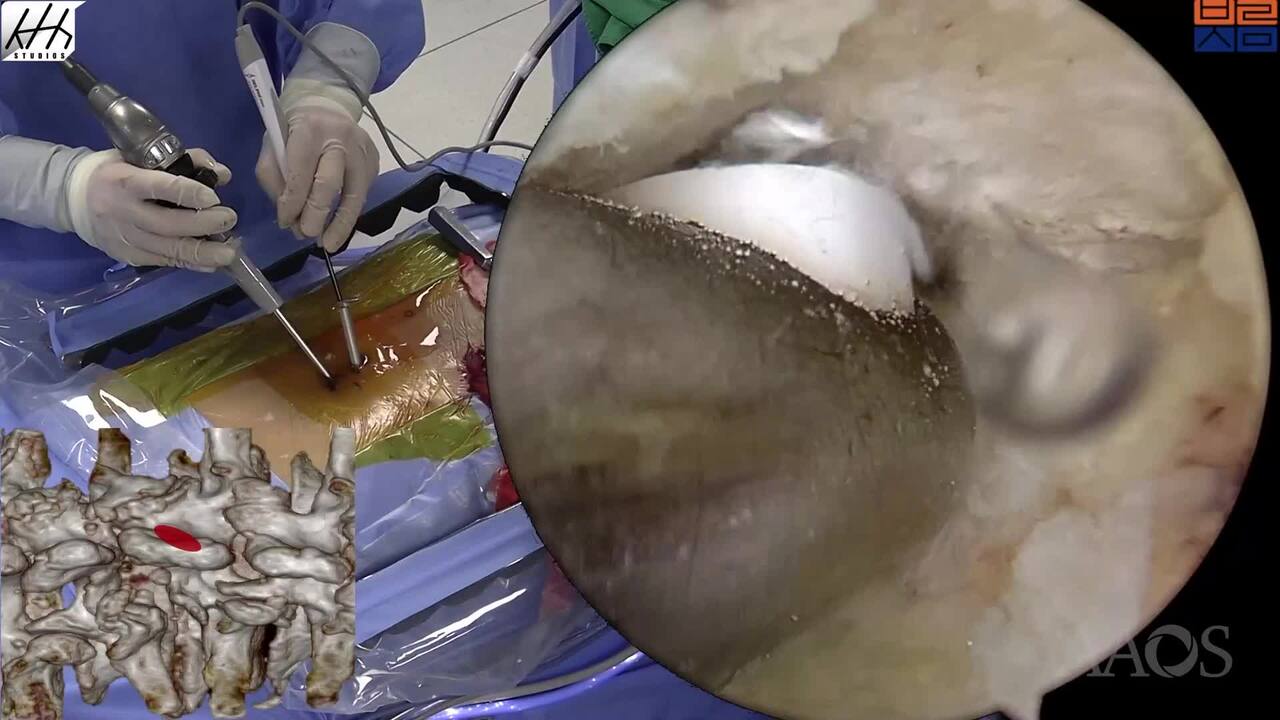
Lumbar degenerative pathology that does not respond to conservative treatment often requires spinal surgery. Based on current understanding, lumbar interbody fusion is regarded as the gold standard for treating spondylolisthesis with both central and foraminal stenosis or instability. With the development of endoscopic techniques, both decompression and lumbar interbody fusion can now be performed endoscopically. This video introduces a technique that uses two cages under endoscopic guidance to achieve a wide footprint. BELIF is an approach method that is utilizing space between transforaminal lumbar interbody fusion and posterior lumbar interbody fusion. Once sufficient space is secured for the work, decortication of lamina and facet joint begins using an arthroscopic burr. decompression can be performed safely using arthroscopic burrs and osteotome. inferior articular process and superior articular process are sufficiently removed. Diskectomy is performed using a 15 blade and RF wand. The size of the diskectomy varies from case to case, but a minimum of 15 mm is recommended. Removing the posterior spur with a blunt osteotome makes it easier to enter the intervertebral space and to remove the cartilage tissue covering the subchondral bone. The disk fragments are removed under magnified view. Annulus release is performed to reduce tension in the annulus, allowing better visualization of the interbody space and facilitating cage insertion by soft tissue release. After bone grafting, cage is inserting into interbody space. Two cages of different heights were inserted and then rotated into a transverse position to create natural segmental lordosis and prevent cage pull-out, achieving favorable segmental lordosis by using a high cage in the anterior and a low cage in the posterior. And two cage with a larger footprint is assumed to be advantageous. To complete the procedure, percutaneous screw fixation is performed to secure segmental alignment and stability.