
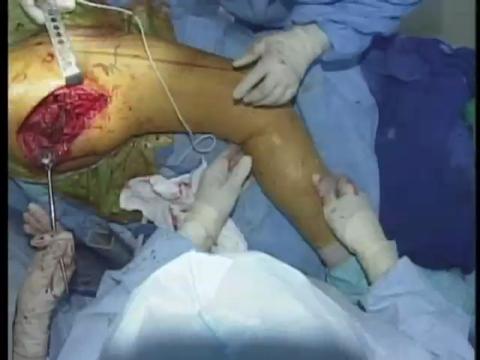
Reconstruction of Abductor Mechanism-Gluteus Maximus Flap Transfer
Peer review has expired on this program. It is the viewer’s responsibility to determine the educational value of this historical content.Peer review has expired on this program. It is the viewer’s responsibility to determine the educational value of this historical content.Peer review has expired on this program. It is the viewer’s responsibility to determine the educational value of this historical content.Chronic avulsion or inflammatory destruction of the abductor portions of the gluteus medius and gluteus maximus in association with total hip arthroplasty (THA) causes severe limp and often pain. This study describes a repair technique and reviews initial results. To treat abductor deficiency, we transferred the anterior half of the gluteus maximus muscle to the greater trochanter and sutured under the vastus lateralis. We sutured both in the abduction and the V-Y repair of the gluteus maximus to ensure tight repair. We repaired and reconstructed 11 hips in 11 patients with complete loss of abductor attachment and followed them for 16 to 42 months. We performed the procedure in nine patients during THA and in two later as a secondary procedure. Preoperatively, all patients had severe limp, abductor lurch, absence of hip abduction against gravity, and positive Trendelenburg signs. Postoperatively, nine hips in nine patients have strong abduction of the hip against gravity, no abductor lurch, and negative Trendelenburg sign. One hip has weak abduction against gravity, negative Trendelenburg sign, and slight abductor lurch. One patient failed to achieve strong abduction, had severe limp after six months of protection and physical therapy, and became lost to follow up. Surgical technique is important, but gluteus maximus transfer can restore abductor function in THA with a high success rate.