
Restoration of Posterior Condylar Offset in Total Knee Arthroplasty: The Effect of Posterior-referencing Jig Design
Typically, the native tibiofemoral joint line is oblique to the mechanical axis and the native posterior condylar axis is internally rotated to the transepicondylar axis. Mechanically-aligned total knee arthroplasty (TKA) alters these relationships. In mechanically-aligned TKA, femoral component rotation parallel to the transepicondylar axis optimizes patellofemoral and tibiofemoral mechanics. Collateral ligament isometry in flexion and extension depends on posterior condylar offset and the level of the joint line. Intramedullary distal femoral cutting jigs commonly set the distal femoral joint line in relation to the distalmost femoral condyle, typically the medial condyle. Posterior referencing jigs reference the posterior condylar axis, allowing for variable degrees of external rotation. If rotation is greater than 0°, then anatomic restoration of posterior offset of both femoral condyles is impossible. Some jigs dictate external rotation around a central point, resulting in small changes in the offset of both condyles. Other jigs reference one femoral condyle. With increasing external rotation, these jigs can markedly alter the offset of the condyle not referenced. Referencing the lateral femoral condyle in flexion and the medial femoral condyle in extension may result in mismatched gaps after bone resection.
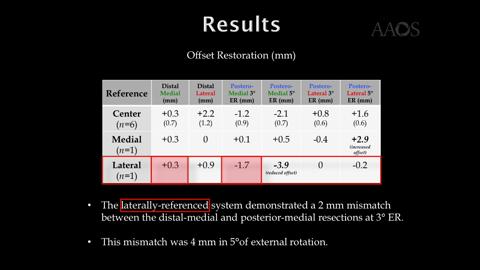
Using 32 identical sawbone specimens, we performed distal and posterior femoral resections with the use of cutting guides from eight widely available TKA systems. Distal femoral valgus resection was set at 5° for all the specimens, whereas rotation was set at 3° for two specimens and 5° for two specimens with each system. We measured the thickness of all bone resections and compared those values to known implant thickness. This video describes the differences in thickness between the distal and posterior femoral resections, which is a marker for potential imbalance of the flexion and extension gaps. Our data offers arthroplasty surgeons insight into the bony resections made with widely-used TKA instrumentation systems. The video demonstrates how adjustments of anteroposterior position are made to balance flexion and extension resections, even with jigs that reference the medial condyle in extension and the lateral condyle in flexion.