
Evolution of Capsular Management in Hip Arthroscopy: Should the Wheel Come Full Circle?
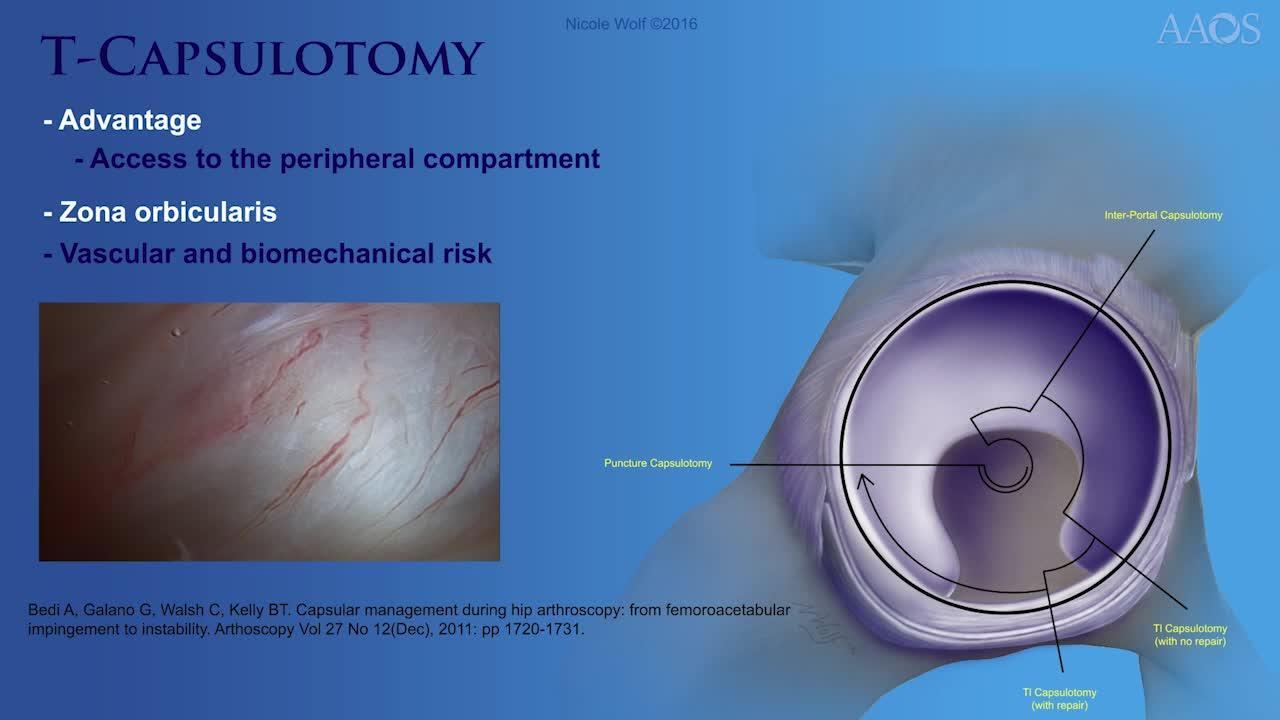
The goal of this video is to review the pearls and pitfalls of capsular management during hip arthroscopy. The senior author’s preferred method for puncture capsulotomy is presented as an alternative to current standards for accessing the central and peripheral compartments. With increasingly complex procedures, adequate visualization and maneuverability are required for modern hip arthroscopy. The progressive need for better visualization has driven the development of surgical techniques for capsular management. Specifically, the use of traditional puncture capsulotomy decreased in favor of interportal capsulotomy and T-capsulotomy, which are associated with larger capsular openings and afford greater exposure for hip arthroscopy. Interportal capsulotomy and T-capsulotomy are associated with clear benefits, especially in patients in whom exposure and maneuverability are difficult during hip arthroscopy.
Recently, concern that capsular release may result in iatrogenic complications, such as anterior subluxation, instability, heterotopic ossification, poor capsular healing, and seroma, has increased. These complications led the senior author to consider returning to the basics of capsular management during hip arthroscopy via puncture capsulotomy. Although visualization with a puncture capsulotomy may be a challenge, this difficulty can be overcome with careful placement of arthroscopic portals by an experienced surgeon. The merits of puncture capsulotomy should be considered for returning to the basics of capsular management during hip arthroscopy as it was originally described and as an alternative to extended capsulotomy.