
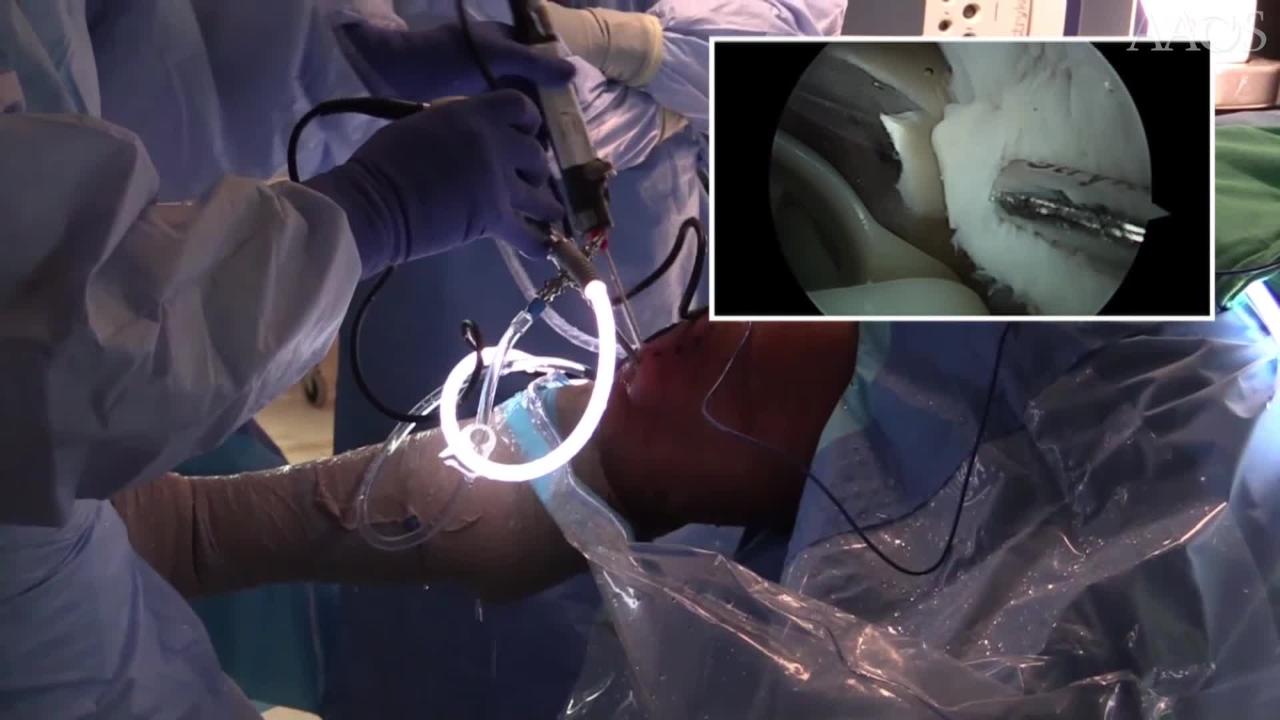
Arthroscopic Debridement for Total Knee Arthrofibrosis
Although most patients who undergo total knee arthroplasty have good outcomes with regard to pain relief and functional improvements, arthrofibrosis develops in a small number of patients. Arthrofibrosis may be a devastating complication because decreased range of motion limits basic activities of daily living, such as sitting, climbing stairs, and tying shoes. If a patient with a well-aligned and well-positioned component who has no demonstrable infection experiences stiffness within 6 to 12 weeks postoperatively, decreased range of motion often can be successfully managed via manipulation under anesthesia. Treatment options for patients who experience stiffness after 3 months postoperatively include open or arthroscopic lysis of adhesions, each of which is associated with advantages and disadvantages.
From 2001 to the present, the authors of this video performed arthroscopic lysis of adhesions in 64 consecutive patients with a long-standing arthrofibrotic total knee arthroplasty implant, which resulted in an overall substantial improvement in range of motion. This video demonstrates an extensive and methodical approach for successful arthroscopic lysis of adhesions in patients with long-standing arthrofibrosis (90 days to 10 years postoperatively) and discusses key surgical pearls.