
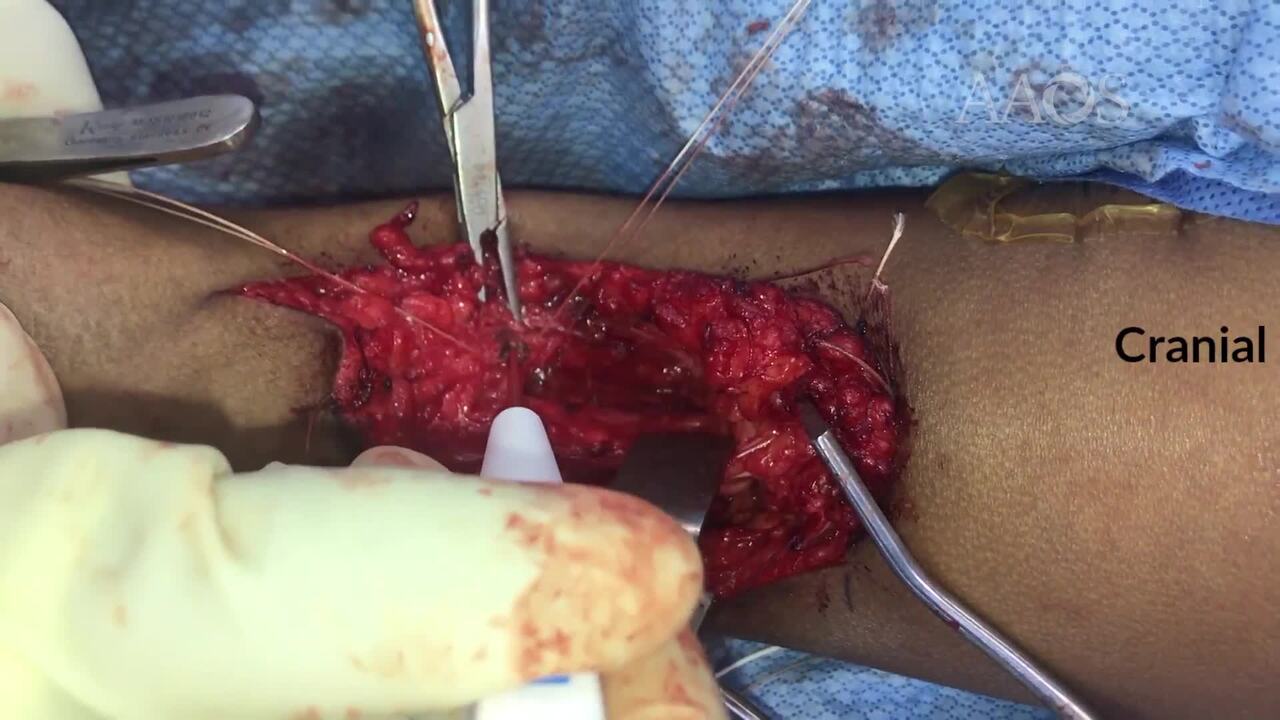
Posterior Approach to the Knee and Contracture Release for Arthrogryposis
Arthrogryposis multiplex congenita may result from various underlying etiologies and can be subclassified as amyoplasia (normal central nervous system function), limb involvement and other body part involvement, or limb involvement and central nervous system involvement. Several nonsurgical and surgical techniques have been described for the management of knee flexion contractures, such as serial cast immobilization, epiphysiodesis, a supracondylar extension osteotomy, and an Ilizarov fixator; however, the most effective corrective method during the growth period is a flexor tenotomy with a posterior capsulotomy and posterior cruciate ligament transection. This video discusses the case presentation of a 3-year-old patient with amyoplasia. Although a flexion knee contracture of 70° is associated with a substantial effect on ambulation capacity and this patient had a surgical history resulting in near-full extension of the contralateral knee, we elected to perform a posterior capsulotomy, posterior transection of the posterior cruciate ligament, hamstring lengthening, and gastrocnemius tenotomy. Although this procedure is associated with maximal improvements in knee extension, it does not preclude recurrence, hamstring weakness, and the potential for neurovascular complications. Using careful surgical techniques and identifying at risk structure, the patient had immediate symptomatic relief after release of the posterior knee structures.