
Steindler Flexorplasty
Proposal
Originally described in 1918, Steindler flexorplasty is a treatment option to consistently restore functional elbow flexion. This video illustrates the author's updated surgical technique for Steindler flexorplasty.
Case Review
The patient in this case presentation is a 32-year-old right hand-dominant man who sustained right brachial plexus palsy during a motorcycle accident in February 2007. At the time of initial presentation to our clinic 1 year postinjury, the patient had not regained any elbow flexion and had 1/5 biceps function on physical examination.
Method/Technique
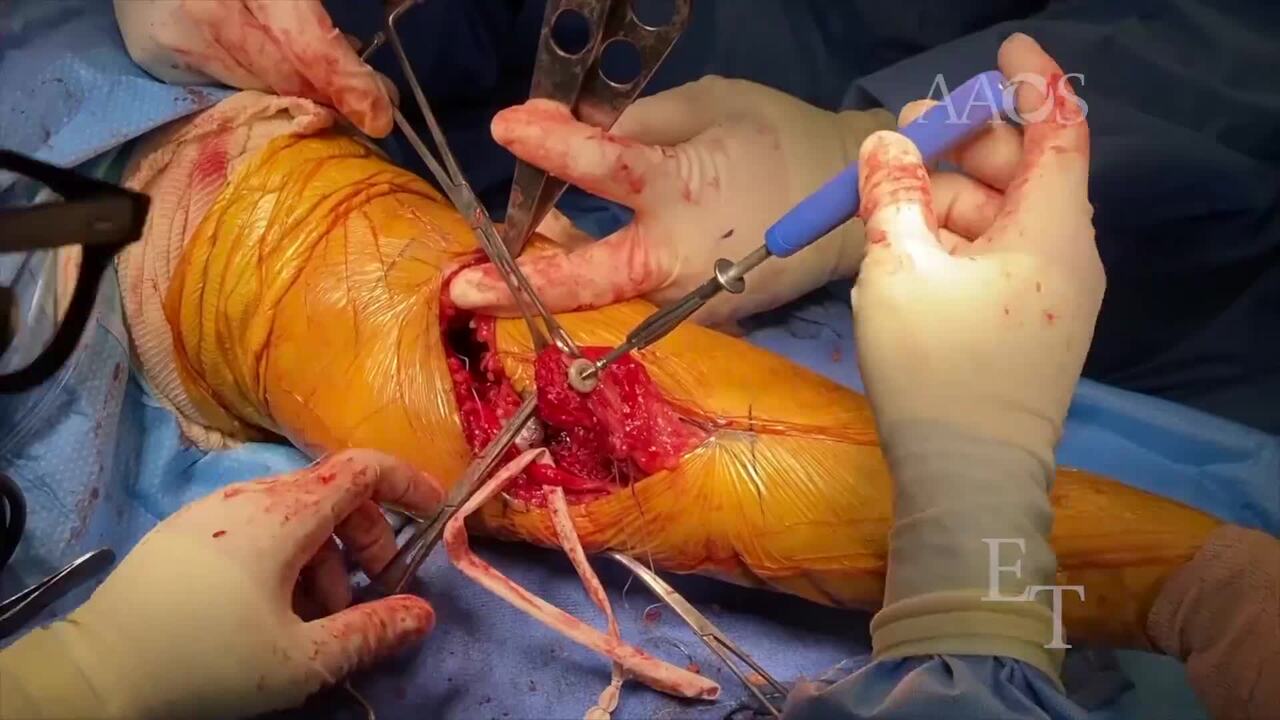
A 15-cm curvilinear incision is centered over medial epicondyle. The medial antebrachial cutaneous nerve is identified, after which the ulnar nerve is identified and decompressed. Next, the median nerve is neurolysed proximally and distally, and the medial intermuscular septum is released. The flexor pronator mass is then elevated, protecting the anterior band of the ulnar collateral ligament. After predrilling, a medial epicondyle osteotomy is created and secured 5 cm proximal to the center of the humerus with the use of a 3.5-mm screw and a soft-tissue washer. Two suture anchors are used to supplement fixation. Postoperatively, the patient's arm is splinted in 90° of flexion.
Results
The patient in this case presentation underwent Steindler flexorplasty in March 2009. At a follow-up of 4 years, the patient had elbow flexion of 105° and 4/5 elbow strength.
Summary
Steindler flexorplasty is a reliable procedure associated with low morbidity; therefore, it should be included in the armamentarium of treatment options to restore elbow flexion.