
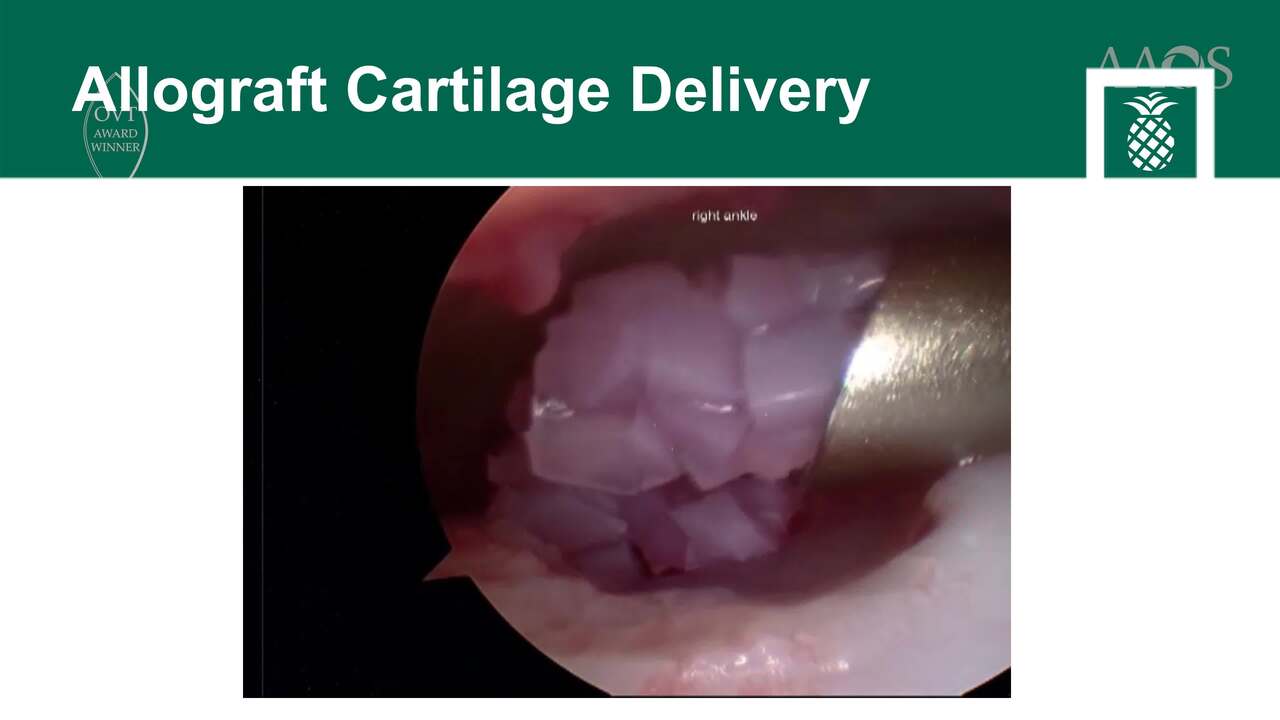
Long-term Outcome Measures After Particulated Juvenile Allograft Cartilage Implantation for Treatment of Difficult Osteochondral Lesions of the Talus
Patients with symptomatic osteochondral lesions of the talus can have serious impairments in their activities of daily living and occupations. The role of particulated juvenile allograft cartilage implantation is not well elucidated in reference to long-term patient outcomes. A total of 13 patients with difficult-to-treat osteochondral lesions of the talus underwent arthroscopically assisted implantation of particulated juvenile allograft articular cartilage into defects from 2010 through 2012 by the same surgeon. Difficult lesions were defined as having some combination of the following: 1) lesions size of 1.07 cm2 or greater, 2) corner/shoulder lesions, 3) patients with failed microfracture surgery, 4) patients older than 40 years, or 5) patients with a body mass index (BMI) higher than 25 kg/m2. Patients were evaluated by means of physical examination, patient interviews, and pre- and postoperative outcome score measures. Patients had follow-up at 2 years, 4 years, and between 6 and 9 years (their most recent follow-up). Differences in functional outcome scores were compared before and after surgery. The most recent follow-up among patients (age, 46.5 &[plusmn] 11.8 years; BMI, 28.5 &[plusmn] 6.1 kg/m2) was, on average, 8.0 years (range, 72 to 113 months). The average visual analog scale pain score decreased for patients by 3.9 points (95% CI, 2.18 to 5.60), when compared to preoperative assessment. Scores on the Foot and Ankle Ability Measure Activities of Daily Living and Sports subscales also showed improvement from 46.5 to 80.9 (95% CI, 21.35 to 47.43) and from 18.8 to 57.9 (95% CI, 21.05 to 57.10), respectively. Scores on the physical component of the Medical Outcomes Study 36-Item Short Form showed significant improvement by an average of 45.5 points (95% CI, 32.42 to 58.50). American Orthopedic Foot and Ankle Society scores improved from 55.2 to 80.3 (95% CI, 12.459 to 37.741). The use of arthroscopically assisted particulated juvenile allograft cartilage implantation of talar osteochondral lesions provides satisfactory outcomes for difficult-to-treat lesions. These results demonstrate clinically positive long-term outcomes for a cohort of patients followed over the course of 6 to 8 years.