
Calcaneus Fracture and Posterior Arthroscopic Primary Subtalar Arthrodesis (C-PASTA)
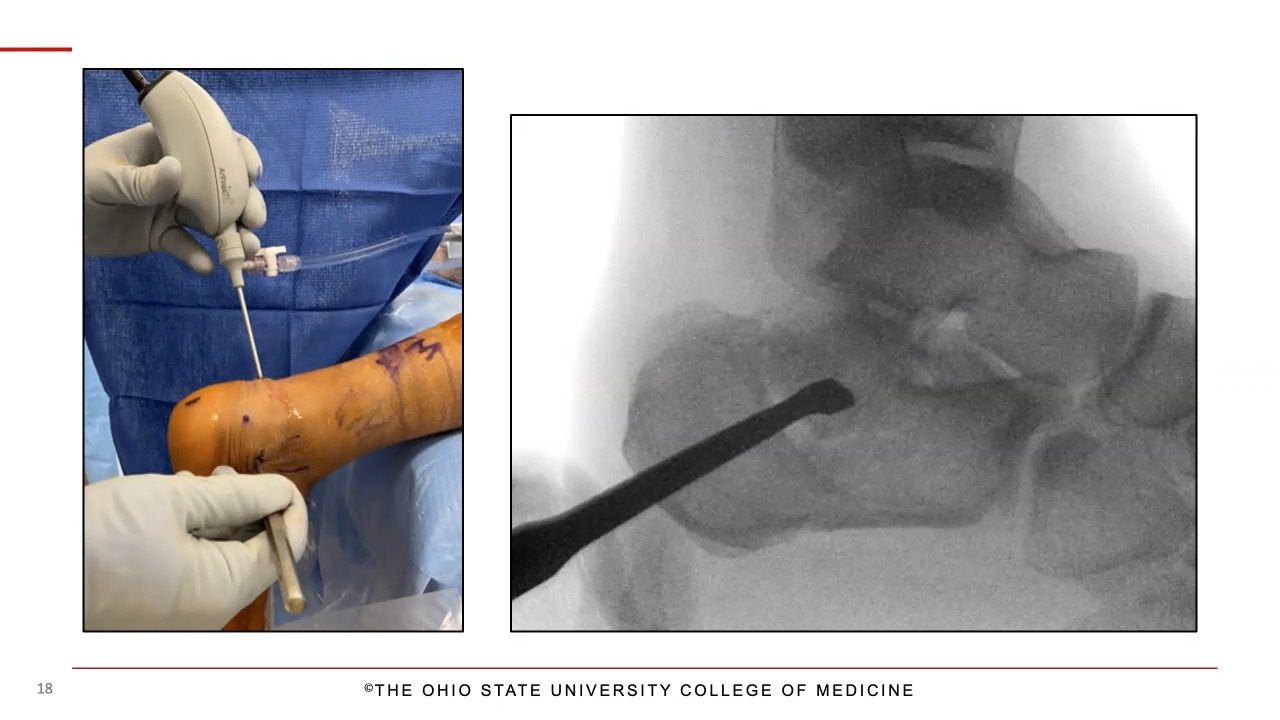
Calcaneus fractures often require surgical intervention, although no optimal management is evident in the literature. Of all calcaneus fractures, roughly 75% are thought to be intra-articular. When they involve the posterior facet of the subtalar joint, calcaneus fractures are further classified on the basis of the number of articular fragments, known as Sanders classifications (types I through IV). Types II through IV are specifically reserved for intra-articular displacement, with type IV being the most severe.3 In general, surgical outcomes are inversely proportional to the more severe fracture pattern, meaning that Sanders III and IV are associated with the worst outcomes. Of particular concern is that displaced intra-articular calcaneus fractures are associated with alarmingly high rates of posttraumatic arthritis. Recent literature suggests severe subtalar posttraumatic arthritis in less than one year in 30% to 70% of patients, making the argument that primary subtalar arthrodesis should be considered. Furthermore, union rates, pain scores, and functional outcomes after primary open subtalar arthrodesis are favorably reported throughout the literature, notably with union rates approaching 95% to 100%. Historically, however, subtalar arthrodesis has been performed open, with the use of a combination of plating and divergent fusion screws and has been associated with revision rates as high as 60%. More recently, subtalar fusion has been achieved entirely through the arthroscope via a technique known as posterior arthroscopic subtalar arthrodesis (PASTA). PASTA has been found to significantly decrease time to union and return to work as well as accelerate return to activities of daily living and sports as compared with open techniques in the management of nonacute posttraumatic arthritis. Given the favorable results of acute primary open subtalar arthrodesis and the proven results of using an arthroscopic technique for subtalar fusion in the nonacute setting, we propose using PASTA for Sanders type III and IV calcaneus fractures. In the video, we outline the surgical steps for doing so.