
Chronic Monteggia Lesion in Children: Diagnosis and Treatment by Combined Ulnar Osteotomy and Annular Ligament Reconstruction by Using Virtual Surgical Planning and Customized Massive Allograft
Introduction
A missed Monteggia lesion is defined as a chronic dislocation of the radial head diagnosed 4 or more weeks after initial trauma. In the pediatric population, dislocation of the proximal radius may result from plastic deformation of the ulnar shaft with no evidence of fracture, making immediate diagnosis a challenge, especially in younger children, if elbow and forearm alignment is not carefully evaluated on radiographs. Occasionally, patients may present with a dislocation without remembering recent trauma. If left unmanaged, this condition may result in capitellar deformity, elbow malalignment with valgus instability, functional impairment, pain, and early elbow osteoarthritis. The surgical management of missed Monteggia fractures in children includes restoration of ulnar length and alignment, closed or open reduction of the radial head, and repair or reconstruction of the annular ligament. Often a combination of these procedures is required to achieve stable reduction. This video reviews a chronic Monteggia lesion in a 7-year-old girl who was treated via an ulnar lengthening osteotomy, open reduction of the radial head, and annular ligament reconstruction. Three-dimensional models were used for preoperative planning, hardware pre-contouring, and allograft customization.
Case Report
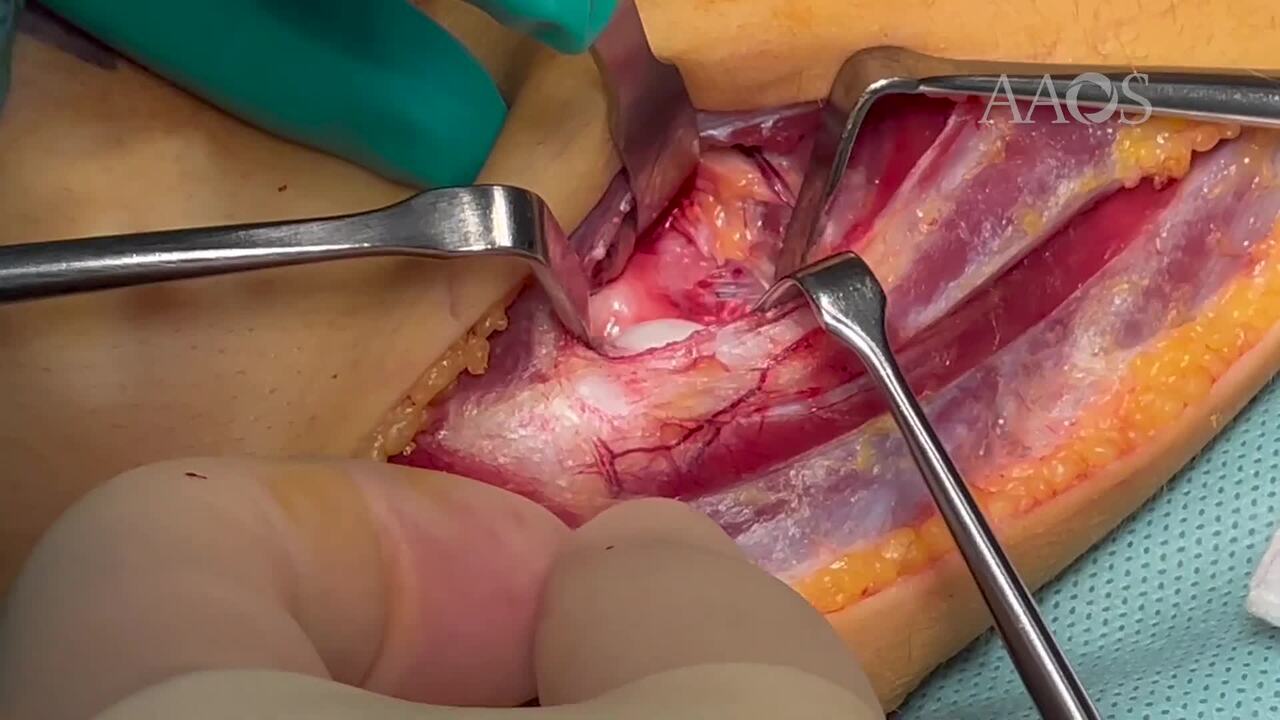
This video reviews the case presentation of a 7-year-old girl with a chronic Monteggia lesion of the right elbow, causing valgus deformity and impaired elbow flexion. Plain radiographs and CT scans of the affected and unaffected elbows were obtained for preoperative planning. Three-dimensional digital models were used for virtual surgical planning. This consisted of simulating the ulnar lengthening osteotomy; calculating the size, shape, and position of the bone allograft; and determining the bending of a one-third tubular plate. The bone allograft was then produced at the Musculoskeletal Tissue Bank using a five-axes computer numerical control milling machine (vivarell-cust mass allograft] based on the simulated surgical procedure. The procedure was performed according to virtual surgical planning. After the ulnar lengthening osteotomy, residual instability of the radial head was managed via open reduction and reconstruction of the annular ligament according to the Bell-Tawse technique.
Results
At 6-month follow-up, the osteotomy had healed, elbow alignment and motion were restored, and radiographs demonstrated stable relocation of the radial head.
Conclusion
Chronic Monteggia lesions in children can be effectively and safely managed via combined ulnar lengthening osteotomy and annular ligament reconstruction. Three-dimensional modelling is a reliable tool to predict correction and to plan surgery in patients with complex deformity. The availability of pre-cut custom bone grafts decreases surgical time and allows the procedure to be more reproducible.