
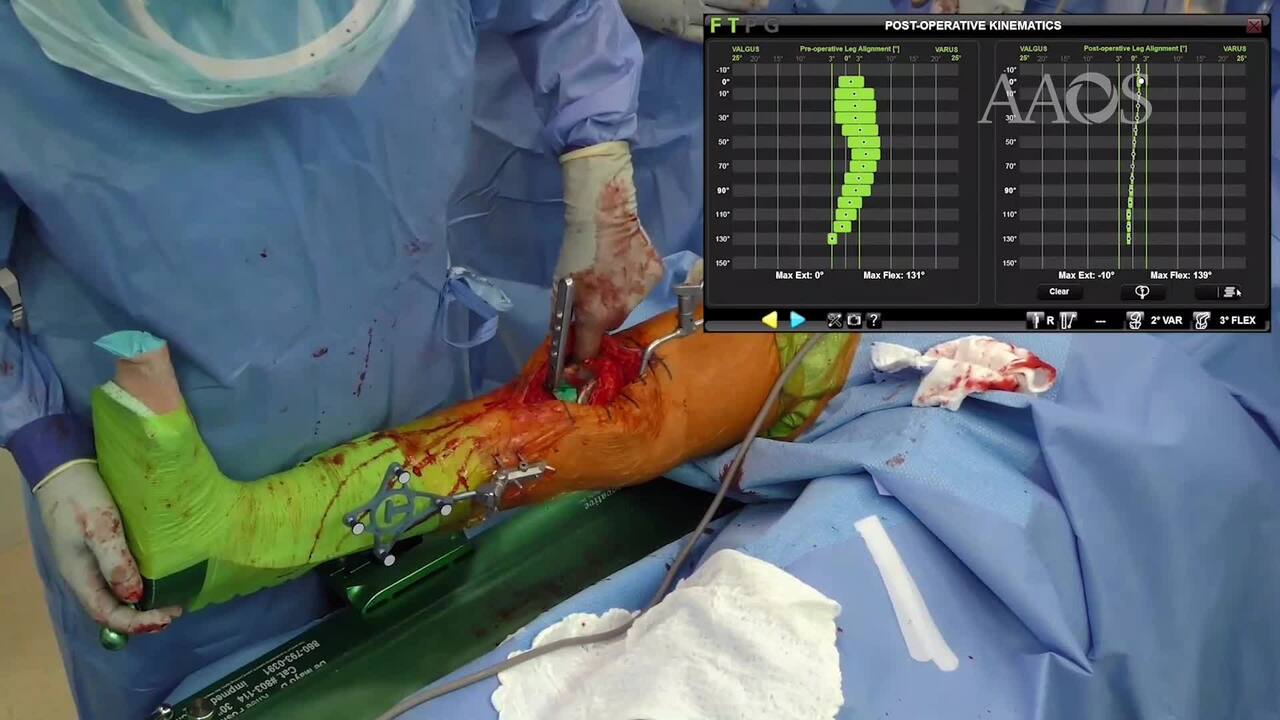
Predictive Balancing Robotic Total Knee Arthroplasty
Modern total knee arthroplasty is a soft-tissue and bony surgical procedure. An expanding body of literature has demonstrated the increasing importance of soft-tissue balance to improve results. Various methods exist for assessing ligament balance, including surgeon manual assessment, pressure-sensing devices, and tensioners.
This video describes the technique and results of a surgical method that uses intraoperative, active robotically controlled ligament tensioning with a CT-free, imageless computer navigation platform. A consistent internal force is applied through full range of motion to the medial and lateral compartments after tibial resection to produce in vivo characterization of the soft-tissue envelope. Femoral component positioning and subsequent ligament balance are determined predictively based on full range of motion characterization of the ligaments before bone cuts are made, which are then calculated to optimize balance and minimize soft-tissue releases. The surgical plan of femoral cuts is executed with the use of a robotically controlled cutting guide. The achieved ligament balance, gaps, and kinematics are documented via the active tensioning device with the femoral trial.
This video presents published results of this technique up to 2 years postoperatively. The accuracy of the system has been documented, showing less than a 1.5-mm difference between predicted and achieved gaps and more than 90% of knees showing balance in comparing medial/lateral gaps and gaps in flexion versus extension. A prospective, multicenter study documented consistently better balance when using the predictive technique versus a femur-first workflow. One year Knee Injury and Osteoarthritis Outcome Scores considerably improved on several subscales. Another prospective multicenter study identified specific joint gap targets in extension, mid-flexion, and full flexion that were associated with improved Knee Injury and Osteoarthritis Outcome Scores for pain at 1 year postoperatively. Most recently, 2-year Knee Injury and Osteoarthritis Outcome Scores demonstrated the effect of nonneutral component positioning and the detriment of soft-tissue releases. Specifically, a wide range of component positioning was associated with good results if the knee demonstrated proper balance within specified targets through full range of motion. In addition, among patients with equivalent deformity, a greater number of soft-tissue releases was associated with poorer outcomes. The video also addresses the implications of manual assessment of ligament tension and pressure-sensor methods versus internally applied robotic ligament tensioning.