
Biceps Rerouting Technique for Large to Massive Cuff Tears
This video discusses the biceps rerouting technique, which can be used to manage large to massive rotator cuff tears.
Case Example
A 66-year-old man presented with chronic right shoulder pain. Plain radiographs revealed slight superior migration of the humeral head. A large supraspinatus tear with 3 cm of retraction was confirmed via MRI. Arthroscopic biceps rerouting (ABR) was performed with supraspinatus tendon repair. At 2-year follow-up, MRI revealed a continuous supraspinatus tendon and a well-fixed rerouted biceps with a fully covered greater tuberosity.
Arthroscopic Biceps Rerouting Technique
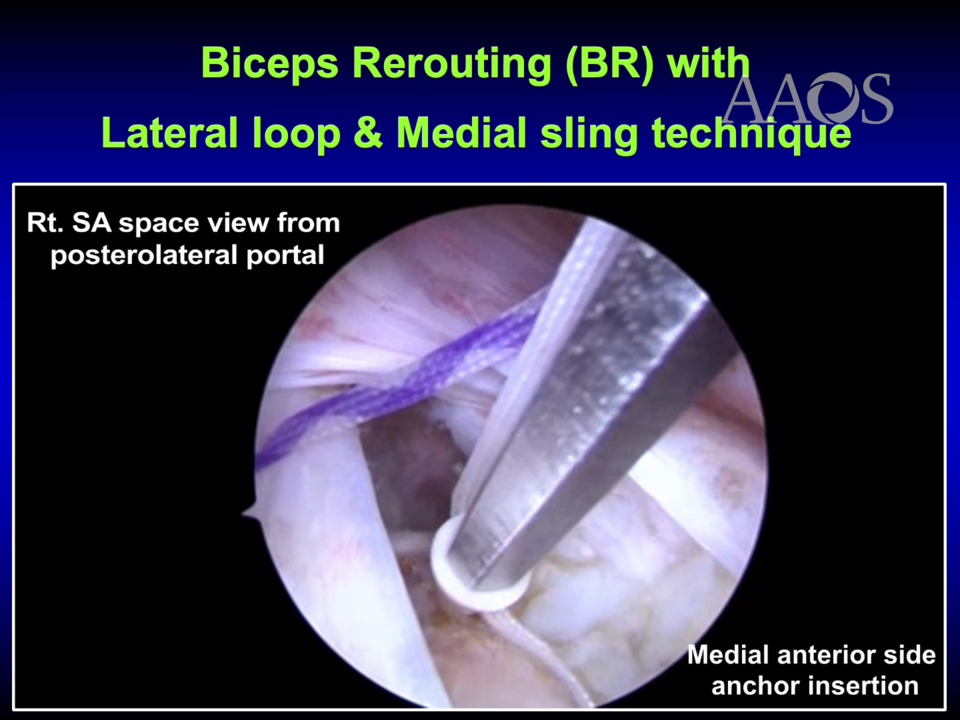
The purpose of ABR is to manage large to massive rotator cuff tears using the long head of the biceps tendon (LHBT). After the glenohumeral joint procedure, the arthroscope is moved into the subacromial space. After transverse humeral ligament and soft-tissue release, a new biceps groove is made at the footprint of the rotator cuff with the use of a burr. The LHBT is repositioned posteriorly to the newly created biceps groove. Two separate suture anchors are used laterally and medially to fix the repositioned LHBT. Using sutures from the anchors for LHBT fixation, rotator cuff repair is performed. One or two more suture anchors can be inserted to perform rotator cuff repair effectively.
Biomechanical Evidence
A 2019 biomechanical study confirmed the effect of ABR. A total of eight cadaver model shoulders were used for comparing five conditions: intact shoulder, irreparable rotator cuff tear, partially repaired rotator cuff, biceps-rerouted rotator cuff, and biceps-rerouted and side-to-side–repaired rotator cuff. Superior humeral translation and subacromial contact pressure were considerably improved in the biceps-rerouted shoulders.
Outcomes for the Technique
The authors of this video evaluated 61 patients who were followed for more than 18 months. The clinical results of ABR showed considerable improvement in functional scores, including the American Shoulder and Elbow Surgeons score and range of motion. The authors published a paper in 2020 in the Journal of Shoulder and Elbow Surgery. Another group evaluated 111 patients with semirigid large to massive rotator cuff tears. Patients were divided into two groups and compared: arthroscopic cuff repair with ABR versus without ABR. A substantially lower re-tear rate was reported in the ABR group. This paper was published in 2021 in the Journal of Arthroscopy.