
Ultrasound-Guided Injection is an Effective Nonsurgical Treatment for Mucoid Degeneration of Posterior Cruciate Ligament
Introduction
Posterior cruciate ligament (PCL) mucoid degeneration is a relatively rare disease that occurs in middle-aged and older adults, with a reported incidence of 0.1%. Symptoms of PCL mucoid degeneration include knee joint pain with limited range of motion. MRI is useful for diagnosis, with characteristic findings, such as a diffusely thickened PCL with increased intra-ligamentous signal intensity. This is called the celery stalk sign. Management includes arthroscopic débridement.PurposeThis video reports an improvement in symptoms after ultrasonographic-guided steroid injection about the PCL.Case Report This video discusses the case presentation of a 48-year-old man with right knee pain and limited range of motion. The patient was referred 8 months after the onset of pain because his symptoms did not improve with intra-articular injections and oral medications.
Clinical Findings
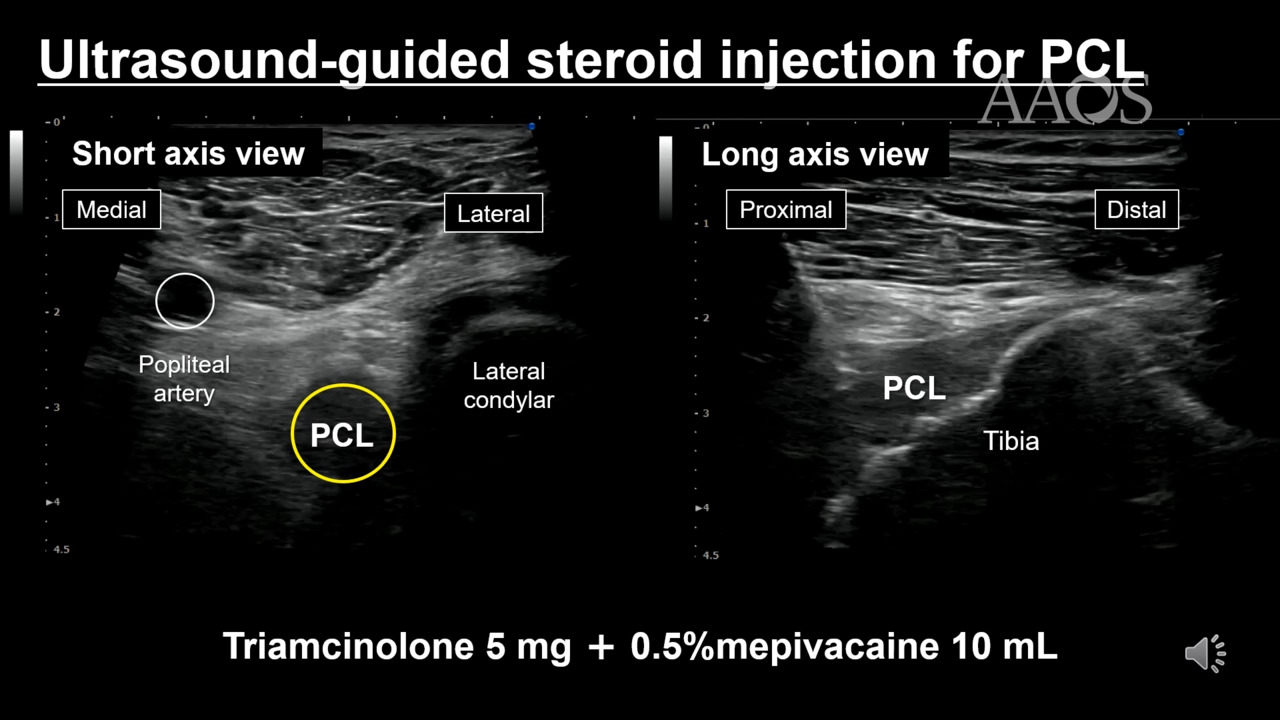
Mild swelling of the right knee and patellar ballottement were observed. Range of motion was 0° in extension and 75° in flexion. MRI revealed thickening and a high signal intensity in the PCL. Echocardiograms showed thickening of the PCL on the affected side. Based on these findings, PCL mucoid degeneration was diagnosed.For PCL mucoid degeneration, ultrasonographic-guided steroid injections about PCL are performed via a short-axis approach. The injection was performed safely by checking the location of the popliteal artery during the injection. Improvement in knee joint range of motion and pain was observed 1 week after injection. The patient was able to perform daily activities without pain. Range of motion gradually increased with injections administered every 1 to 2 months. At 11 months after the first injection, echocardiograms showed improvement in the thickening of the PCL on the affected side.
Discussion
In PCL mucoid degeneration, impingement because of thickening of the ligament is a factor in pain and limited range of motion. Arthroscopic débridement has been reported to decrease the volume of the ligament and improve symptoms. In this patient, the injection was thought to reduce thickening of the ligament and improve symptoms. Using ultrasonographic equipment to identify the popliteal artery allowed for safe and accurate injections deep into the popliteal fossa.
Conclusion
Using ultrasonographic equipment allowed for safe and accurate injections deep into the popliteal fossa. Ultrasonographic-guided steroid injection can be an effective nonsurgical treatment option for PCL mucoid degeneration.