
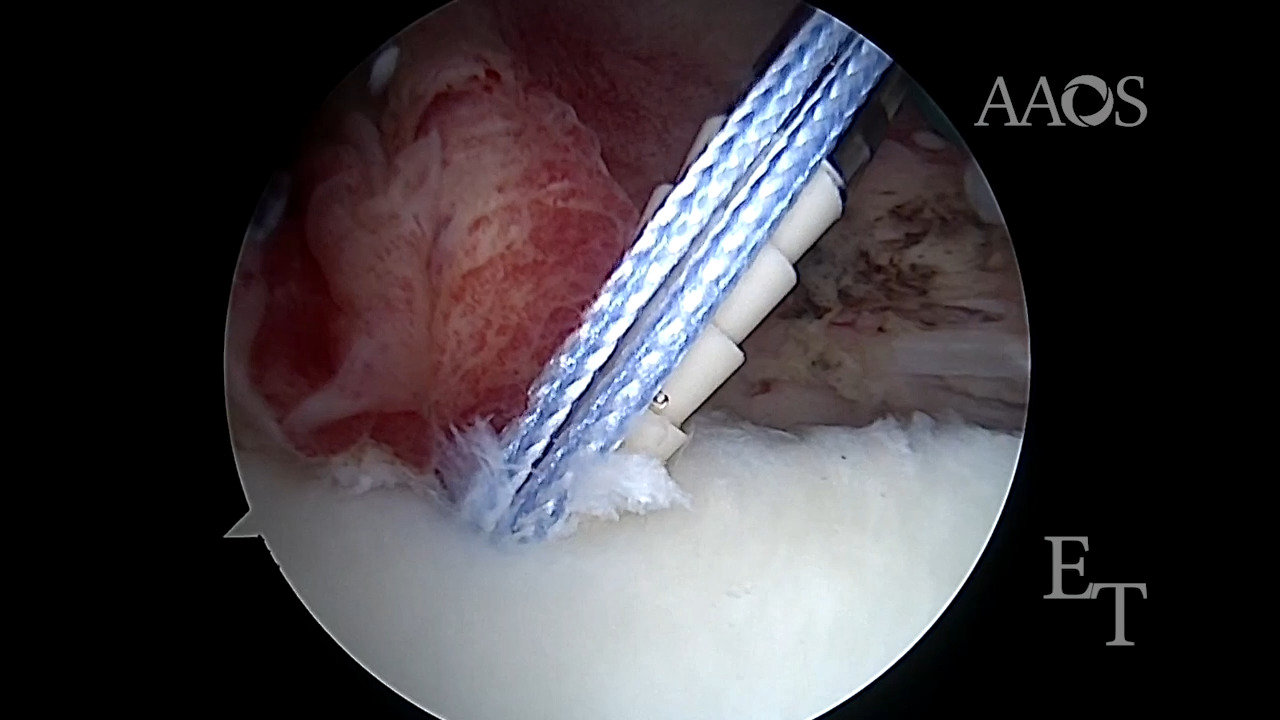
Arthroscopic Hill-Sachs Defect Filling With Osteochondral Autograft Transplantation
Bipolar bone loss is a major factor determining recurrence after arthroscopic Bankart repair. The on-track/off-track concept represented a game changer because it overcomes percentages and dichotomizes the result, making it very easy for surgeons to determine when bone loss needs to be addressed. Subsequent studies questioned the reliability of this concept, with mixed results. The grey zone of the on-track/off-track concept recently has been identified. Various labels have been used: peripheral-track, near-track, nearly off-track; however, the basic concepts do not change: Hill-Sachs lesions close to being off-track lesions are associated with an increased risk of poor functional outcomes and structural failure after conventional Bankart repair. Currently, remplissage is the most common treatment option to fix small to medium Hill-Sachs lesions. Although technically easy, remplissage is a nonanatomic technique. This video presents an arthroscopic technique to fill a Hill-Sachs lesion, with osteochondral autografts harvested from the lateral border of the lateral femoral condyle of the knee. A near-track lesion is the main indication for this technique. The graft size can be estimated based on three-dimensional CT reconstruction images of the humeral head; however, the indication must be confirmed arthroscopically if the Hill-Sachs lesion matches one of the two following patterns: wide and large or narrow but medially located.