
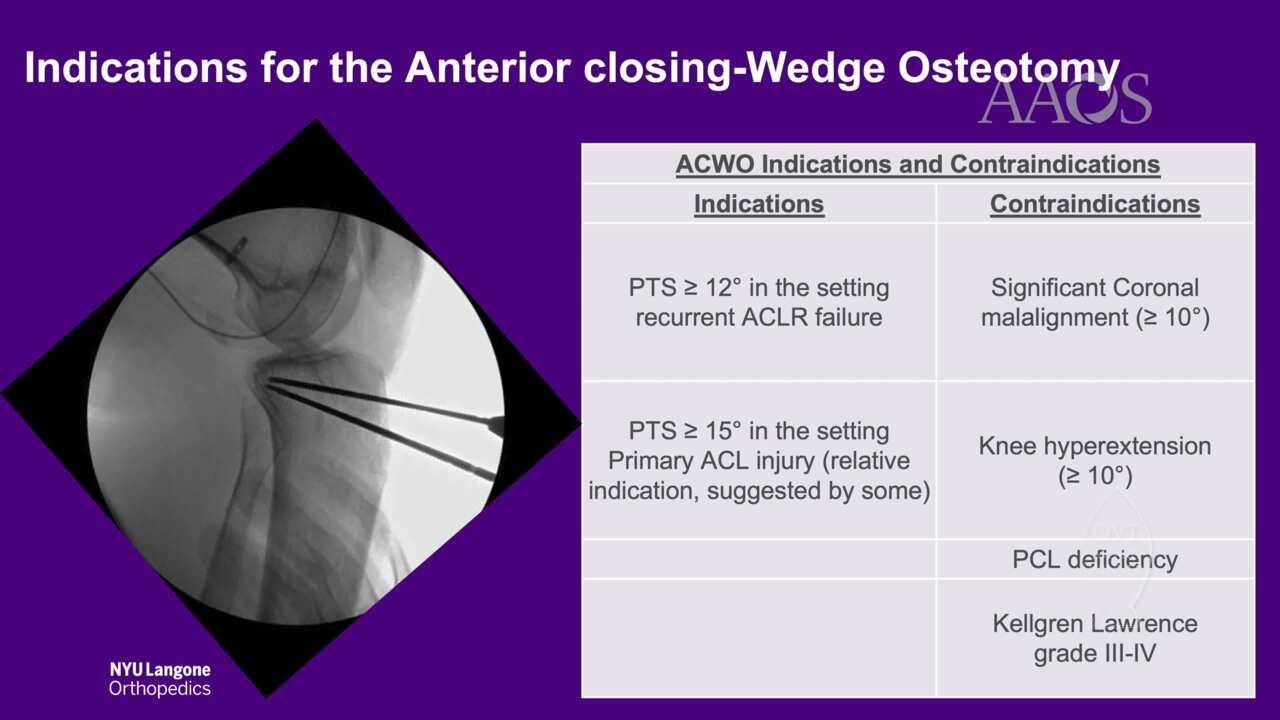
Proximal Tibia Anterior Closing Wedge Osteotomy With Revision Anterior Cruciate Ligament Reconstruction and Modified Lemaire Procedure Using Patient-Specific Instrumentation
Background
Failure of an anterior cruciate ligament (ACL) graft after primary ACL reconstruction has been reported to be as high as 9.6%. Malalignment in the coronal and sagittal planes is a risk factor for ACL injury and re-tear of the graft after ACL reconstruction. In the sagittal plane, increased posterior tibial slope is a risk factor for an ACL tear. In the coronal plane, varus alignment is a risk factor for an ACL tear. A posterior tibial slope greater than 12° is associated with a fivefold increased risk for ACL injury.
Purpose
This video demonstrates a proximal tibia anterior closing wedge osteotomy with revision ACL reconstruction and the modified Lemaire procedure with the use of patient-specific instrumentation.
Methods
The anatomy of, physical examination of, diagnosis of, and treatment options for revision ACL reconstruction are reviewed. The case presentation of a 24-year-old woman with ACL graft failure and malalignment in the sagittal and coronal planes is reviewed. The patient's hamstring autograft, which was placed 6 years ago, failed, and malalignment was observed in the sagittal and coronal planes. After thorough discussion of the risks, advantages, and prognosis, the patient elected to proceed with single-stage revision ACL reconstruction with the use of bone-patellar tendon-bone autograft, the Lemaire procedure, and a proximal tibia anterior closing wedge osteotomy with the use of patient-specific instrumentation. Preoperative planning with software showed the treatment options and the amount of correction necessary in both planes via a medial opening wedge osteotomy versus an anterior closing wedge osteotomy.
Results
Knee stability was restored after ACL reconstruction. Malalignment in the sagittal and coronal planes was corrected via a proximal tibia osteotomy. Postoperative clinical outcomes included good restoration of range of motion and stability.
Conclusion
Single-stage revision ACL reconstruction and a proximal tibia anterior closing wedge osteotomy is a viable surgical treatment option for ACL graft failure in patients with malalignment in the sagittal and coronal planes. In complex cases, patient-specific instrumentation can be used for preoperative planning to attain better and more accurate correction. Appropriate patient selection and adherence to postoperative rehabilitation are crucial for optimal outcomes.