
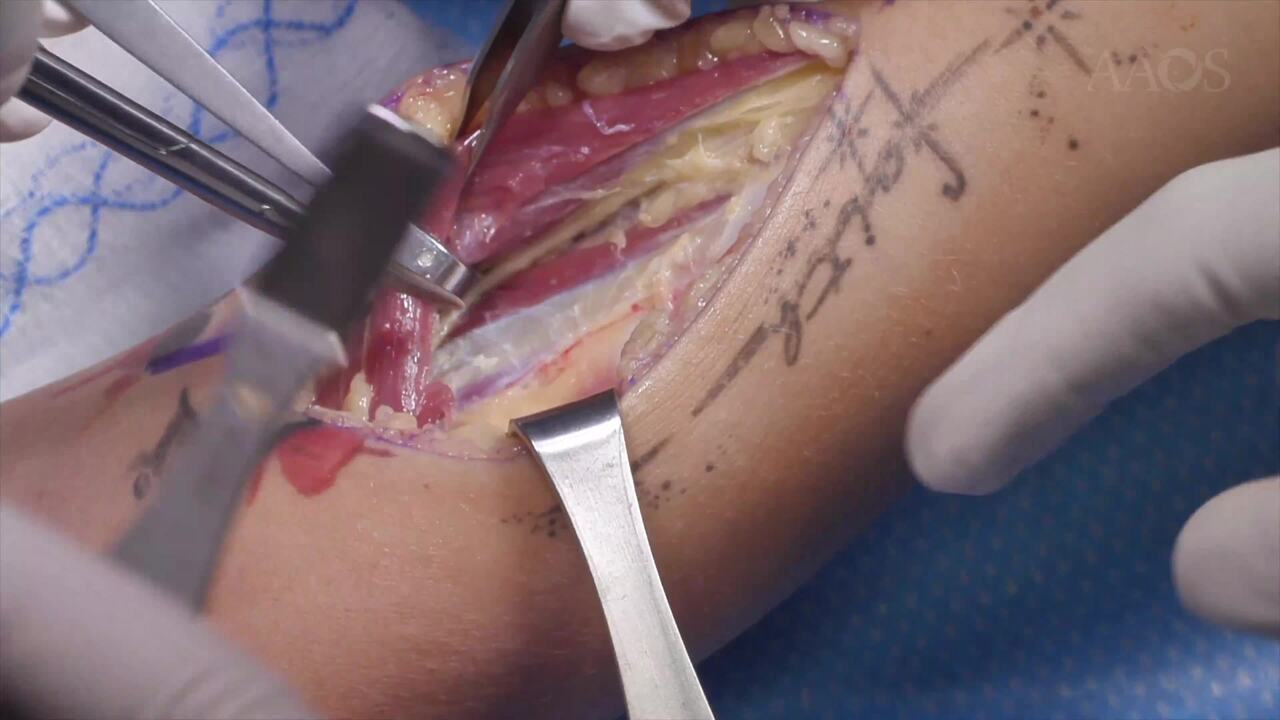
Surgical Repair of Essex-Lopresti Injury: A Comprehensive Technique Video
Background: Essex-Lopresti injuries are difficult to diagnose and are commonly the result of a fall or high-energy trauma with the elbow extended. These injuries are characterized by fracture of the radial head, disruption of the Interosseous Membrane (IOM), and dislocation of the distal radio-ulnar joint (DRUJ). This causes axial and longitudinal instability of the forearm associated with functional limitations. Failure to treat the problem leads to chronic wrist pain due to ulnocarpal abutment or chronic elbow pain from arthrosis.Purpose: In this technique video, we present a complex case of an Essex-Lopresti injury repaired surgically to improve forearm longitudinal instability, range of motion (ROM), and pain reduction. This video provides a comprehensive guide with educational operative pearls at every step for academic purposes.Methods: The anatomy, diagnosis, and treatment options to address an Essex-Lopresti injury are reviewed. We present a case of a 33-year-old female who sustained a traumatic right elbow fracture leading to an Essex-Lopresti injury. The patient has a history of previous radial head arthroplasty and a revision for said procedure, DRUJ pinning for longitudinal forearm instability, and reconstruction of her lateral ulnar collateral ligament. The patient complains of persistent elbow and wrist pain, and notable positive ulnar variance, impaction, decreased range of motion, and reduced strength were observed. Given her clinical picture, we performed a reconstruction of the interosseous membrane with the use of a pronator teres tendon transfer and a tight rope suture suspension device. Subsequently, we executed an ulnar shortening osteotomy, followed by the radial head implant removal.Results: The post-operative clinical outcome showed elbow stability to varus and valgus stress testing, and no pain with ROM from 30- 100. Additionally, full forearm supination was observed, along with 60 of pronation. Wrist was observed to have 40 of extension and flexion. Furthermore, Axillary, Musculocutaneous, Anterior Interosseous, Posterior Interosseous, and ulnar nerves are firing. Sensation is intact to superficial Radial, Median, and Ulnar nerves.Conclusion: Radial head reconstruction, along with IOM reconstruction using a pronator teres transfer, a tight rope suture suspension device, and ulnar shortening osteotomy, is a viable surgical treatment for complex Essex-Lopresti injuries. This treatment restores forearm longitudinal stability, relieves pain, and stabilizes the DRUJ.