
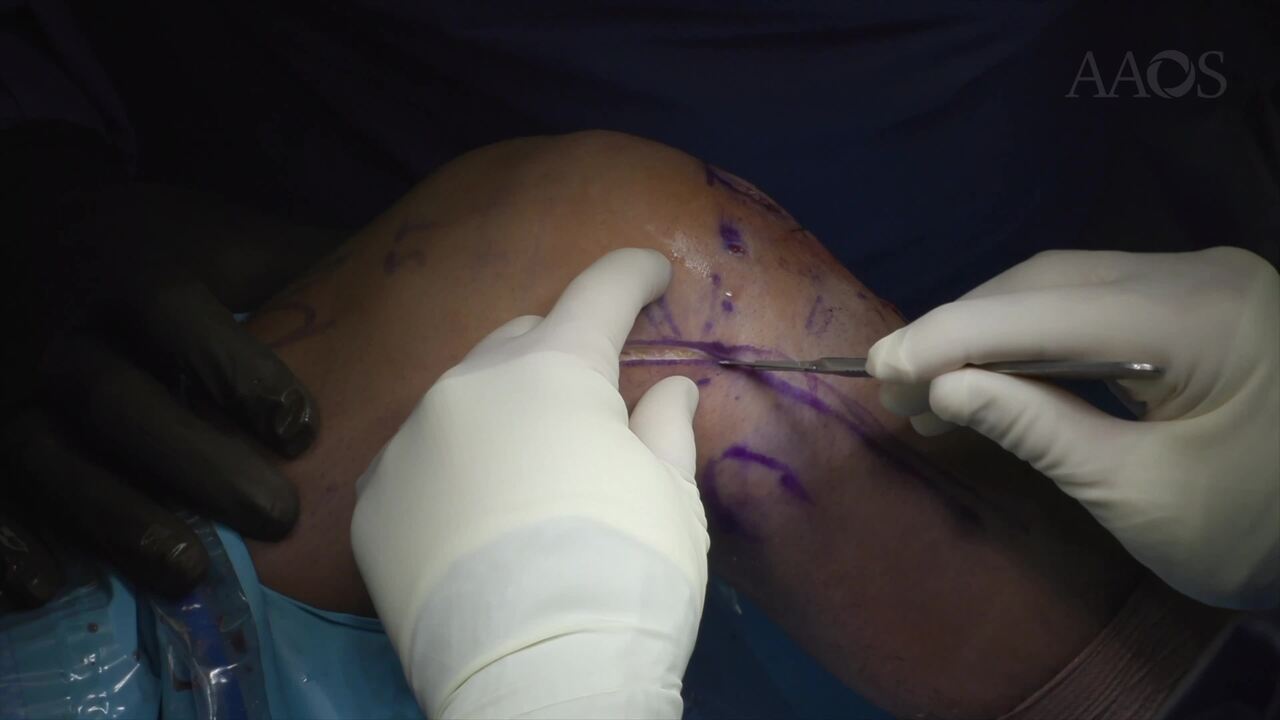
Multiligament Knee Injury with Common Peroneal Nerve Rupture: Single-Stage Reconstruction of the ACL, PLC, and Common Peroneal Nerve Graft
Background: Multiligament knee injuries (MLKIs) are rare injuries that can result devastating outcomes and functional impairment, especially in the setting of concomitant peroneal nerve injuries. Incidence of common peroneal nerve (CPN) injuries in MLKIs or knee dislocations ranges from 10% to 40%, with significant morbidity associated, especially in the setting of complete rupture. Treatment for MLKI with associated CPN injury depends on the degree of ligamentous and nerve injury. Options for the MLKI include nonoperative, repair or reconstruction and options for the CPN include included observation, neurolysis, direct nerve repair and nerve grafting.Purpose: This video overview and case presentation demonstrates treatment of a multi-ligamentous knee injury and common peroneal nerve rupture with anterior cruciate ligament (ACL) and posterolateral corner (PLC) reconstruction as well as nerve allograft reconstruction.Methods: The anatomy, examination, diagnosis, and treatment options for MLKIs are reviewed. A case of an 18-year-old male with an acute MLKI with tears of his ACL and PLC. This injury occurred while wrestling with his friends. After a thorough discussion of risks, benefits and prognosis of both operative and non-operative options, the patient elected to proceed with ACL reconstruction with bone patellar bone autograft, PLC reconstruction with Achilles allograft, and CPN allograft reconstruction.Results: Knee stability was restored intraoperatively. Post-operative clinical outcome showed good restoration of range of motion and stability. At 2.5 months, the patient still had not recovered any appreciable sensory or motor function. Although there was discussion on giving the patient more time to recover, because of the length of nerve defect, we concluded that likelihood of recovery was essentially zero with nerve reconstruction alone. Thus, the decision was made for patient to undergo nerve transfer of soleus branch of tibial nerve to anterior compartment musculature.Conclusion: Treatment of a multi-ligamentous knee injury with ACL reconstruction with bone patellar bone autograft, and PLC reconstruction with Achilles allograft is a viable surgical option for symptomatic multi-ligamentous knee injuries. Treatment of CPN rupture with nerve allograft reconstruction is an adequate option, however one should consider the length of nerve defect intraoperatively on ability of nerve reconstruction to allow recovery. Appropriate patient selection and adherence to post-operative rehabilitation are crucial for optimal outcomes.