
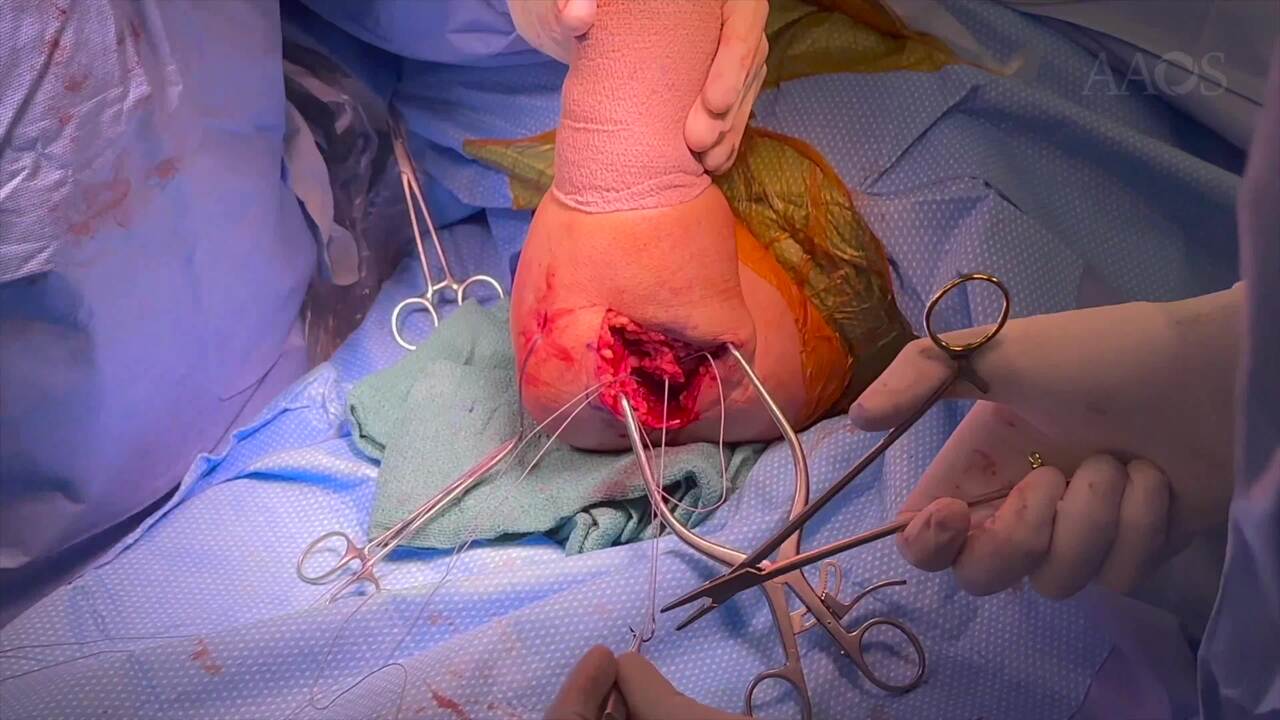
Coronoid Fracture “Lasso” Repair Using Arthroscopic Instrumentation in Terrible Triad Injuries with Fixable Radial Head Fractures
Background: Terrible triad injuries are a complex constellation of elbow pathologies to treat given the balance between recurrent instability and postoperative stiffness. Involving a posterolateral elbow dislocation, lateral ulnar collateral ligament (LUCL) injury (often proximal avulsion of the lateral epicondyle), radial head fracture, and coronoid fracture (often an O’Driscoll tip fracture or Regan and Morrey type I), a systematic approach to surgical treatment is essential for the single staged repair of these injuries.Purpose: This video overview and case presentation demonstrates coronoid fracture “lasso” repair using arthroscopic instrumentation in terrible traid injuries with fixable or intact radial heads to allow for improved instrumentation when visualization is poor.Methods: A single staged operative repair of terrible triad injuries through a single laterally-based approach using arthroscopic instrument-assisted reduction of the coronoid fracture, with suture anchor-based repair of the LUCL, in cases in which the radial head is deemed appropriate for repair rather than arthroplasty is described in this technical trick. Using an arthroscopic suture lasso, anterior cruciate ligament-adjustable drill guides, cannulated guide-pins with nitinol shuttling wires, and a suspensory cortical button all allow for a more precise, minimally invasive, and facile technique of capturing and fixing coronoid fractures with intact radial heads in terrible triad injuries.Results: The patient is doing well at most recent follow up with full range of motion and no recurrent instability. The authors’ own series involves 7 patients with a mean age of 48.0 +/- 20.4 years, (range 22-76), with 5 (71.4%) female patients and 2 (28.6%) male patients. Mean follow-up for the cohort was 17.7 +/- 6.6 months (range 12 – 31), mean body mass index (BMI) at time of surgery was 29.4 +/- 6.8 (range 21.3 – 34.2) and there was a mean American Society of Anesthesiologists (ASA) grade of 1.7 +/- 0.8 (range 0 – 3). At final follow-up, there was a mean extension-flexion arc of 9.3 – 129.6°, mean pronation of 77.1+/-4.9°, and mean supination 72.9+/-11.1°. There were no cases of neurovascular injury, and one complication necessitating reoperation (14.3%), which was hardware removal.Conclusion: This technical trick demonstrates that arthroscopic instrumentation can make the “lasso” transosseousu suture repair of coronoid tip fractures in terrible triad injuries with fixable radial head fractures a more precise and facile procedure. This technique is not limited to only terrible triads with intact or fixable radial heads however, as even in radial head arthroplasty cases the use of a suture lasso and single transosseous tunnel with cortical button fixation can decrease the number of drill paths during the case.