
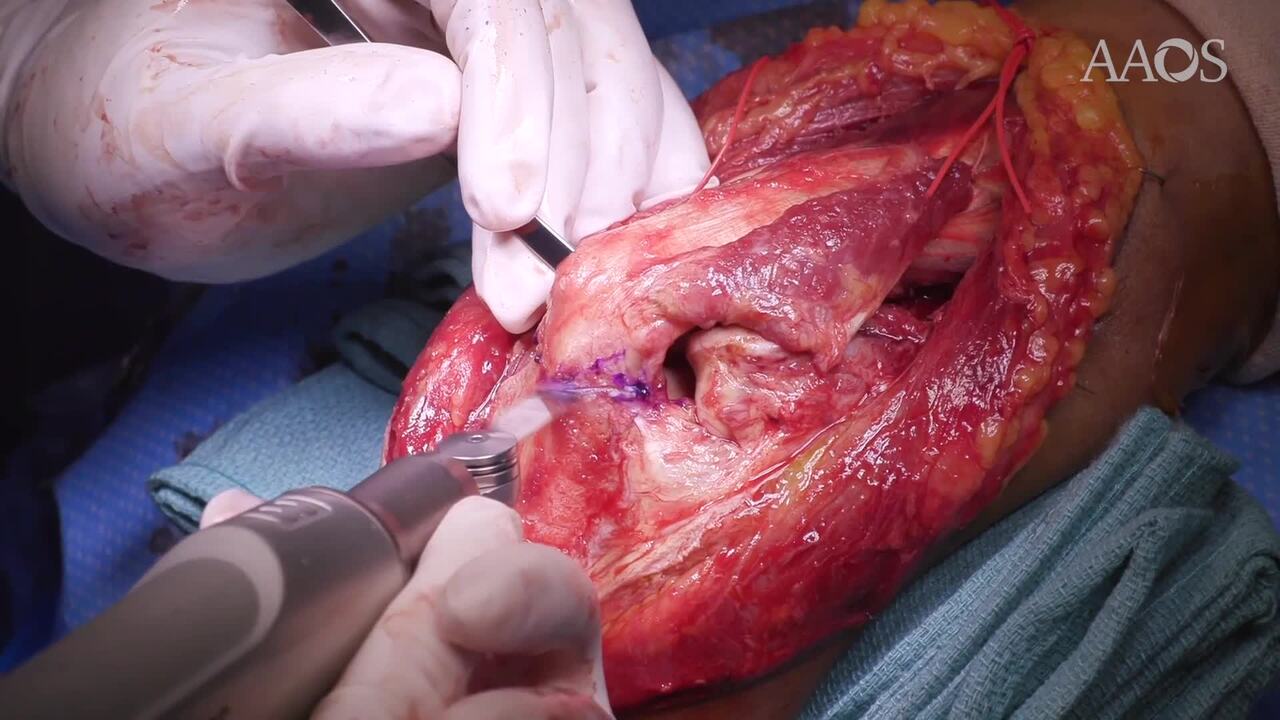
ORIF of Intra-articular Distal Humerus Fracture Using Anconeus Pedicle and Olecranon Osteotomy
Background: Distal humerus fractures are relatively uncommon injuries, comprising only 2% of adult elbow fractures, and present unique surgical challenges due to complex articular geometry and soft tissue considerations. Open reduction and internal fixation (ORIF) remains the mainstay of treatment in functionally active patients, but outcomes can be limited by complications including stiffness, nonunion, and ulnar nerve symptoms. This video highlights a technique utilizing an olecranon osteotomy and anconeus pedicle approach to optimize articular exposure and promote stable fixation.
Purpose: This video overview and case presentation demonstrates ORIF of a distal humerus fracture through an olecranon osteotomy with preservation of the anconeus pedicle. The technique aims to restore anatomic alignment and joint congruity while minimizing soft tissue disruption and optimizing postoperative outcomes.
Methods: We present the case of a 59-year-old female with a displaced intra-articular distal humerus fracture following a mechanical fall. After external fixation and debridement, she underwent ORIF using parallel plating, following O'Driscoll’s fixation principles, with an olecranon osteotomy and careful dissection to preserve the anconeus pedicle. Postoperative rehabilitation emphasized early motion to minimize stiffness.
Results: The patient achieved 45–90° flexion-extension and 50°/50° pronation-supination by 6 weeks. Intraoperative stability enabled early range of motion. No postoperative ulnar neuritis or wound complications occurred.
Conclusion: An olecranon osteotomy combined with anconeus pedicle preservation offers excellent visualization for ORIF of complex distal humerus fractures and facilitates stable fixation with early rehabilitation. Adherence to fixation principles and meticulous technique are essential to optimize outcomes.