
Tibial Cortex Transverse Transport (TTT) Surgery in the Treatment of Diabetic Foot Ulcer
Introduction: Millions of people around the world are affected by foot ulcers due to Diabetes Mellitus. These diabetic foot ulcers (DFU) precede many lower extremity amputations in this type of patients. DFU develop as a result of poor glycemic control, diabetic sensory, motor and autonomic neuropathy and peripheral arterial disease. Treatment for DFU involves wound care with debridement of necrotic tissue, reduction of weight-bearing pressure on the affected area, management of blood glucose levels ideally to a hemoglobin A1c less than 8%, treatment of infection with appropriate antibiotics, and evaluation for revascularization when peripheral artery disease is present. For several years, the Tibial cortex transverse transport (TTT) technique has been used to achieve neovascularization of the lower limb and achieve the healing of these ulcers.
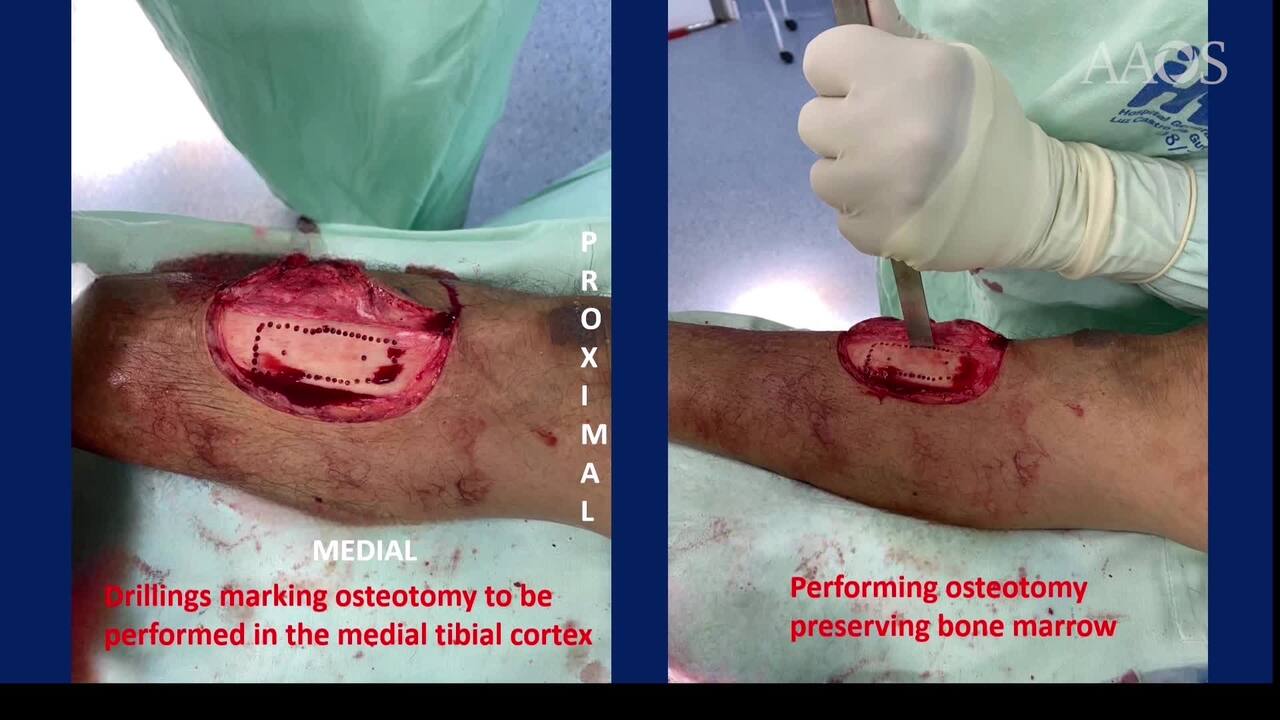
Purpose: This video shows the surgical technique used to perform tibial cortex transverse transport in diabetic patients with persistent foot ulcers. It also presents the results obtained during follow-up of our patients with this procedure and the published outcomes with this treatment.MethodsThe video shows the step-by-step surgical technique for performing the TTT in the medial cortex of the proximal tibia with an external fixator that allows medial and lateral transport of the osteotomized fragment starting 7 days postoperatively; the bone chip is distracted outward, 1 mm per day, (divided 4 times, every 6 hours) for 2 weeks, and stopped moving for 5 to 7 days; then compress the bone chip back at the same speed (2 weeks). Weight bearing is permitted from the first postoperative day. An X-ray is taken 4 weeks later to verify bone healing, and the external fixator is removed once the wound has healed. Progressive results were evaluated during follow-up and the final result after removal of the external fixator.
Results: In total, 8 patients with diabetic patients with persistent foot ulcers were treated with tibial cortex transverse transport. The mean age of the patients was 59.6 years (range, 54 to 72 years; standard deviation [SD] ± 5.85 years). The mean time of evolution of the ulcer was 4.25 months (range, 1 to 12 months; SD ± 3.15 months) and the mean Visual Analog Pain Score (VAS pain) was 6 (range, 2 to 9; SD ± 2). The Ankle-Brachial Index (ABI): 0.95 (range, 0.7 to 1.2; SD ± 0.19). In all patients, ulcer healing and osteotomy consolidation were achieved, with a mean time with the external fixator in place of 3,43 months (range, 3 to 4 months; SD ± 0,39 months).
Conclusion: The tibial cortex transverse transport (TTT) facilitates wound healing and improved skin tissue regeneration in diabetic patients with persistent foot ulcers.