
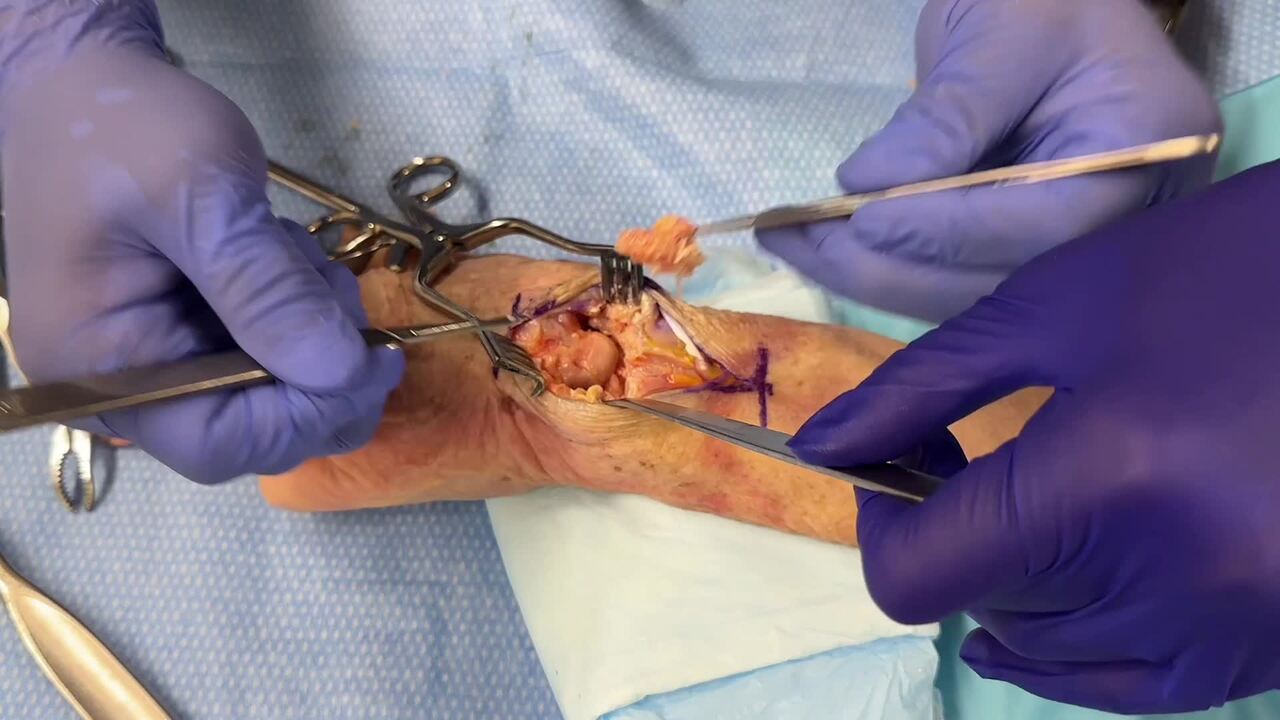
P.A.M.P.E.R.: Proximal Row Carpectomy Arthroplasty with Matrix Placement for Enhanced Reconstruction
Background: Proximal row carpectomy (PRC) remains a reliable motion-preserving procedure for wrist arthritis, yet patients with capitate degeneration face limited options. Interpositional arthroplasty using biologic scaffolds has emerged as a potential solution. However, optimal graft positioning and fixation techniques remain under investigation.
Objective: This video demonstrates a novel method for enhancing graft stability during PRC by securing an interpositional matrix to the capitate’s proximal articular surface using transosseous drill holes. The technique is designed to improve scaffold integration and minimize graft migration.
Technique Overview: The video outlines patient selection criteria, preoperative planning, surgical exposure, execution of the PRC, matrix preparation, and fixation. Drill holes are created in the proximal capitate, through which the matrix is tied down, creating a stable biologic articulation between the capitate and the lunate fossa of the distal radius.
Viewers will learn: Indications and contraindications for PRC with interpositional matrix arthroplasty. Step-by-step surgical technique with emphasis on graft fixation strategy. Tips for graft sizing, drill placement, and suture passage. Pearls and pitfalls to optimize outcomes and avoid complications.
Preliminary Experience: In our early experience with this technique, we have found it to be reproducible with no intraoperative complications, and early patient-reported outcomes suggest preserved wrist motion and pain relief. Further study is needed to validate long-term outcomes.