
Latissimus Dorsi (ld) and Teres Major (tm) Transfer (modified L’episcopo Technique) with Reverse Shoulder Arthroplasty for Combined Loss of Active Elevation and External Rotation: From Anatomy to Surgical Technique
Introduction: Loss of active external rotation is a rare but disabling condition, resulting from massive, irreparable posterosuperior cuff tear, when both the infraspinatus and teres minor muscles are absent or fatty-infiltrated, with or without arthritis or from muscle denervation. Activities of daily living that specifically require active external rotation become difficult or even impossible. In these cases, the Reverse shoulder arthroplasty (RSA) can restore active elevation but cannot restore active external rotation. The L'Episcopo procedure (described in 1934, for obstetric paralysis) consists of a transfer of the latissimus dorsi (LD) and teres major (TM) laterally and posteriorly on the humerus, through a double incision (anterior and posterior), such that the function of the LD/TM changes from internal to external rotation. A modified L’Episcopo procedure (described by Pascual Boileau, in 2007), with LD and TM transfer through a single deltopectoral approach simultaneously with RSA, restores the active elevation and external rotation necessary for activities of daily living. Purpose To show the gross anatomy of the anterior and posterosuperior shoulder with emphasis in the musculotendinous anatomy of pectoralis major, LD and TM muscle and adjacent nerves. The video also shows the LD and TM transfer to posterosuperior rotator cuff tear in cadaver lab and in a patient with this pathology who also required an RSA. Additionally, we report the results of our patients with this transfer.
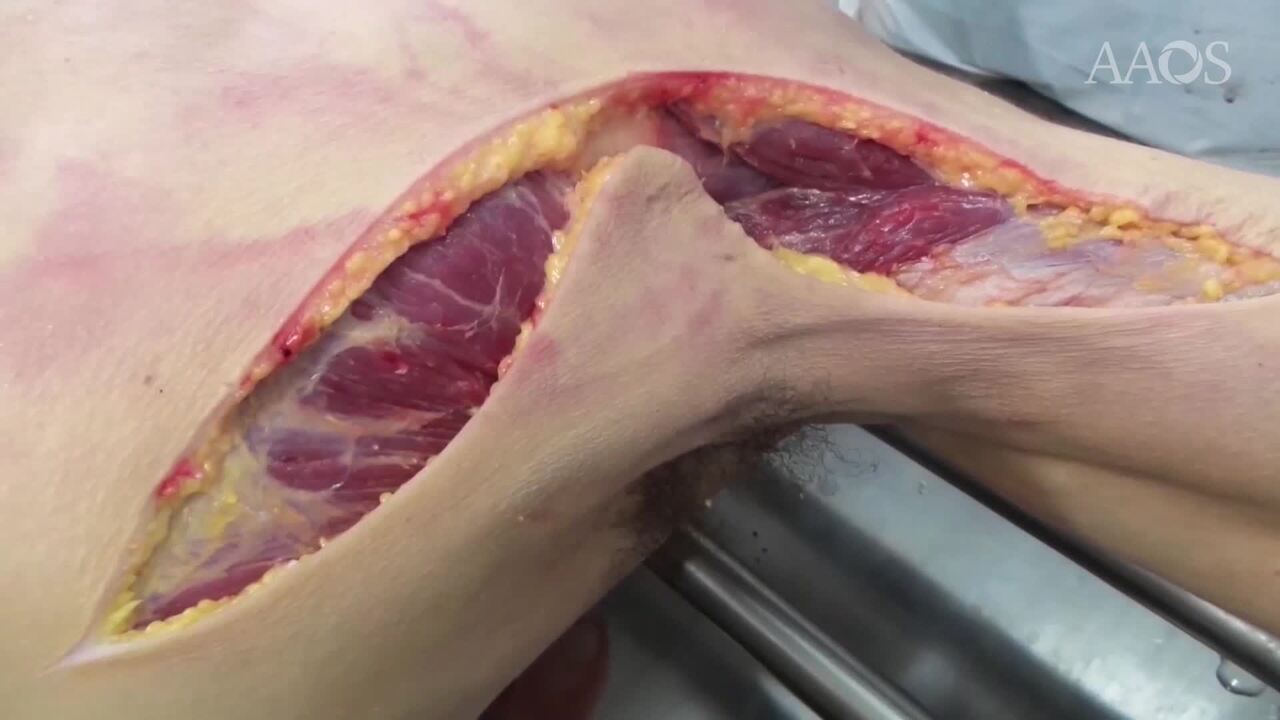
Method: A video of gross anatomy of the anterior and posterosuperior shoulder with emphasis in pectoralis major, LD and TM muscle and adjacent nerves is showed. Also, the video shows the step-by-step surgical technique for performing the transfer of LD and TM laterally and posteriorly on the proximal humerus, through deltopectoral approach without disinserting the pectoralis major, in cadaver lab and in a patient. Four patients with irreparable posterosuperior rotator cuff tears, with insufficient LD and TM, with fatty infiltration and with loss of active elevation and external rotation, who also required RSA. Rotator cuff tears (RCT) were confirmed with magnetic resonance imaging. The outcomes were assessed at a mean follow-up of 3.25 years (range, 1 to 5 years; Standard Deviation (SD) ± 1.7 years)), specifically in activities of daily living with Single Assessment Numeric Evaluation (SANE).
Results: A total of 4 patients (all women) with a mean age of 69.25 years (range, 65 to 75 years; SD ± 4.34 years) were included in the study. All the patients had an irreparable posterosuperior RCT, with a positive lag sign and positive hornblower sign. Both clinical signs disappeared in all patients at final follow-up, and the mean visual analog pain score was 1 (range, 0 to 2; SD ± 0.81). The mean Single Assessment Numeric Evaluation (SANE) score was 90% (range, 85% to 95%; SD ± 4.08), and with full satisfaction of all patients. Conclusion LD/TM transfer in association with RSA restores active elevation and external rotation in patients with irreparable posterosuperior cuff tears, when both the infraspinatus and teres minor muscles are absent or fatty-infiltrated. The combined procedure, performed in the same session through a deltopectoral approach, without disinserting the pectoralis major, is easy to perform and avoids the posterior incision and its possible risks and complications.