
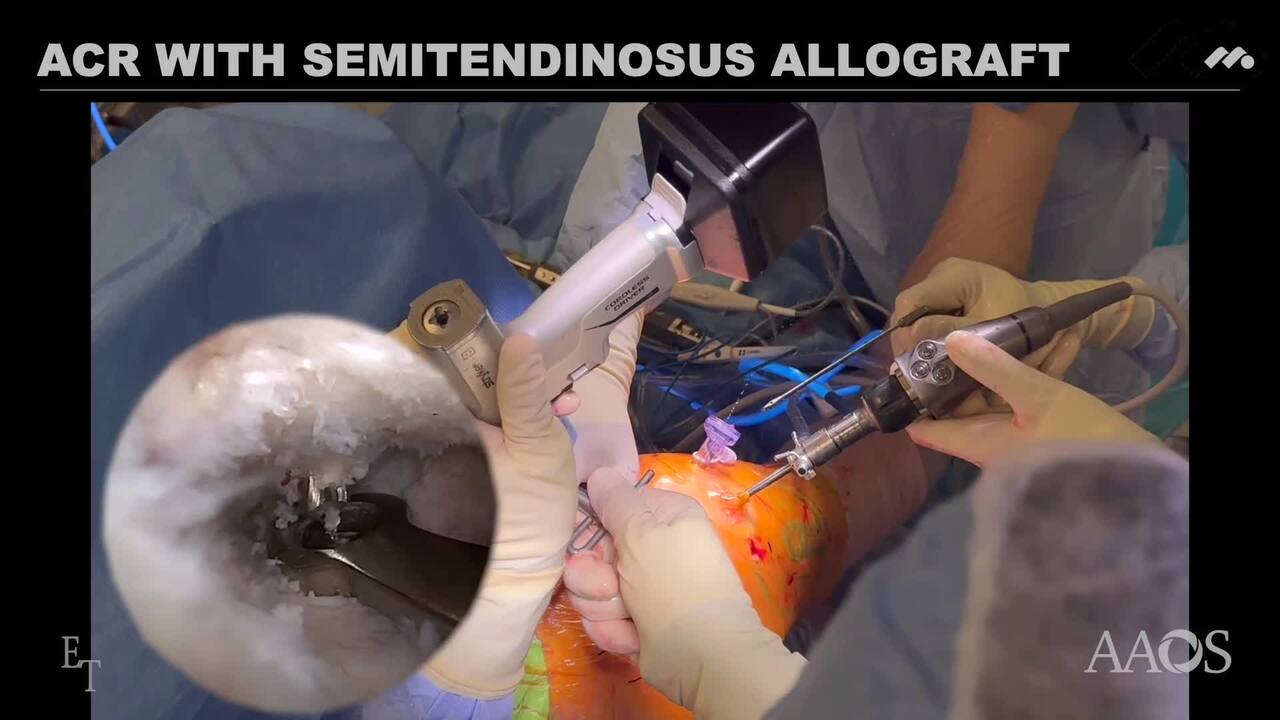
Acromioclavicular Joint Reconstruction Using the X's Technique with a Semitendinosus Allograft
Background: The acromioclavicular (AC) joint provides anterior sterile stability to the lateral clavicle where it connects to the acromion of the scapula, whereas the coracoclavicular (CC) joint provides stability in the superoinferior axis. AC dislocations are a common injury to the joint and may result in tearing of the AC capsule, conoid ligament, or trapezoid ligament. When AC joint injuries are graded IIIB or higher, they most commonly require operative treatment to reduce the superior lay displaced clavicle and reduce pain. When present for more than 3 weeks, a reconstruction of the joint is indicated. The senior author’s technique for treating these types of injuries using an arthroscopic-assisted “X's” approach is detailed in this video.
Indications: This technique is indicated for chronic AC joint dislocations that are Rockwood grade IIIB and have failed conservative management or are grade IV-VI. Patients should have both horizontal and vertical AC instability for the utilization of this technique.
Technique Description: The senior author’s AC joint reconstruction using an X's technique with semitendinosus (ST) allograft is detailed here. This arthroscopically-assisted open approach first uses diagnostic arthroscopy to identify landmarks in the joint. The undersubscribed of the voracious is identified and a brief bursectomy is performed. An Arthrex TightRope and Dog Bone are utilized to reduce the clavicle inferiorly. Four all-suture anchors are used to form an "X" configuration and reduce the AC joint. The ST allograft is passed through the anterolateral portal wrapped around the coracoid and brought up over top of the clavicle for additional fixation of the joint.Results: This technique does not have specific outcomes data, however, similar techniques have demonstrated that ST allograft and autograft augmentation provides improved patient reported outcomes and better load resistance. Additionally, reconstructing the AC joint in addition to the CC joint improve patient horizontal instability. Allograft and autograft reconstruction techniques have low failure rates and help patients return to sport at their pre-injury level.
Conclusion: AC joint reconstruction with ST allograft in an X's technique is a novel method of AC and CC joint treatment for patients with chronic AC joint dislocations that are Rockwood grade IIIB-VI with the goal of providing improved patient vertical and horizontal fixation via the TightRope and Dog Bone “X” of the all-suture anchors, the “X” of the ST graft around the coracoid and clavicle and a potential “X” across the AC joint with the ST graft.