
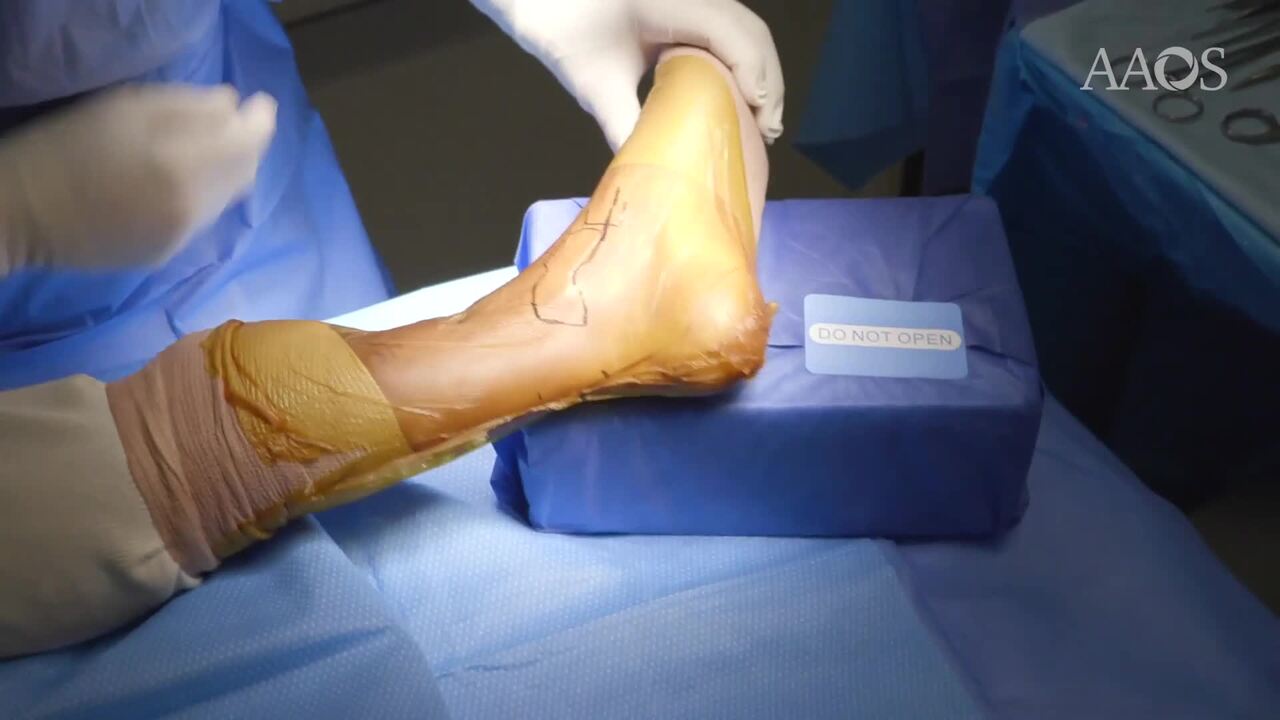
Posterior Tibial Tendon Transfer and Achilles Tendon Lengthening for Foot Drop
Background: Foot drop is a neuromuscular condition defined by the inability to actively dorsiflex the ankle, most commonly due to peroneal nerve palsy. This results in a characteristic high-steppage gait pattern to clear the foot during ambulation. In cases where motor recovery is no longer feasible, tendon transfer remains the gold standard surgical solution. Posterior tibial tendon (PTT) transfer has demonstrated consistent functional improvement with acceptable safety in chronic foot drop, especially when combined with Achilles tendon lengthening for equinus correction.
Purpose: This video demonstrates the surgical technique for posterior tibial tendon transfer combined with Achilles tendon lengthening to restore dorsiflexion and correct equinus contracture in the setting of chronic foot drop due to peroneal nerve palsy.
Methods: A case of a 30-year-old male with a history of traumatic open tibia fracture, treated with ORIF and flap coverage, is presented. Three years post-injury, he developed chronic foot drop and a 10-degree equinus contracture. Electrodiagnostic studies confirmed irreversible peroneal nerve injury with preserved tibial nerve function. Surgical intervention involved a Hoke percutaneous Achilles lengthening followed by a posterior tibial tendon transfer through the interosseous membrane with fixation into the navicular using a 3.5 mm knotless suture anchor. Postoperative rehabilitation progressed from casting to weightbearing and formal physical therapy.
Results: Posterior tibial tendon transfer with Achilles tendon lengthening is a reliable treatment for chronic foot drop when nerve recovery is no longer viable. This approach restores ankle dorsiflexion and improves functional mobility. Thorough dissection of the interosseous membrane and careful tensioning at the time of fixation are critical to optimize outcomes.
Conclusion: Surgical reconstruction is a reliable treatment option for patients with an chronic rectus femoris rupture. Early results suggest good to excellent clinical outcomes.