

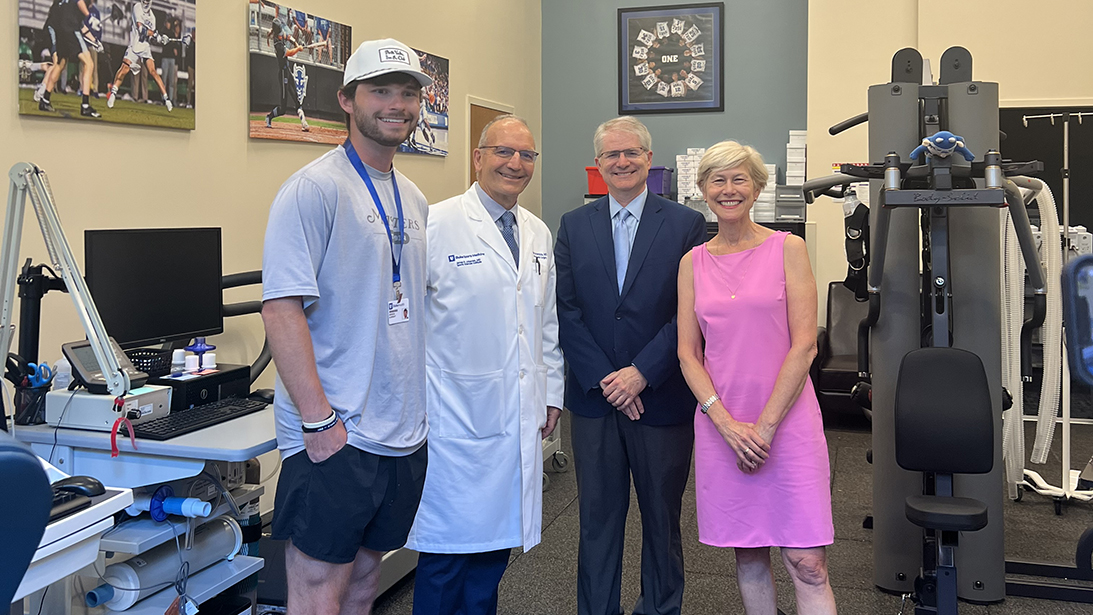
AAOS President Annunziato (Ned) Amendola, MD, FAAOS (second from left), hosted a site visit at the Duke University orthopaedic center for Rep. Deborah Ross (right), who represents the greater area of Durham, North Carolina. The site visit consisted of a tour of the facility and discussion about issues most important to orthopaedic surgeons and musculoskeletal health. Dr. Amendola and Rep. Ross are pictured in the James R. Urbaniak, MD, Sports Sciences Institute with Andrew Albright (left), a recent Duke University graduate and future medical school student, and Benjamin Alman, MD, FRCSC (second from right), chair of orthopaedic surgery at Duke.
Published 8/13/2025
|
Annunziato (Ned) Amendola, MD, FAAOS
Today’s world is evolving rapidly, and our policies and regulations are no exception. As orthopaedic surgeons, we understand firsthand the importance of being efficient, working collaboratively, and conquering any challenge at hand. As new hurdles have emerged, we have taken the same approach with advocacy, discovering new ways to ensure that decision-makers act on the concerns of the musculoskeletal care community.
As with any new administration, we face new challenges. We started the year raising concerns about proposed funding cuts for medical research, both at the National Institutes of Health and the Department of Defense’s Peer Reviewed Orthopaedic Research Program (PRORP), and their potential impact on patients. PRORP supports life-changing orthopaedic research that benefits service members and civilians alike. Despite receiving bipartisan support for more than a decade, PRORP saw its funding fully eliminated in fiscal year 2025, and the House’s current proposal for fiscal year 2026 only partially restores the program. After additional attempts to further cut defense research funding were defeated in the House, AAOS is now shifting its focus to working with our champions in the Senate to fully restore the PRORP program.
Annunziato (Ned) Amendola, MD, FAAOS
AAOS President Annunziato (Ned) Amendola, MD, FAAOS (second from left), hosted a site visit at the Duke University orthopaedic center for Rep. Deborah Ross (right), who represents the greater area of Durham, North Carolina. The site visit consisted of a tour of the facility and discussion about issues most important to orthopaedic surgeons and musculoskeletal health. Dr. Amendola and Rep. Ross are pictured in the James R. Urbaniak, MD, Sports Sciences Institute with Andrew Albright (left), a recent Duke University graduate and future medical school student, and Benjamin Alman, MD, FRCSC (second from right), chair of orthopaedic surgery at Duke.
The recently passed “One Big Beautiful Bill” also includes several provisions of note for our members, including changes to Medicare eligibility and loan programs for medical students. AAOS raised concerns about both issues, and although small progress was made to raise the threshold on the student-loan issue to a $200,000 cap, the Medicaid cuts were significant. For Medicare, Congress passed yet another temporary physician payment fix of 2.5% in this year’s budget bill. I’m proud of the work performed by the AAOS Advocacy Council and the AAOS Office of Government Relations (OGR) to ensure that this update was in the final bill language. AAOS worked tirelessly with our champions on Capitol Hill to secure this provision, leading a coalition of 75 health groups in rallying for reinstatement of a payment fix when it was briefly removed from the legislation.
Although this update to the conversion factor is positive, the Centers for Medicare & Medicaid Services (CMS) Medicare Physician Fee Schedule proposed rule, released just a few weeks later, could undermine this progress through other payment policy changes. One new policy in the rule would impose a 2.5% “efficiency adjustment” cut on payments for all services and procedures except for those that are currently tied to time (such as office or outpatient evaluation and management codes). Another policy would reallocate payment away from services performed in facilities (such as hospitals and ambulatory surgery centers) and shift payments to non-facility settings such as physician offices. Because orthopaedic surgeons primarily perform procedures in facilities, we would be faced with both cuts. According to CMS, orthopaedic surgeons would face a 3% cut overall, including a 9% cut to services and procedures performed in facilities, but a 5% increase for non-facility services.
This doesn’t just impact our fellow physicians. Experts warn of declining healthcare quality for Medicare beneficiaries over time if these practices continue to incentivize rapid consolidation in the healthcare system. AAOS will be submitting comments to CMS and working with our allies in Congress to push back against these payment cuts that would make it harder for orthopaedic surgeons to stay in private practice and ultimately harm patient access.
Despite these obstacles, orthopaedic surgeons are taking action and standing up for their profession and patients like never before. In September, we’ll welcome advocacy leaders, including the AAOS Board of Directors, Board of Councilors, and Board of Specialty Societies, to Washington, D.C., to meet with key leaders and push for change in musculoskeletal care. We’ve also seen new bipartisan efforts from Congress on two issues deeply impacting our members: reforming prior authorization and repealing the ban on physician-led hospitals. Similarly, our OGR continues to address concerns regarding the latest budget, including provisions relating to Medicaid and student loans.
Although our efforts are centered on Capitol Hill, advocating on behalf of orthopaedic surgeons extends far beyond Washington, D.C. 2025 marks the fifth year of Orthopaedic Advocacy Week, an event dedicated to shifting the needle on health policy through virtual collective action. Thanks to your participation, dozens of letters and social posts were shared with policymakers on key policy areas. Whether they participated from the office, OR, or home, I’m grateful for the members who took a few minutes out of their days to share their voices.
I know firsthand just how labor- and time-intensive it can be to work in orthopaedics, and it can be challenging to figure out how advocacy fits into your schedule. With this in mind, we’ve redesigned our Advocacy Action Center (aaos.quorum.us) so that you can easily send a pre-written letter or social post to your elected officials, log interactions with lawmakers, and even earn points through different actions taken. These activities often take just a few minutes but can make a world of difference. I hope you’ll join me in sharing your story and fighting for a stronger healthcare system.
There’s more work to be done to support musculoskeletal care and our patients, but I’m proud of the progress we’ve made during a very challenging year. Your experiences with patients, fellow physicians, and lawmakers are the foundation of our advocacy efforts, so keep speaking up about the issues that matter to you. I truly believe that when we work together, we can make a real difference for the orthopaedic community.
Annunziato (Ned) Amendola, MD, FAAOS, is the 2025–2026 AAOS president and professor of orthopaedic surgery and chief of sports medicine at Duke University.