

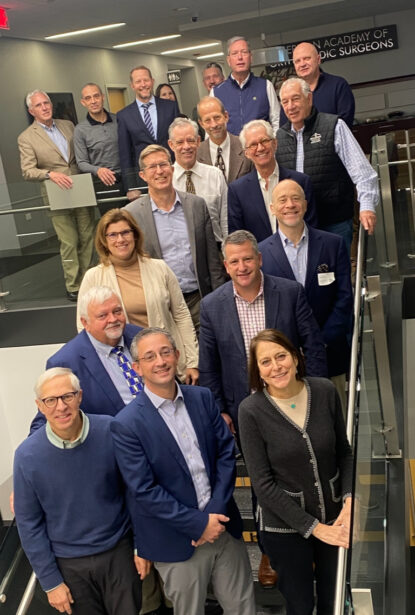
Consisting of 23 members, the Coding Coverage and Reimbursement Committee met in November 2024 to discuss payer policy changes and review code change requests. The committee generally meets three times per year.
Published 8/13/2025
|
Molly Todd Rudy
From policy changes and denials to modified codes, coding for orthopaedic procedures presents numerous challenges for even the most seasoned physicians. Current Procedural Terminology (CPT) may not accurately describe everything that is involved in a patient’s treatment, and even though the CPT used may be the best option, payers can still deny reimbursement based on their own rules and interpretation.
AAOS has developed a portfolio of coding tools to provide clear guidance on what is and is not billable, as well as direction for denials and appeals. In addition to these tools, the online AAOS Coding Community (available at aaos.org/codingcommunity) offers resources to meet the coding needs of orthopaedic professionals. The coding program is overseen by the Coding Coverage and Reimbursement Committee (CCRC), which represents the interests of orthopaedic surgeons on coding and physician payment issues and helps develop resource materials to help the orthopaedic community manage their practices, provide high-level patient care, and receive fair compensation.
Consisting of 23 members, the Coding Coverage and Reimbursement Committee met in November 2024 to discuss payer policy changes and review code change requests. The committee generally meets three times per year.
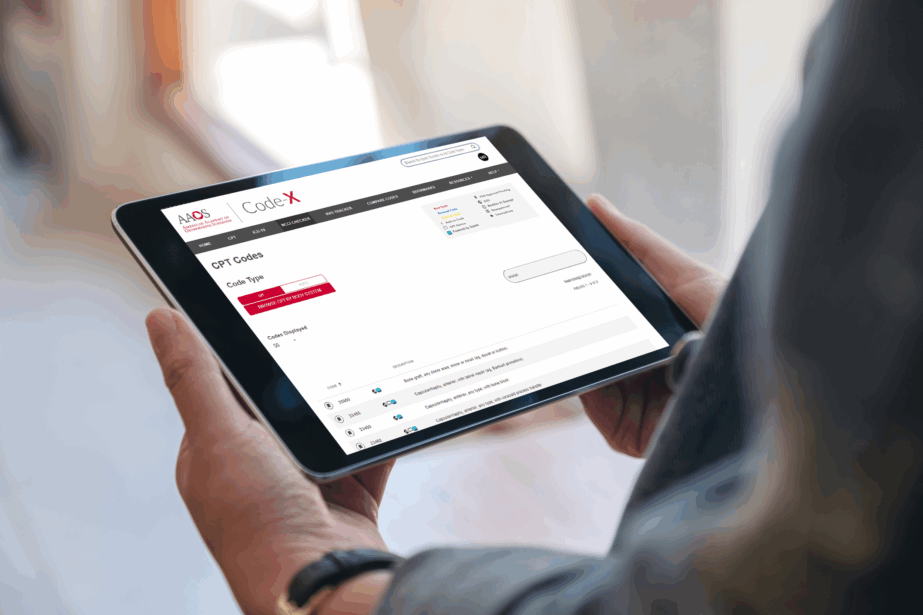
Code-X® offers a companion mobile app, offering flexibility for use on the go, as well as continuous code updates to help with reimbursement.
“What sets the AAOS coding portfolio apart is its unmatched focus on orthopaedics and the expert-driven content developed by orthopaedic surgeons for orthopaedic surgeons,” said Madelaine Reese, senior product manager at AAOS. “We bring clarity and efficiency to a complex landscape by organizing coding information, which is often scattered across multiple sources, into a single, easy-to-use resource. Rather than spending time searching through dense spreadsheets on the Centers for Medicare & Medicaid Services (CMS) website, users benefit from a curated, centralized platform that delivers relevant, accurate, and actionable coding guidance tailored specifically to their specialty.”
Three key materials make up the Academy’s coding portfolio — the Complete Global Service Data for Orthopaedic Surgery (GSD), Code-X®, and the Musculoskeletal Coding Guide. Additionally, many resources are available online in the Coding Community to help with practice management, coding, and reimbursement.
The GSD is a fully updated e-book for orthopaedic surgical coding and reimbursement that covers more than 1,700 procedures and incorporates coding updates, procedural classifications, and national reimbursements to guarantee documentation and reimbursement for orthopaedic surgeons and office managers. It includes:
- Comprehensive coding guide that covers all relevant orthopaedic procedures
- CPT codes and descriptors
- Included and excluded services
- AAOS guidelines based on committee deliberations and National Correct Coding Initiative (NCCI) edits
- Guidance on the American Medical Association (AMA) CPT parenthetical instructions
The GSD, which is updated annually, outlines exactly what pre-, intra-, and postoperative services are bundled with each procedure, helping to reduce claim errors and allow for cleaner submissions.
Code-X
A web-based and mobile app resource, Code-X includes CPT, ICD-10, and Healthcare Common Procedure Coding System codes. It details each orthopaedic code and provides cross-references to relative value units (RVUs), NCCI edits, and Medicare’s geographic practice cost index data. It also includes AAOS’ GSD guidelines, which are not available on any other coding platform.
Each yearly subscription includes:
- Ask-a-Coder feature, where experts in the field provide guidance
- Advanced search to make it easier to find procedure and diagnosis codes
- NCCI Checker, which helps resolve NCCI conflicts by comparing codes and understanding the scenarios in which modifiers are required to avoid coding errors
- Relative value unit (RVU) tracker, which records the RVUs generated over time to document work and justify reimbursement
- AAOS Now coding articles
- Professional coding webinars and podcasts
“Code-X can live on your cell phone, giving users easy access to CPT codes, diagnosis codes, and GSD data, which are helpful in the day-to-day practice of orthopaedics,” said R. Dale Blasier, MD, FAAOS, past chair of the CCRC. “While we have the most common procedural codes memorized, it is difficult to know every single one. Code-X makes it easy to search and substantiate what we are doing.”
Musculoskeletal Coding Guide
Available as an e-book, the Musculoskeletal Coding Guide pares down the CPT codes to those for musculoskeletal only, providing a quick reference guide. It also clarifies evaluation and management (E&M) coding, combining E&M coding guidelines with more than 1,700 musculoskeletal CPT codes.
Coding resources
From virtual and live courses to coding alerts and expert insights, AAOS’ coding community has everything needed to support a physician’s practice management and coding needs. These include:
- Patient Pre-optimization Quick Coding Guide to help surgeons accurately code presurgical optimization services
- Prior authorization resources, including tip sheets, appeal letter templates, and webinars
- Resources to support appeals of inappropriate denials
- Coding and reimbursement resources for residents
- Opportunity to submit coding questions directly to the CCRC for consideration
- AAOS Now coding articles
- Coding courses and webinars
CCRC promotes coding needs for orthopaedics
Working mainly behind the scenes, the CCRC is a unique committee that provides a valuable service to AAOS members and the orthopaedic community at large. Comprising 23 members with 12 seats for musculoskeletal specialty societies, CCRC manages proposals for new and revised CPT codes, as well as all Medicare RVUs for orthopaedic codes. It provides input to the AMA, CMS, and private payers on various coding and payment policy issues and activities. Members help build the education resources available in the online coding community as well.
“CCRC members each have a different function on the committee, which can include representing the different specialty societies, sitting on the AMA Relative Value Update Committee, or working with the AMA on CPT,” Dr. Blasier said. “Many of the members have been on the CCRC for years, as we find that their experience and expertise are so important to what we do. It also helps in the mentoring of younger members as we bring them on the committee. Their institutional knowledge is invaluable.”
Committee members serve two-year terms that can be renewed with no limit. This is the only AAOS committee that has this exception, with some members serving almost 30 years. Many of the members are also CPT and Relative Value Update Committee advisers, who do not have term limits. When a member is thinking of retiring from the committee, they often bring on a mentee who attends meetings with them. This helps build the knowledge base of new members before they are full CCRC members.
In addition to the specialty societies, CCRC also has representatives from the AAOS Board of Councilors, a member-at-large appointed by the AAOS Board of Directors, one general orthopaedic surgeon, and a candidate member.
Those interested in serving on the CCRC can apply through the AAOS Committee Appointment Program, available at aaos.org/cap.
Molly Todd Rudy is a freelance writer for AAOS Now.