

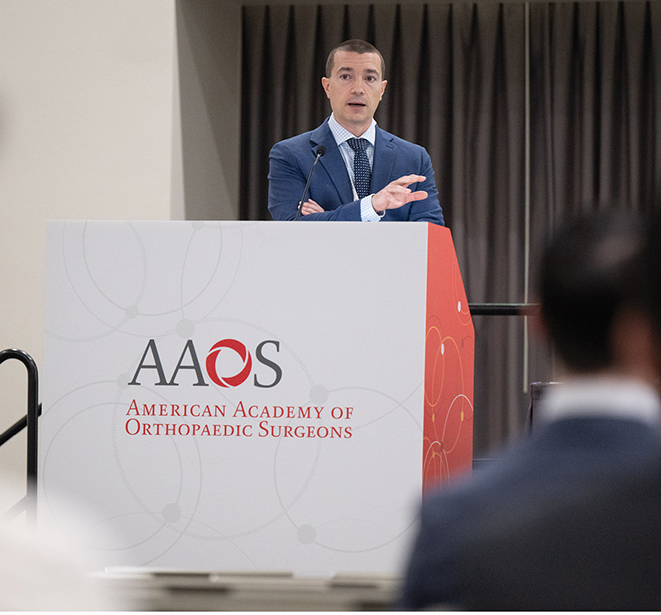
Gary F. Updegrove, MD, FAAOS, encouraged early-career orthopaedic surgeons to set clear financial goals.
Published 9/10/2025
|
Leah Lawrence
The financial decisions made early in an orthopaedic surgeon’s career could have significant effects on short- and long-term financial wealth.
“What do you do when you go from a med student in massive debt, to a resident with a little bit of money, to all of the sudden getting a paycheck with another ‘0’ at the end?” asked Gary F. Updegrove, MD, FAAOS, of Penn State Health, during the Instructional Course Lecture “Personal finance for the early-career orthopaedic surgeon: Things nobody teaches you … anywhere” at the AAOS 2025 Annual Meeting. During the session, Dr. Updegrove and colleagues discussed common financial questions for orthopaedic surgeons who are new to practice and some strategies that can help reduce financial stress.
The foundation
Dr. Updegrove emphasized that none of the presenters in the course is a financial professional and that none of the advice was personalized financial advice. “We are just here to describe what our personal thoughts are,” he said.
His first piece of advice was to “know your goals. Is your goal to retire early? Is it to have generational wealth? Is it to have three houses?” Dr. Updegrove asked. It is important to know where you want to be in order to make a map for how to get there.
He encouraged young professionals to start saving early. It is not about timing the market, but time in the market. One thousand dollars placed in the market with 8% interest at age 50 is $21,725 by age 90, but $1,000 placed in the market at 8% interest at age 20 would be $218,606 at age 90.
An understanding of employment and compensation models is vital to forming a financial plan. Michael P. Ast, MD, FAAOS, of Hospital for Special Surgery in New York City, discussed the multitude of employment models available to surgeons as they finish their training, including solo practice, private practice, hospital employed, “privademics,” academics, and others.
“It is important to know how [these models] work and what they do,” Dr. Ast said. “We can’t save money unless we make money.” Surgeons should also be familiar with the various compensation models: salary, salary plus bonus, relative value units, etc.
In addition to payment, Dr. Ast recommended making sure that the type of employment one is seeking fits with one’s personal goals. “You have to know yourself,” he said. “Talk to the mirror, talk to your spouse, significant others, or parents. This isn’t residency or fellowship.” Once these career choices are made, it is harder to leave.
Knowing one’s worth
Another important step to financial health is calculating net worth, Dr. Updegrove said. Knowing this information will help guide other financial decisions.
During his presentation, Dr. Updegrove covered a lot of important information, including student loan management forgiveness programs, the idea of “financial independence retire early” — or FIRE — and a breakdown of some of the ins and outs of retirement savings plans.
Just as important as earning and investing assets is protecting assets. Dr. Updegrove encouraged any resident attending the session who did not already have disability insurance to look into it immediately.
“You need to be able to cover your income if you become disabled,” he advised. “The rate you get on disability insurance is the rate you pay forever,” meaning the younger and healthier one is when they apply, the better. “You can put in a cost riser for when you make more income but can get a small benefit for right now,” he said.
Life insurance is also another key part of financial health. Dr. Updegrove passionately recommended term life insurance but noted that others are proponents of whole life insurance. Coverage amounting to seven to 10 times your annual salary is typically recommended.
Estate planning is also important, especially for surgeons with a family. This information maps out what to do in case of death. “Have a good will and estate plan drawn up,” Dr. Updegrove said. It also never hurts to have an emergency fund with three to six months of liquid assets.
Where is the value?
Eric F. Swart, MD, FAAOS, of Lahey Hospital & Medical Center in Burlington, Massachusetts, discussed finance from a more philosophical standpoint. He encouraged young professionals to think about how much they want to save and what they want to do with the savings.
“Make a plan. Talk to your family,” Dr. Swart said. “Family is an essential part of the plan.”
Dr. Swart noted that he aggressively pays off debt. “In the long term, that probably isn’t the highest return, but I own my house, I own my car, and that changes the way I live my life,” he said. “I find value in that.”
A key to establishing financial health is having a budget. There are online tools or apps to track spending, and he said that you might be surprised at what you spend in different categories of personal expenditures over a month or a year when it is compiled.
Think not about what you can afford, Dr. Swart advised, but what you need. He shared an anecdote about a respected colleague who is 50 years old and maintains a busy practice. When asked why he is not looking into retirement yet, the colleague said he cannot retire because he still needs to pay off the purchase of two vacation homes.
“That is fine if that is what you want to do, but do it with your eyes open,” Dr. Swart said. In contrast, Dr. Swart shared that he recently took a year off practice to live abroad with his family. “It has value to me to not be chained to the things I have chosen to buy.”
Finance is personal
Arjuan Saxena, MD, MBA, FAAOS, of Rothman Orthopaedics, finished the session by repeating an important theme of the session: Finance is personal.
There are different ways to build wealth, and he advised attendees to find the way that works best for them.
One way is to limit silly expenses. Dr. Saxena shared a personal example of recently deciding to grab three sodas from his garage before heading out to help a friend move a couch.
“I could have stopped at Wawa and paid $3 each for sodas, but instead I went and grabbed my 50-cent sodas,” he said. “These are things you want to instill in yourself. I don’t want to waste money.”
Other methods for building wealth include entrepreneurship or passive income, such as investing in real estate.
“With your family and support system, decide what you want to do, where you want to be, and work toward that,” Dr. Saxena said. “Being an orthopaedic surgeon is fantastic, but you can keep working and grinding and make more money, or you can be happy helping the people you help and choosing to be happy outside work as well.”
Leah Lawrence is a freelance writer for AAOS Now.