

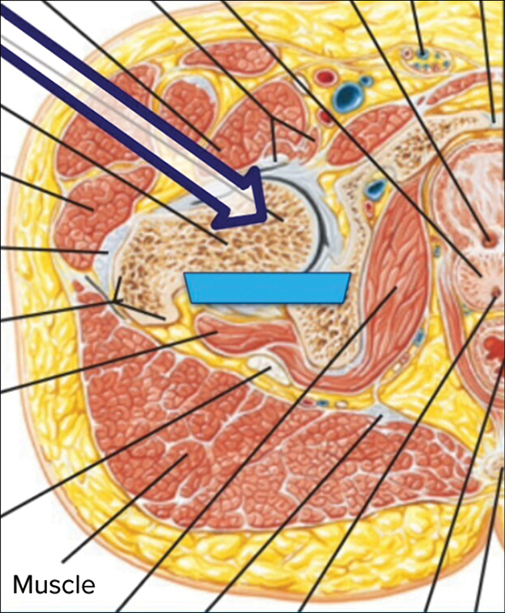
Figure 1: With the patient supine, the fluid is accessible via the anterolateral approach. Fluid pools in the posterior hip joint.
Published 12/17/2025
|
Leslie Schwindel, MD, FAAOS
Editor’s note: The following article is a review of a video available via the AAOS Orthopaedic Video Theater (OVT). AAOS Now routinely reviews OVT Plus videos, which are vetted by topic experts and offer CME. For more information, visit aaos.org/OVT.
Hip joint aspiration is a commonly performed orthopaedic procedure used to withdraw fluid for synovial fluid analysis. It can be utilized in a variety of clinical scenarios but is especially important for the diagnosis of native and periprosthetic joint infections. Although hip joint aspiration is possible with the use of landmarks alone, the deep location makes it challenging. Furthermore, confirmation of intra-articular needle placement is often advisable, making use of a large C-arm the traditional technique. In a recent AAOS OrthoDome® video, a group of surgeons at Mount Sinai Hospital in New York described a novel technique for hip aspiration using a mini C-arm, which facilitates timely bedside aspiration.
Figure 1: With the patient supine, the fluid is accessible via the anterolateral approach. Fluid pools in the posterior hip joint.
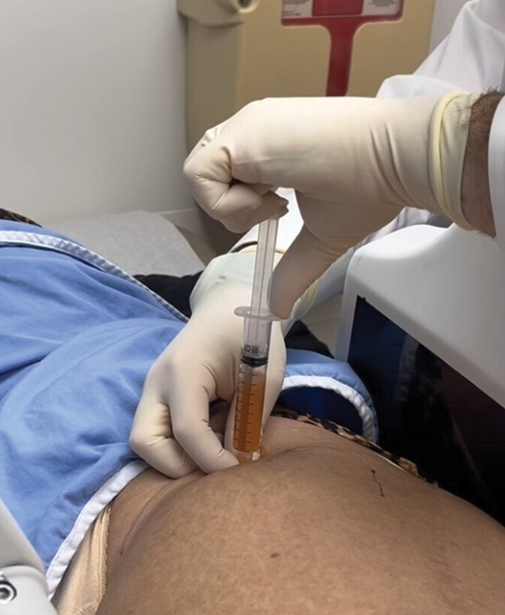
Figure 2: Lateral positioning of patient and aspiration using mini c-arm
Hip aspirations are typically performed at the level of the femoral neck or at the head/acetabular junction, with an intracapsular spinal needle. Patient positioning for aspiration can influence the location and accessibility of intracapsular fluid. When a patient is supine, fluid in the joint tends to collect posteriorly, so that aspiration from an anterolateral approach only reaches a portion of the fluid collection and may limit aspirate yield (Figure 1). When the patient is placed in a lateral position, the fluid collects in a more accessible location for an anterolateral approach.
First, the patient is placed in the lateral position, affected hip up, with the mini C-arm over the top of the hip, and an AP image is made of the hip. An unopened spinal needle is placed over the hip and used to localize the planned insertion site and trajectory of the needle. C-arm positioning can then be adjusted for optimal view of the joint.
The greater trochanter is marked out, along with the planned insertion site of the spinal needle. The skin is prepped with a topical anesthetic spray and cleansed with chlorhexidine. Using sterile technique, an 18-gauge spinal needle is inserted at the target site and advanced deeper inferomedially into the hip joint. The trajectory is checked with periodic fluoroscopic shots.
After accurate placement of the needle is confirmed, the stylet is removed, and a 10 milliliter syringe is attached for aspiration of fluid. This aspirate is then sent for synovial fluid analysis.
An example of hip aspiration with a patient supine using a large C-arm is then shown for comparison. When compared to standard supine C-arm technique, lateral aspiration with a mini C-arm is advantageous in scenarios where space is limited, such as at a patient’s bedside or in an examination room.
When access to an OR or fluoroscopy suite is limited and/or diagnosis is time sensitive, this may prove very helpful. Additionally, this allows the procedure to be performed without transferring the patient to a radiolucent table and back again, decreasing patient discomfort. There may also be a more accessible volume of synovial fluid in the hip joint when the patient is placed in the lateral position, as it avoids pooling of fluid in the posterior aspect of the hip joint.
Hip aspiration is frequently performed, and a technique that is easier to perform; accesses a larger volume of fluid; and can be done in scenarios where space, staff, and time are limited has great clinical value.
Leslie Schwindel, MD, FAAOS, is a general orthopaedic surgeon at Lake Cumberland Regional Hospital in Somerset, Kentucky, and a member of the AAOS Now Editorial Board.
Video details
Title: Novel Mini C-Arm Hip Aspiration Technique
Authors: Michael Stephen Shatkin, MD; Kyle Rako, MD; John Cordero, MD; Brett Hayden, MD
Published: April 22, 2025
Time: 4:27
Tags: Featured, Adult Reconstruction Hip, Revision Hip Arthroplasty, Total Hip Arthroplasty, Arthroplasty, Emerging Technique, Infection, Pre-Surgical Evaluation, Technique
Visit aaos.org/OVT to view this award-winning title and more than 1,600 other videos from across orthopaedic topics, institutions, practice management, and industry.