

Published 12/17/2025
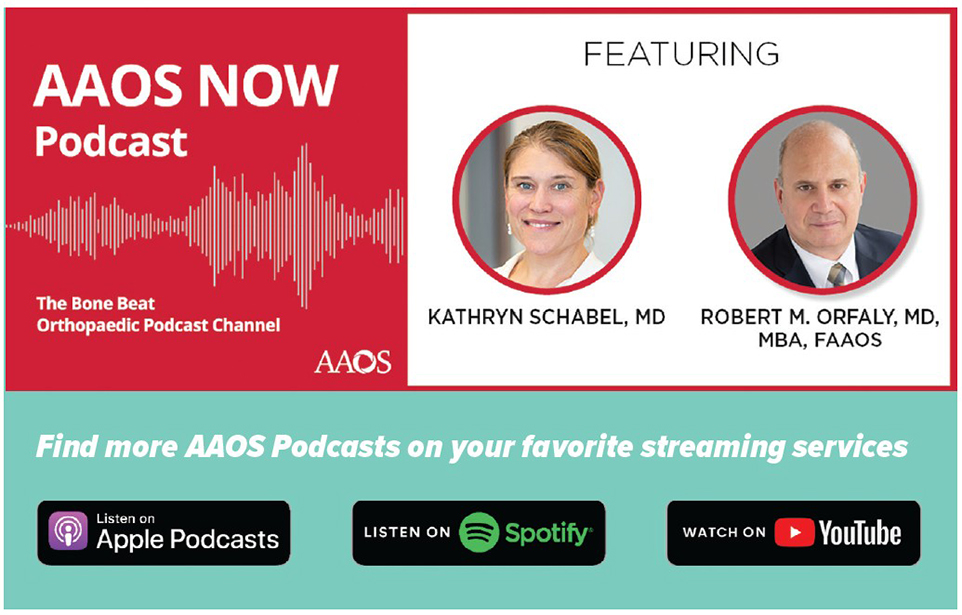
In the latest episode of the AAOS Now Podcast, host Robert M. Orfaly, MD, FAAOS, editor-in-chief of AAOS Now, was joined by Kathryn Schabel, MD, FAAOS, for a compelling conversation about the importance of communicating effectively with patients and what doctors at every career stage can do to become better communicators.
Dr. Schabel’s interest in doctor-patient communication was inspired by former AAOS President John Tongue, MD, FAAOS, through the AAOS Communication Skills Mentoring Program. She took the tools and framework she learned there to teach communication skills to residents and attendings. Dr. Schabel explained that good doctor-patient communication is not just good for patients but also helps doctors feel more satisfied with the care they provide. “That can be one of the long-sought antidotes to the burnout a lot of us feel,” she added.
The “4 Es” of effective patient communication
Dr. Schabel and Dr. Orfaly discussed the “4 Es” that doctors can use to make sure they are communicating effectively with their patients: engage, empathize, educate, and enlist.
Attention paid to word choice, active listening, and non-verbal communication can show patients that doctors are engaging and truly hearing them. Asking open-ended questions and letting patients explain their own condition without interrupting them are two actionable ways doctors can show engagement.
Dr. Schabel recommended that doctors find a few ways that are sincere and easy to remember to communicate empathy to their patients — for instance, repeating back what a patient says. This can help them understand that you, their doctor, have heard them. Another way to show empathy is by normalizing the patient’s condition and letting them know it is a shared experience with other patients — that they are not alone.
With more and more patients coming to appointments having already researched their conditions online, doctors have the opportunity to educate them in a meaningful way. It is important for doctors to first ask patients what they know, through either their own research or family/friends who have gone through similar experiences, and where they got their information. For patients who are using biased or unreliable sources, Dr. Schabel recommended using humor and “taking people down to the most basic true statements to get away from the potentially biased or inflected information they have been getting from the Internet.”
Dr. Schabel spoke on enlisting patients as collaborators in their own care, including how to communicate preoperative issues while remaining focused on the complex treatment of the patient’s initial problem. “It’s partnering with your patient. First of all, getting them to believe that you’re a partner and that you’re committed to helping them — just saying those words, ‘I’m committed to helping you.’” When the patient understands that their doctor wants to help them, it can be easier for them to make the changes needed to optimize them for surgery. Continuing to monitor the patient’s progress and showing them that their doctor is committed to seeing them through is another great way to enlist patients in their own care.
Creating accountability
Dr. Orfaly and Dr. Schabel concluded the episode with advice about how physicians can check in with themselves to make sure they are being good communicators. They recommended that doctors reflect on both good and bad interactions — including conducting self-assessments after each patient encounter about what went well and what did not and inviting medical students and residents to provide objective feedback. Evaluating the positives and the negatives can help doctors continually refine their communication skills and improve their future interactions with patients.
“[Patient communication] is really a skill just like the ones [doctors] use in the operating room and ones that you can continue to refine throughout your career,” Dr. Schabel said.