

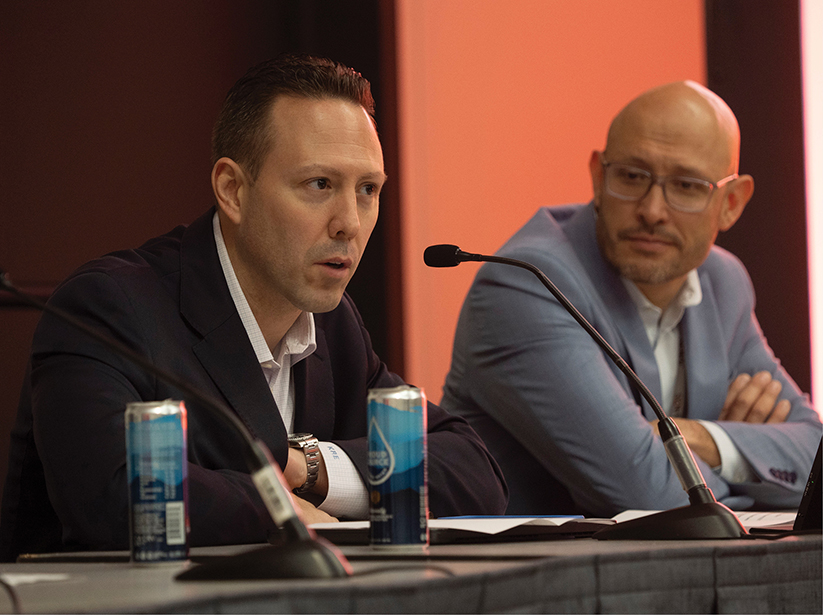
Kyle R. Eberlin, MD (left), noted that orthopaedic surgeons see a variety of cases that may benefit from collaboration with plastic surgeons.
Published 12/17/2025
|
Leah Lawrence
Multidisciplinary collaboration between orthopaedic surgeons and plastic surgeons — often called “orthoplastic” surgery — is vital for successful limb salvage in the setting of tumor or trauma. This collaboration may also be necessary for cases involving infection, ischemia, or postoperative skin necrosis.
At the AAOS 2025 Annual Meeting, several surgeons familiar with this type of multidisciplinary collaboration provided an overview of some of the applications and benefits of orthoplastic surgery during the Instructional Course Lecture titled “If you don’t ask, you don’t get: When to ask for help from plastic surgeons in orthopaedic oncology and traumatology.”
A growing field
The field of orthoplastic surgery is growing, and an increasing number of residents are interested in pursuing this type of career, according to Kyle R. Eberlin, MD, associate professor of surgery at Harvard Medical School. In his experience, orthoplastic surgery combines orthopaedic surgeons of various disciplines — oncology, trauma, arthroplasty — with plastic surgeons often specializing in hand, microsurgery, or peripheral nerve surgery.
Contrary to popular belief, some plastic surgeons do not focus solely on cosmetic surgery, Dr. Eberlin explained. Personally, he said, he finds value in these types of complex limb-salvage surgeries because they allow him to think outside the box and work as a member of a team.
Orthopaedic surgeons see a variety of cases that may be appropriate for collaboration with their plastic surgery colleagues. These include cases involving radiation or prior surgery, cases where the consequences of poor healing would be disastrous, or simply cases where the surgeon’s gut instinct says that the patient will heal poorly.
“If you think that your patient might need a flap, they need a flap,” Dr. Eberlin advised.
Soft-tissue sarcoma complications
Orthopaedic surgeons treating patients with soft-tissue sarcomas may encounter cases that could benefit from orthoplastic collaboration. Erik T. Newman, MD, FAAOS, an orthopaedic oncology surgeon at Massachusetts General Hospital, discussed predicting and managing radiation-associated complications related to these surgeries.
By decreasing angiogenesis and causing “leaky” microvasculature and fibroblast inhibition, “radiation impacts all phases of wound healing,” Dr. Newman explained.
A study of preoperative versus postoperative radiation to sarcoma of the limbs by O’Sullivan et al. found that preoperative radiation resulted in a wound-healing complication rate of 35%, compared with 17% in patients who received postoperative radiation. For thigh tumors, the rate of wound-healing complications was nearly 50%.
“There is not much we can do when the risk is the flip of a coin,” Dr. Newman said. “Because of that, I have made it practice with soft-tissue sarcoma of the thigh or buttock to ask plastics to be involved preoperatively. They do this work better than I do, and it decreases the risk of vasculature and wound problems.”
Dr. Newman also collaborates with plastic surgeons in cases involving “limb rejuvenation” with vascularized bone in patients with tumors.
Collaboration on trauma cases
In the trauma realm, plastic surgeons can assist with post-traumatic limb salvage. Derek S. Stenquist, MD, assistant professor of orthopaedics at Harvard Medical School, shared that as a trauma surgeon, it is essential to recognize when soft tissue is a limiting factor for limb reconstruction after trauma.
“Outcomes can be optimized by following established principles regarding the relative timing of bony and soft-tissue reconstruction,” Dr. Stenquist said. “Close collaboration with plastic surgery partners and honest communication with patients is essential.”
During his presentation, Dr. Stenquist discussed the evolution of “fix and flap” principles — referring to a strategy achieving definitive reconstruction within 72 hours. A study conducted in the 1980s by Godina et al. in Yugoslavia established the approach, finding lower rates of flap failure and infection, shorter hospitalization time, and a smaller number of surgeries with early reconstruction. The findings of their study demonstrated that “the team approach is paramount,” Dr. Stenquist said.
In the years since, more evidence has demonstrated the value of “fix and flap.” Unfortunately, there are many cases where early flap coverage does not occur. However, recent evidence suggests that proximity of the definitive fixation to the flap, in addition to total delay, directly affects prognosis. This may aid those operating outside of orthoplastic centers. Coordination will be key to this approach, Dr. Stenquist remarked.
During the lecture, Santiago A. Lozano Calderon, MD, PhD, associate professor of orthopaedics at Harvard Medical School, discussed using vacuum-assisted wound-closure temporization in patients with myxofibrosarcoma until final margins are achieved. He also noted that this approach offers patient-reported outcomes similar to single-stage excision reconstruction.
Many of the solutions demonstrated with the cases presented at the course “could only have been landed upon through discussion between the orthopaedic surgeon, the plastic surgeon, and the patient together,” Dr. Eberlin said. However, he also acknowledged that the type of collaborations discussed during the course are not without barriers, including the availability of hospital resources. Finally, for all orthoplastic collaborations, the ability to find colleagues who work well together as a team is paramount.
Leah Lawrence is a freelance writer for AAOS Now.
References
- O’Sullivan B, Davis AM, Turcotte R, et al. Preoperative versus postoperative radiotherapy in soft-tissue sarcoma of the limbs: A randomised trial. Lancet. 2002;359(9325):2235-41. doi:10.1016/S0140-6736(02)09292-9
- Godina M. Early microsurgical reconstruction of complex trauma of the extremities. Plast Reconstr Surg. 1986;78(3):285-92. doi:10.1097/00006534-198609000-00001