

Published 11/20/2025
|
Sarah A. K. Johnson, AAS; Romney C. Andersen, MD
Records of war and care for the injured date back as far as the Trojan War circa 700 BCE. Physicians then, as they do now, used all their knowledge and skills to attempt to save lives. In the United States, military and civilian medicine have always been intertwined. In 1775, the formation of America’s first national institution, the Continental Army, marked the beginning of a shift from a small group of civilian volunteer doctors to the expertly trained career military physicians of today.
Orthopaedic surgery is considered the quintessential combat specialty. The field has borne witness to dramatic improvements in patient outcomes based on knowledge gained from battlefield medicine. For example, during World War I, the mortality rate for battlefield femur fractures decreased from 80% to 20% with the utilization of immediate splint immobilization alone. The care of open fractures, once considered the most severe battle injury, improved significantly through external fixation methods, both in military and civilian use, during World War II. The Küntscher nail — the contemporary femoral nail’s precursor — was developed by German surgeon Gerhard Küntscher and used heavily during WWII. Over the past century, many of the breakthroughs and advancements in battlefield medicine have been used to inform and improve civilian trauma care.
Tourniquets
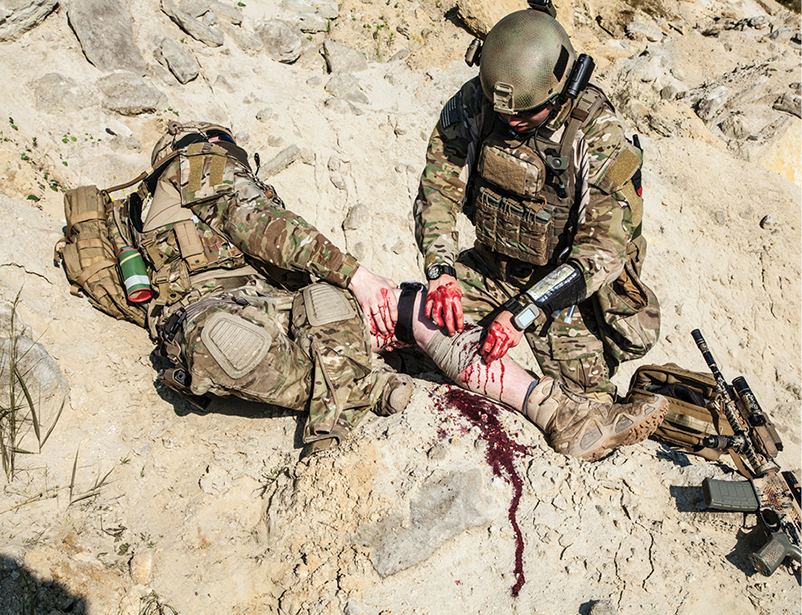
Tourniquets were previously feared to lead to increased amputations and death. However, a large-scale 2016 investigation of battlefield tourniquet use proved otherwise, influenced in part by how casualty information is reported in the military. From 2001 to 2011, the leading cause of battlefield mortality was massive, uncontrolled hemorrhage. Tourniquets were prolonging the lives of many fatally wounded soldiers, leading them to be later counted as having died of wounds, when historically they would have been classified as being killed in action. Tourniquets were so widely utilized in the field during the Iraq and Afghanistan wars that, as a regular practice, soldiers would loosely wear one on all four extremities in anticipation of injury while on patrol.
Once unheard of, tourniquet use is now commonplace in civilian emergency medicine practice. This technique also serves as a pillar of the national public awareness initiative “Stop the Bleed,” formed through the combined efforts of the American College of Surgeons’ Committee on Trauma and the Department of Defense. This educational effort seeks to instruct individuals on ways to control severe, life-threatening bleeding in emergency situations, citing blood loss as the number one cause of preventable death after injury.
Infection and debridement
Battlefield injuries are almost certain to have higher levels of infection due to their frequently gross contamination with foreign bodies such as patient clothing, dirt, primary projectile fragments, or secondary projectile fragments such as rocks and body parts. The risk of systemic infection increases with the length of evacuation delay. Throughout the 18th and early 19th centuries, physicians believed that imbalances of humors caused diseases such as gangrene. Experimental wound care for open fractures was commonly performed with caustic mixtures of chlorine, tar, or silver nitrate, and without the sanitization of either surgical instruments or the surgeon’s hands before procedures.
One noteworthy debridement concoction, Dakin’s solution, has resurfaced for current use by modern-day surgeons, in part due to its effectiveness against antibiotic-resistant bacteria without damaging living tissues. It is said by some to be one of the most important tools of surgeons since its inception in the 1900s. The mixture of diluted sodium hypochlorite and boric acid was first used to treat gangrenous wounds by irrigation through rubber tubing in conjunction with delayed wound closure, which showed excellent results. Despite this, Dakin’s was only briefly popular, falling out of favor because of difficulty of use, an unwieldy delivery system, and uncertainty regarding the solution’s long-term impact on healing. Research has shown that Dakin’s solution increases skin-graft survival rates. A 2010 study using dilute solution with vacuum-assisted closure devices facilitated successful engraftment in 100% of patients with wounds containing dangerously high loads of multidrug-resistant bacteria.
Explosion-related injury
War wounds during the period spanning 2007-2017 were composed of high-energy blasts (60.4%) and gunshot wounds (19.2%), with most injuries categorized as polytrauma. Although the explosion-related injuries of the 21st century are far more severe than war wounds of the past, they are increasingly less lethal, illustrated by the decreasing case-fatality rate from around 20% at the start of the Iraq and Afghanistan conflicts to 10% at their conclusion for the same types of injuries. This dramatic increase in survival is, in part, due to lessons learned from the past — notably, torniquet use has reduced fatalities that would otherwise have resulted from massive blood loss in the period immediately following an injury, before hospital transport.
The degree of damage associated with a battlefield injury depends on multiple factors, including the patient’s proximity to the explosion. Survivors often exhibit rupture of tympanic membranes, bowel perforation, brain injury, dismemberment, severe tissue devastation, fractures, rhabdomyolysis, or compartment syndrome.
Outcomes are also dependent on the level of care available immediately after injury, a logistical hurdle on the battlefront. For comparison, explosion-related injuries treated at a level 1 trauma center have a 50% higher chance of limb survival and superior overall survival rates compared with those treated at a level II trauma center.
Military health professionals caring for individuals wounded in combat have fought to save patients even with the odds against them — from near-certain death by simple spear or sword in the time of the Iliad to the disfiguring blast injuries of Iraq and Afghanistan — producing medical innovations borne of necessity. As William J. Mayo, MD, said: “Medicine is the only victor in war.” The surgical advances originating from combat medicine are also critically relevant to civilian orthopaedic trauma care. Antiseptics from the 1900s are being rediscovered, namely Dakin’s solution, utilized as a modern-day tool to fight against multidrug-resistant bacteria. Splinting, another World War I practice, reduced mortality of femoral fractures from 80% to 20%, and World War II saw the rise of both external fixation methods and the development of the femoral nail used today. Conflicts in Iraq and Afghanistan resulted in widespread tourniquet use, once controversial but now an indispensable tool.
The legacy of battlefield trauma care continues to save countless lives. Whether on the battlefield or in a trauma center, the resilience and sacrifice of military and civilian care teams are to thank for improved orthopaedic outcomes and the advancement of modern medicine.
Sarah A. K. Johnson, AAS, is a premedical honors student at Christopher Newport University, where she is pursuing a bachelor of science degree in cellular, molecular, and physiological biology, with expected graduation in 2026.
Romney C. Andersen, MD, is a fellowship-trained orthopaedic trauma surgeon with extensive military and civilian experience. He is a professor of surgery at the Uniformed Services University of the Health Sciences. He deployed to combat as chief of orthopaedic surgery at Ibn Sina Hospital in Baghdad, Iraq, and served as director of orthopaedic trauma and first chairman of the Department of Orthopaedics at Walter Reed National Military Medical Center.
References
- Manring MM, Hawk A, Calhoun JH, Andersen RC. Treatment of war wounds: A historical review. Clin Orthop Relat Res. 2009;467(8):2168-2191. doi:10.1007/s11999-009-0738-5
- American College of Surgeons. Stop the Bleed — History. Accessed May 7, 2025. https://www.stopthebleed.org/about/history/
- Beekley AC, Starnes BW, Sebesta JA. Lessons learned from modern military surgery. Surgical Clinics of North America. 2007;87(1):157-184. doi:10.1016/j.suc.2006.09.008
- Hildebrand F, Giannoudis P, Kretteck C, et al. Damage control: Extremities. Injury. 2004;35(7):678-689. doi:10.1016/j.injury.2004.03.004
- Newman MS. Military and Civilian Surgery Partner for Innovation, Effectiveness. Accessed May 7, 2025. https://www.facs.org/for-medical-professionals/news-publications/news-and-articles/bulletin/2025/january-2025-volume-110-issue-1/military-and-civilian-surgery-partner-for-innovation-effectiveness/
- Cubano MA, Butler FK, Borden Institute (U.S.) (Eds.). Emergency War Surgery (5th United States revision). U.S. Department of Defense, Borden Institute; 2018.
- Army Heritage Center Foundation. Caught in the Line of Fire: Civil War Medicine. Accessed May 8, 2025. https://www.armyheritage.org/soldier-stories-information/caught-in-the-line-of-fire-civil-war-medicine/
- Rokayak OA, Lammers DT, Baird EW, et al. The 16-year evolution of a military-civilian partnership: The University of Alabama at Birmingham experience. J Trauma Acute Care Surg. 2023;95(2S Suppl 1):S19-S25. doi:10.1097/TA.0000000000004051
- American College of Surgeons. Part 2: Why the U.S. trauma system needs a robust civilian-military partnership. Accessed May 8, 2025. https://www.facs.org/quality-programs/trauma/systems/trauma-series/part-ii/
- Rigby W. Lessons from 2 war zones make a difference in medic training. Accessed May 8, 2025. https://www.bpr.org/2016-11-02/lessons-from-two-war-zones-make-a-difference-in-medic-training
- Sabino JM, Slater J, Valerio IL. Plastic surgery challenges in War Wounded I: Flap-based extremity reconstruction. Adv Wound Care (New Rochelle). 2016;5(9):403-411. doi:10.1089/wound.2015.0656
- Kragh JF Jr., Dubick MA. Battlefield tourniquets: Lessons learned in moving current care toward best care in an Army medical department at war. US Army Med Dep J. 2016;(2-16):29-36.
- Gawande A. Casualties of war — Military care for the wounded from Iraq and Afghanistan. N Engl J Med. 2004;351(24):2471-2475. doi:10.1056/NEJMp048317
- S. Army Corps of Engineers. West Point in the Early Republic. Accessed May 8, 2025. https://www.usace.army.mil/About/History/Historical-Vignettes/250th-Anniversary-Vignettes/25001-USMA-in-the-Early-Republic/
- Civilian tourniquet use associated with six-fold reduction in mortality. Trauma System News. April 11, 2018. Accessed May 8, 2025. https://trauma-news.com/2018/04/civilian-tourniquet-use-associated-with-six-fold-reduction-in-mortality/
- Küntscher Society. Gerhard Küntscher. Accessed May 8, 2025. https://www.kuentschersociety.org/the-society/gerhard-kuentscher.html
- Pierach CA. Give me a break: Gerhard Küntscher and his nail. Perspect Biol Med. 2014 Summer;57(3):361-73. doi:10.1353/pbm.2014.0021
- Howard JT, Kotwal RS, Stern CA, et al. Use of combat casualty care data to assess the US military trauma system during the Afghanistan and Iraq conflicts, 2001-2017. JAMA Surg. 2019;154(7):600-608. doi:10.1001/jamasurg.2019.0151
- For military, different wars mean different injuries. NPR. June 8, 2011. Accessed May 8, 2025. https://www.npr.org/2011/06/12/137066281/for-military-different-wars-mean-different-injuries
- Eastridge BJ, Mabry RL, Seguin P, et al. Death on the battlefield (2001-2011): Implications for the future of combat casualty care. J Trauma Acute Care Surg. 2012;73(6 Suppl 5):S431-S437. doi:10.1097/TA.0b013e3182755dcc
- Keyes M, Jamal Z, Thibodeau R. Dakin Solution. In: StatPearls. Treasure Island (Florida): StatPearls Publishing; Jan. 26, 2023.
- Georgiadis J, Nascimento VB, Donat C, et al. Dakin’s solution: “One of the most important and far-reaching contributions to the armamentarium of the surgeons.” Burns. 2019;45(7):1509-1517. doi:10.1016/j.burns.2018.12.001
- Raad W, Lantis JC II, Tyrie L, Gendics C, Todd G. Vacuum-assisted closure instill as a method of sterilizing massive venous stasis wounds prior to split thickness skin graft placement. Int Wound J. 2010;7(2):81-85. doi:10.1111/j.1742-481X.2010.00658.x
- Liao CD, Deccico JB, Cuzzone D, et al. Interrupting negative-pressure wound therapy with Dakin’s solution is associated with increased skin graft survival. Plast Reconstr Surg Glob Open. 2022;10(12):e4724. doi:10.1097/GOX.0000000000004724
- Howard JT,Kotwal RS, Stern CA, et al. Use of combat casualty care data to assess the US Military trauma system during the Afghanistan and Iraq conflicts, 2001-2017. JAMA Surg. 2019;154(7):600-608. doi:10.1001/jamasurg.2019.0151