

Published 10/19/2025
|
Benjamin Boss, AuD, CCC-A; Christopher J. DeFrancesco, MD
The Occupational Safety and Health Administration and the National Institute for Occupational Safety and Health have been charged with regulating sound exposure in working environments, as repeated exposure to hazardous sound levels can damage cochlear hair cells and cause permanent noise-induced hearing loss (NIHL). These organizations have set the recommended exposure limit (REL) for occupational noise at 85 decibels (dB) averaged over an eight-hour period, which is comparable to the sound intensity of a kitchen blender. It is crucial to note that every 3 dB increase in sound above this threshold effectively halves the allowable exposure time. This means that maximum allowable exposure time for a sound of 100 dB is just 15 minutes.
Experts also differentiate between types of noise, with continuous noise describing steady sounds (e.g., a suction device) and impulse noise encompassing sudden sounds (e.g., two metal objects striking each other). Although the high-intensity impulses of the latter are considered more harmful than continuous noise because they can cause instant mechanical damage to the inner ear, it is important to recognize that concurrent impulse and continuous noise act synergistically to increase the risk of hearing damage.
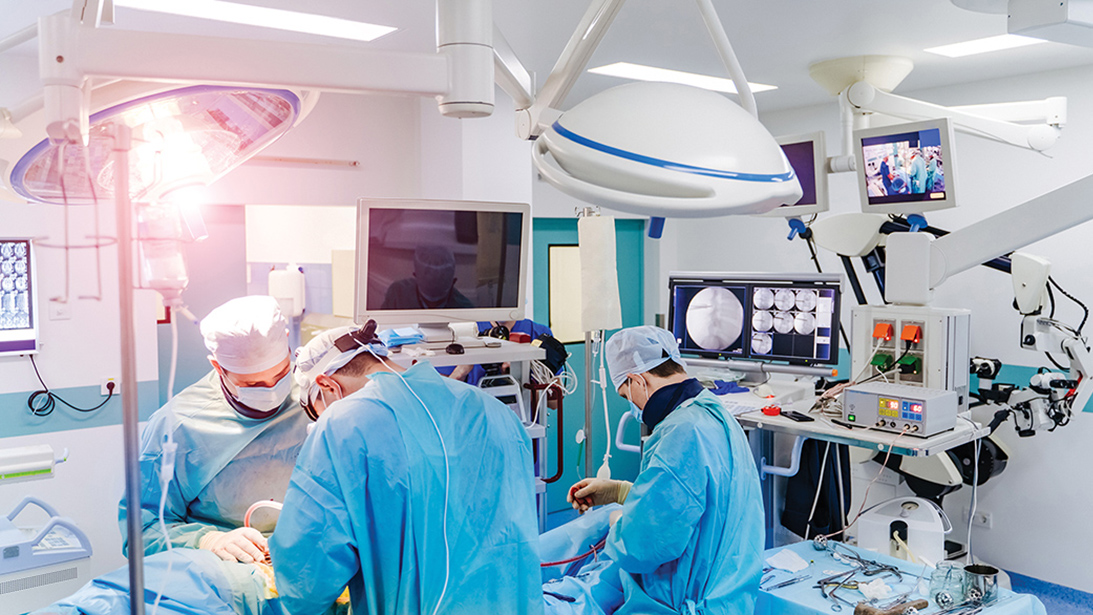
Studies have confirmed what many readers already know — the orthopaedic OR can be noisy due to the use of powered instruments and other tools. In fact, research has shown that noise in the orthopaedic OR frequently outpaces the REL of 85 dB, occasionally even surpassing the higher limit of 140 dB for impulse noise recommended by the Occupational Safety and Health Administration.
Sound levels in orthopaedic surgery
Mallets can produce sounds as loud as 113 dB, saws used in total joint arthroplasty can be as loud as 110 dB, and drills can generate sound >90 dB. These values do not include the synergistic effect of background continuous noise — such as that from suction systems, surgical hood fans, ambient music, and more — so the actual noise exposure to surgeons and staff may be even higher. Understanding this, it is not surprising that multiple studies have shown that about 50% of orthopaedic staff members have signs of NIHL when tested.
Research has shown that total hip arthroplasty and total knee arthroplasty (TKA) are particularly noise-intensive procedures, with reported maximum decibel levels (MDL) consistently exceeding 100 dB. In a study of manual total joint arthroplasty, for example, the average MDL was found to be 102 dB. In other work, robot-assisted TKA was associated with even higher sound levels, with sound from a single robot-assisted TKA procedure constituting 18.7% of the maximum allowable daily sound dose on average. Kwan et al. warned that exposure limits may be surpassed with as few as two TKAs in one workday.
Spine surgery is another orthopaedic subspecialty at particular risk of sound exposure, with noise levels in spine ORs having been measured as high as 111.5 dB. In one study of spine surgeries, a single microdiskectomy case was found to account for 11.3% of the maximum allowable daily sound dose, and 78% of cases exhibited an MDL higher than 100 dB.
The implications of excessive OR noise extend beyond auditory health. Noisy environments increase stress levels and raise the potential for misheard orders, overlooked alarms, or incomplete handoffs. According to a study by Wang et al. in Noise and Health, ambient noise can increase cognitive load and distract from tasks, contributing to delays in response or judgment errors among nursing staff in the orthopaedic OR. A loud OR is not only an occupational hazard but also a potential patient hazard.
Although studies on the topic date back to the 1980s, sound guidelines and oversight for the operating environment seem to lag behind those in the industrial sector. Even so, the issue is gaining attention, as a simple PubMed search of “noise exposure orthopaedic” reveals 84 results since 2015 compared to only 31 prior to that. The National Institute for Occupational Safety and Health even dispatched its Health Hazards Program to audit orthopaedic ORs at a single institution in 2015, finding hazardous levels of noise during TKAs, with one surgeon surpassing the 85 dB REL during a single workday. Still, the issue of the hazard of excessive noise in the orthopaedic OR may be underappreciated, with no major orthopaedic organization having published guidelines or standards addressing the issue.
Several measures can be taken on the systems level to protect orthopaedic surgeons and other staff members from NIHL from the OR. Hospitals may consider monitoring sound in high-risk ORs, as well as implementing audiometric screenings to detect early signs of NIHL in orthopaedic personnel. Institutions could prioritize noise-reduction strategies, such as the installation of sound-absorbing materials and acquisition of quieter surgical tools. Orthopaedic organizations could work to bring awareness to the issue and establish relevant guidelines about noise in the OR.
Individual surgeons and other OR personnel can also take measures to protect their hearing. The use of custom-fitted hearing protection, such as flat-attenuation earplugs, can help reduce peak sound exposure in noisy cases. Although adoption rates remain low for this type of protection because of concerns about communication in the OR, high-fidelity attenuating earplugs (such as those worn by musicians) can reduce decibel levels by double digits while maintaining clarity of sound. Additionally, practical noise-reduction measures can be employed, such as clamping on-field suction and reducing the volume of music being played.
In conclusion, excessive noise in the orthopaedic OR has been increasingly recognized as a hazard to surgeons’ health and well-being. Although raising awareness of this issue among orthopaedic surgeons is important, it is vital that surgeons and staff be open to reasonable interventions to protect from these hazards.
Benjamin Boss, AuD, CCC-A, is director of audiology for the Department of Otolaryngology at West Virginia University Medicine. He is a nationally recognized expert in cochlear implant assessment and programming, tinnitus therapy, diagnostic testing, hearing aids, and more.
Christopher J. DeFrancesco, MD, is an attending surgeon in the Division of Orthopaedic Surgery at the Children’s Hospital of Philadelphia. His clinical practice focuses on hip surgery and sports medicine.
References
- Occupational Safety and Health Administration. Occupational noise exposure — standards. Accessed Aug. 25, 2025. https://www.osha.gov/noise/standards
- Centers for Disease Control and Prevention. Noise-induced hearing loss. Accessed August 25, 2025. https://www.cdc.gov/niosh/noise/about/noise.html
- Mullett H, Synnott K, Quinlan W. Occupational noise levels in orthopaedic surgery. Ir J Med Sci. 1999;168(2):106. doi:10.1007/BF02946475
- Willett KM. Noise-induced hearing loss in orthopaedic staff. J Bone Joint Surg Br. 1991;73(1):113-115. doi:10.1302/0301-620X.73B1.1991742
- Kwan SA, Ong AC, Lutz RW, Lau VW, Santoro AJ, Deirmengian GK. Noise-induced hearing loss: Should surgeons be wearing ear protection during primary total joint arthroplasty? HSS J. 2025;21(1):8-14. doi:10.1177/15563316241254352
- Kamal SA. Orthopaedic theatres: a possible noise hazard? J Laryngol Otol. 1982;96(11):985-990. doi:10.1017/s0022215100093403
- Mistry D, Ahmed U, Aujla R, Aslam N, D’Alessandro P, Malik S. The relationship between exposure to noise and hearing loss in orthopaedics. Bone Joint J. 2023;105-B(6):602-609. doi:10.1302/0301-620X.105B6.BJJ-2022-0921.R1
- Wang Q, Wu H, Zhang Y. Effect of noise exposure during orthopaedic surgery on nurses’ information processing: analysis of reaction delays and errors in judgment. Noise Health. 2025;27(125):97-103. doi:10.4103/nah.nah_3_25