

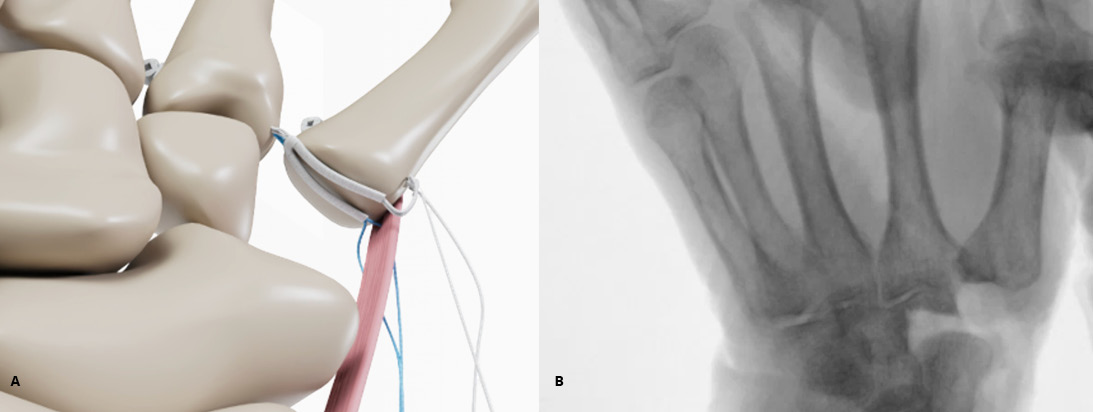
Figure 1. Suspensionplasty for treatment of thumb CMC arthritis. (A) Schematic of a two-suture cortical fixation suspension construct. (B) Intraoperative fluoroscopic view showing maintained space with manual stress.
Courtesy of Michael C. Doarn, MD, FAAOS
Published 8/26/2026
|
Michael C. Doarn, MD, FAAOS
At a Glance
- No single procedure remains the consensus treatment for thumb CMC arthritis.
- New suspension techniques and dual-mobility arthroplasty implants are expanding options.
- Arthritis severity, recovery goals, and revision considerations influence procedure selection.
Estimated read time: 4 minutes
Thumb carpometacarpal (CMC) joint arthritis is the second most common degenerative joint condition in human hands. Upwards of 15% of people older than 30 display radiographic arthritis. Nonoperative management has not changed much, with the mainstays being topical and oral medication, a myriad of braces and splints, corticosteroid injection, and platelet-rich plasma (PRP) injection. Modalities for surgical treatment, meanwhile, have evolved over the last 60 years and recently have seen a rapid change within the US landscape of hand surgery. Currently, there is no gold standard or consensus approach for every stage of the disease.
Historically, CMC was approached with tendon transfers, interposition, and ligament reconstruction, and a cohort of surgeons still prefers this method and reports acceptable outcomes. One study showed that nearly 84% of CMC cases are being addressed this way in the U.S. Denervation, nano arthroscopic synovectomy, and interposition grafting, along with other procedures, have also been implemented in earlier grades of arthritis.
Figure 1. Suspensionplasty for treatment of thumb CMC arthritis. (A) Schematic of a two-suture cortical fixation suspension construct. (B) Intraoperative fluoroscopic view showing maintained space with manual stress.
Courtesy of Michael C. Doarn, MD, FAAOS
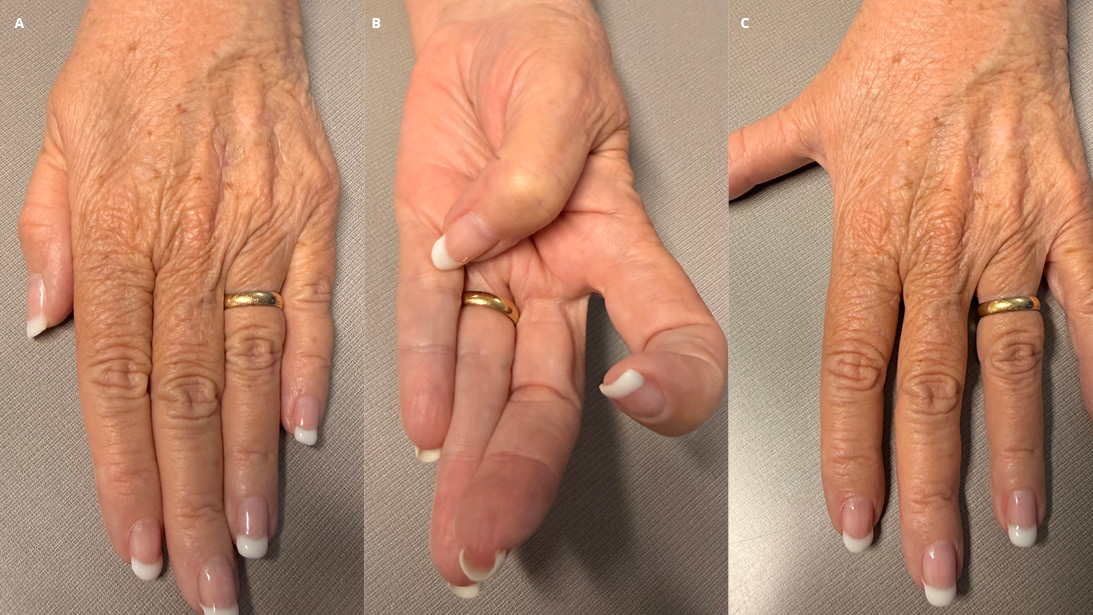
Figure 2. Clinical appearance following thumb carpometacarpal (CMC) arthritis surgery. (A) Postoperative appearance demonstrating thumb adduction. (B) Postoperative thumb opposition. (C) Postoperative resting alignment demonstrating improved thumb position and first web-space restoration.
Courtesy of Michael C. Doarn, MD, FAAOS
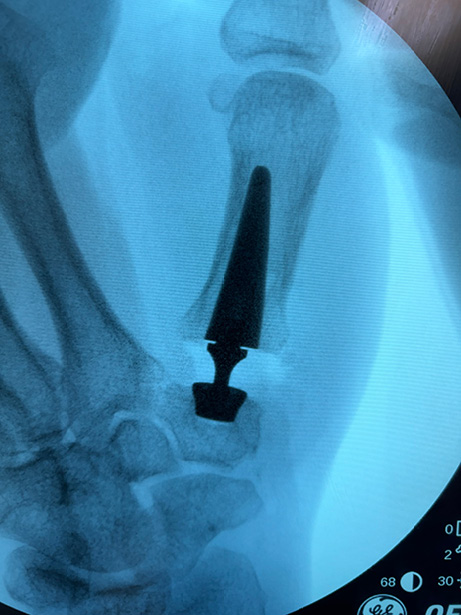
Figure 3. Intraoperative fluoroscopic image following dual-mobility thumb CMC arthroplasty.
Courtesy of Michael C. Doarn, MD, FAAOS
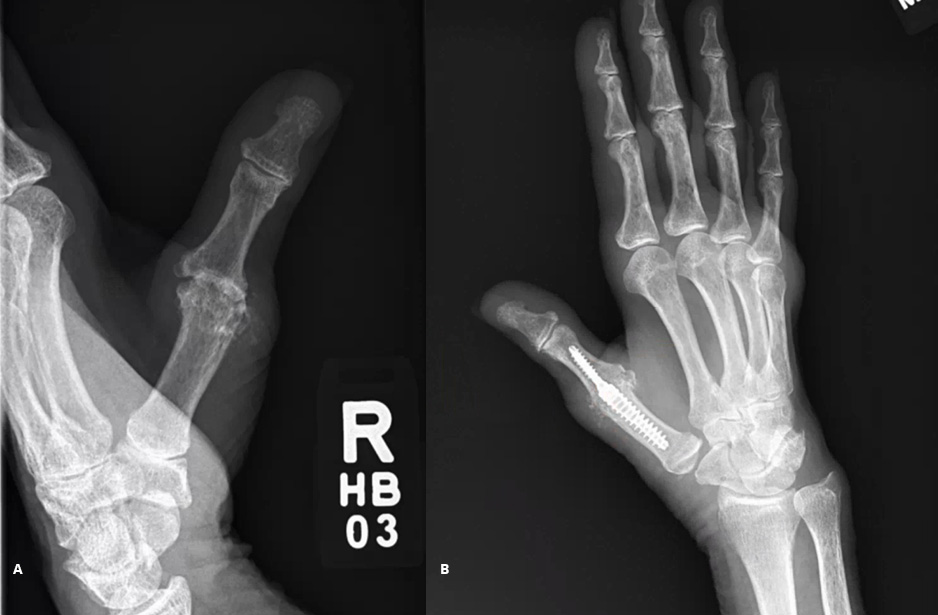
Figure 4. Concomitant thumb MP joint disease may influence treatment planning for patients with thumb CMC arthritis. (A) Preoperative radiograph demonstrating advanced MP joint degeneration. (B) Postoperative radiograph after MP arthrodesis.
Courtesy of Michael C. Doarn, MD, FAAOS
New suspension techniques seek to improve outcomes
Over the last 15 to 20 years, many surgeons transitioned to using suture implants that create a “suspensionplasty” construct. Within the last couple of years, improved variations in suspensionplasty design and technique have been proposed. One that stands out is a two-suture limb cortical fixation suspension construct that has been approved for use in the United States for about a year and a half (Figure 1). There have been multiple case studies reported, and the body of evidence is growing. Florida Orthopaedic Institute is currently evaluating this procedure retrospectively and prospectively and has found good early motion and function (Figure 2).
Dual-mobility arthroplasty expands treatment options
Joint preservation has been a struggle in the CMC space. By keeping the trapezium and implanting a dual mobility arthroplasty, surgeons may see improved postoperative early return to function and potentially less pain than in procedures that require trapeziectomy. This is a large shift in care for a small joint that causes disproportionate pain and dysfunction. CMC arthritis has been shown to decrease grip and pinch strength by 10% or greater.
Early this year, the FDA approved an innovative total joint arthroplasty that has been used in thousands of patients across Europe since 2018. This implant features a ball-in-socket design comparable to a total hip arthroplasty (Figure 3). Reyniers et al. report a 2.7% complication rate in 184 prostheses used in 168 patients, and all of these occurred within the first postoperative year. Their primary endpoint of comparison was dislocation rate, and they found significantly fewer dislocations in dual mobility compared to the single mobility cohort. They also found implant survival of 97% at more than two years of follow-up.
One potential advantage of joint-preserving procedures and newer suspensionplasty techniques is faster postoperative recovery. Soft tissue-only procedures or those involving temporary pin fixation are often treated with prolonged rigid immobilization for six weeks or more. These patients have been found to have more stiffness and longer return to daily activities, recreation, and work along with a measurable difference in grip and pinch strength. Many surgeons implementing these newer techniques are avoiding immediate postoperative immobilization and only using a soft dressing. Some patients will have a removable brace or custom splint made at their first postoperative appointment to be used until around the six-week mark.
As the implant arthroplasty is being used in earlier grades and may show better return to work and function, it may bear out in the literature to be a better first option. Then, if there is future need for revision of the primary implant arthroplasty, no bridge has been burned to proceed with trapeziectomy and suspensionplasty. Florida Orthopaedic Institute is currently evaluating older and newer techniques and working to see if there are measurable differences, with a goal of helping surgeons better understand which technique they should consider for each patient.
Treatment decisions remain highly individualized
Within the CMC space, one factor to consider is what grade of arthritis the patient has, especially if scaphotrapezial (STT) joint arthritis is involved. Other factors to consider are patient occupation and treatment goals, which are imperative to understand when discussing treatment options with the patient. Concomitant issues must also be considered, such as thumb metacarpophalangeal (MP) joint instability and arthritis. Several techniques are available for MP arthrodesis (Figure 4).
Revision surgery still requires careful planning
Orthopaedic surgeons need to consider revision surgery for the procedures they provide patients. Revision CMC surgery is still uncommon. The revision rate for soft tissue procedures and suspensionplasty (those not using implant arthroplasty) has been reported around 3% to 4%. Those patients who had older implant generation arthroplasty, such as silicone, have a larger risk of requiring revision — upwards of 16%.
The etiology of continued symptoms or recurrence of symptoms after primary soft tissue procedure includes metacarpal subsidence, which can lead to thumb metacarpal-scaphoid or thumb metacarpal-index metacarpal impingement. This mechanical failure presents with loading pain, grinding, and, often, instability. In line with primary procedures, there is no current consensus on what procedure is best for revision — it varies depending on the primary procedure and the reason the patient requires revision. One revision option is a suspensionplasty with interposition allograft.
Innovation is reshaping the future of thumb arthritis care
Hand surgeons now have more options than ever for treating thumb CMC arthritis, and additional changes are likely as newer implants and techniques are studied. Take a broader view across orthopaedic subspecialties: treatment of shoulder arthritis and fractures has evolved; total ankles are becoming more commonly implanted, and even reverse hip arthroplasty is now an option. Total wrist arthroplasty is also seeing a surge in more innovation and possibly earlier and more widespread application. The thumb is now on that list, and surgeons need to consider these innovations while remaining thoughtful in the indications for each patient. Surgeons ultimately must tailor treatment to each patient’s anatomy, symptoms, goals, and demands. New techniques may help surgeons better match treatment to individual patients.
Michael C. Doarn, MD, FAAOS, practices at Florida Orthopaedic Institute, where he cares for all conditions of the upper extremity, and his special interests include fracture care, arthritis, tendon and ligament injuries, nerve decompression, repair and reconstruction, Dupuytren’s, arthroscopy and arthroplasty of large, medium, and small joints, as well as regenerative medicine.
References
- Reyniers P, Verrewaere D, Houben A, Verstreken F. Short-term complication rate in single- versus dual- mobility thumb carpometacarpal joint arthroplasty. Hand. 2025. DOI 10.1177/15589447251371091.
- Zhang Y, Niu J, Kelly-Hayes M, Chaisson CE, Aliabadi P, Felson DT. Prevalence of symptomatic hand osteoarthritis and its impact on functional status among the elderly: the Framingham Study. Am J Epidemiol. 2002;156(11):1021-1027.
- Doarn M, McLaughlin M, Fernandez J. Revision trapeziometacarpal arthroplasty with dermal xenograft interposition. ePlasty. 2026;26:e2.
- Portney D, Lee C. Moriatis Wolf J, Strelzow J, Stepan J. A changing landscape in surgical treatment of basilar thumb arthritis: is the rate of denervation increasing? J Hand Surg Am. 2025;50(10):1280.e1-e8.