

Charles Lawrie, MD (right), discussed a study about patient attitudes to AI with Richard Schaefer, MD, MPH, FAAOS, of the AAOS Now editorial board, at the AAOS 2026 Annual Meeting.
Published 8/26/2026
|
Theresa Witham
At a Glance
- Most arthroplasty patients preferred human interaction over AI for postoperative concerns.
- Patients prioritized information accuracy and personal relationships above convenience.
- AI may help expand access and patient engagement, but trust remains essential to adoption.
Estimated read time: 4 minutes
As artificial intelligence becomes increasingly visible in healthcare, orthopaedic surgeons are beginning to face a new reality: patients are no longer arriving armed only with Google search results.
“Patients used to come into the office telling us they’d Googled something, and more and more over the past few years, they’ve come in saying that they’ve ChatGPTed something,” said Charles Lawrie, MD, senior author of a poster exhibit titled “Alexa, Can I Talk to My Surgeon? Patient Attitudes Towards Artificial Intelligence Agents in Arthroplasty Care,” presented at the AAOS Annual Meeting.
That observation led Dr. Lawrie and colleagues at Baptist Health South Florida to explore a question that has received far less attention than the technical performance of AI platforms: Are patients actually willing to use AI tools as part of their orthopaedic care? He sat down with Richard Schaefer, MD, MPH, FAAOS, of the AAOS Now Editorial Board, at the AAOS 2026 Annual Meeting to discuss.
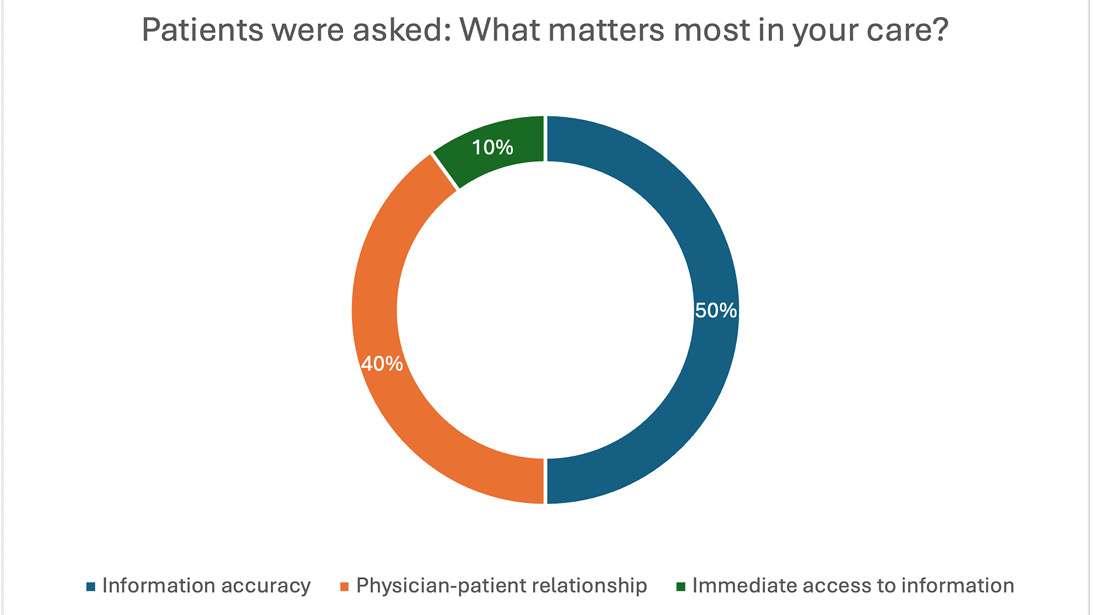
Figure 1. A recent survey of patient attitudes toward AI demonstrated that 50% rated information accuracy as the highest priority, closely followed by a personal relationship with the provider at 40%. Only 10% rated immediate access to information as the most important.
Source: Brutti JA, Greer K, Grand ZA, Lawrie CM. Alexa, can I talk to my surgeon? Patient attitudes toward artificial intelligence agents for arthroplasty care. Poster P140. Presented at the American Academy of Orthopaedic Surgeons Annual Meeting; March 2-6, 2026; New Orleans, LA.
According to Dr. Lawrie, recent studies have demonstrated strong performance by large language models when answering patient questions.
“There have been several papers recently ... looking at the accuracy of platforms like ChatGPT, Gemini, [and] Claude AI in answering patient questions,” he said. “The accuracy in those papers has actually been quite good.” He noted that some studies have found chatbot responses to be more than 90% accurate when compared with surgeon responses.
What remained less clear, however, was whether patients were comfortable using those tools in their perioperative care after hip and knee arthroplasty.
What arthroplasty patients said
The study focused on an arthroplasty population with an average age of 66 years. Most participants had at least a high school education, more than half had education beyond college, and approximately one-third had previously used AI tools.
Researchers surveyed 100 patients using a 13-question questionnaire to better understand attitudes toward AI-assisted care.
The results suggest that patients are not opposed to technology, but they remain strongly attached to the physician-patient relationship.
“What we really found was that patients, on the whole, weren’t willing to have these tools substitute for the personal care of the physician or the physician’s team,” Dr. Lawrie said.
When asked what mattered most in their care, patients prioritized accuracy and personal relationship with the provider over convenience.
“The number one [factor] was the accuracy of the information,” Dr. Lawrie said, noting that 50% of patients rated accuracy as their highest priority (Figure 1).
The second most important factor was the personal relationship with the provider, selected by 40% of respondents.
By contrast, only 10% of patients identified immediate access to information as the most important consideration.
For practices evaluating AI-powered communication tools, that finding may be particularly noteworthy. Although AI is often promoted for its ability to provide answers instantly, patients in this study appeared willing to trade speed for confidence in the information and connection with their care team.
“Patients now are still willing to wait on that callback,” Dr. Lawrie said. “They’re still willing to have extra time elapse between when they call the office and when the surgeon gets ahold of them to answer their question” rather than relying exclusively on an AI chatbot available around the clock.
Looking ahead
While patients may not yet view AI agents as a replacement for physician interactions, Dr. Lawrie believes financial and operational pressures could make these technologies increasingly important.
“We’re all experiencing the squeeze from payers, especially small private practices,” he said. “Reimbursements are going down; the cost of staff is going up.”
As a result, AI-based tools may eventually become necessary to help practices manage patient communication and maintain access, particularly in resource-constrained environments. “I think at some point these sorts of tools are going to become absolutely necessary to survive, [particularly] in private practice,” he said.
Still, Dr. Lawrie believes patient education will be critical to adoption.
“The big takeaway of this study isn’t that patients are unwilling to use these tools,” he said, “but maybe that patients don’t really fully understand what these tools are.”
He suggested that greater transparency regarding how AI tools function and the accuracy of their responses could increase patient comfort. He also raised the possibility of developing AI systems that feel more personalized and empathetic to patients.
“I think these types of tools are going to become more commonplace and really play a pivotal role in the care we deliver moving forward,” Dr. Lawrie said.
Preserving the human element
When Dr. Schaefer asked whether future AI systems might become more human-like through avatars or surgeon-specific digital assistants, Dr. Lawrie emphasized that he does not envision technology replacing physicians.
“I don’t think we’re at a point in time right now ... when we’re willing to let AI robots provide all of our healthcare,” he said. “I certainly don’t want that right now.”
Instead, he sees AI as a potential tool for extending care while preserving the qualities patients value most.
“I think we all still want the human touch of care in our lives,” Dr. Lawrie said.
The opportunity, he added, may lie in using AI to expand capacity while maintaining a personalized experience.
“I do think there’s a real opportunity with the pace that this technology is advancing ... allowing us to take care of more patients at scale but also providing them the same high level of care that we would expect us and our staff to provide them.”
For orthopaedic surgeons, the findings suggest that successful AI implementation may depend less on immediacy and more on trust. Patients appear open to innovation, but they are not yet ready to trade accuracy and personal connection for convenience alone.
Theresa Witham is managing editor of AAOS Now.
References
- Brutti JA, Greer K, Grand ZA, Lawrie CM. Alexa, can I talk to my surgeon? Patient attitudes toward artificial intelligence agents for arthroplasty care. Poster P140. Presented at the American Academy of Orthopaedic Surgeons Annual Meeting; March 2-6, 2026; New Orleans, LA.