

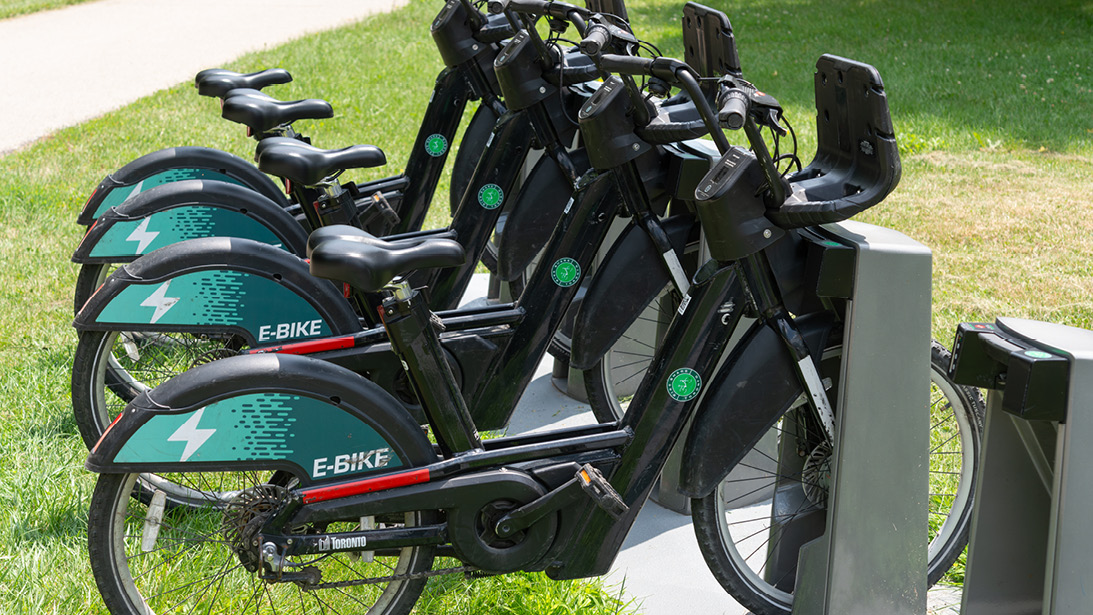
Docked e-bikes reflect the rapid growth of powered cycling — bringing new mobility options alongside emerging orthopaedic injury risks.
Published 7/28/2026
|
Sean A. Tabaie, MD, MBA, FAAOS; Rami Rajoub, BS
At a Glance
- E-bikes are changing the trauma landscape.
- Head and upper-extremity injuries predominate.
- Patient counseling and safety policy matter.
Estimated read time: 5 minutes
U.S. e-bike imports topped 1.1 million in 2022, up from 437,000 just two years earlier, and that trajectory has continued. Not surprisingly, the explosion of e-bike sales has led to an increase in injuries, but what’s arriving in trauma bays is not quite what doctors have seen from conventional cycling. The injury profile looks superficially similar, but the kinetic energy is higher and the patients sustaining these injuries tend to be older and less physiologically equipped to handle the consequences.
Epidemiology
Fernandez and colleagues, using National Electronic Injury Surveillance System data, documented a 30-fold rise in e-bicycle injuries between 2017 and 2022 and a 43-fold increase in e-bike hospitalizations over the same period. A companion analysis found that e-bicycle injuries increased nearly 100% annually and hospitalization rates were higher among e-bike riders than conventional cyclists, consistent with higher-energy mechanisms. Looking specifically at fractures, Namiri and colleagues found a 2,371% increase in e-bike-related fractures presenting to U.S. emergency departments between 2019 and 2023, with a 3,146% increase in associated admissions.
The injury mechanism is not complicated. E-bikes weigh 20 to 30 pounds more than standard bicycles. Class 2 and Class 3 models (Figure 1) reach 20 to 28 mph, and they are frequently ridden by people whose cycling experience was acquired at considerably lower speeds. Falls generate energy profiles closer to low-speed motor vehicle incidents than to the recreational cycling mishaps that shaped clinical intuitions. A persistent problem in the domestic literature is that many e-bike crashes are still logged under general bicycle injury codes, which means the magnitude of the problem is underreported and understated.
Docked e-bikes reflect the rapid growth of powered cycling — bringing new mobility options alongside emerging orthopaedic injury risks.
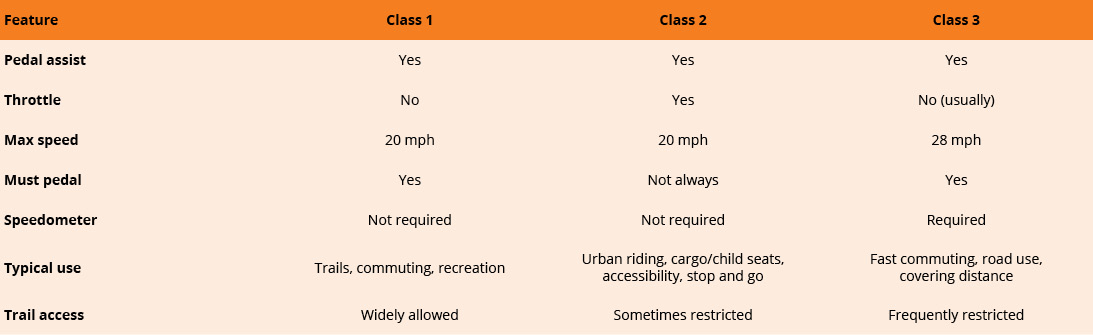
Table 1: E-bikes explained
Fracture patterns
The fracture distribution in e-bike trauma follows from the injury mechanism. The outstretched upper extremity takes the initial impact; distal radius fractures, scaphoid injuries, radial head fractures, and clavicle fractures are the consistent findings. Namiri and colleagues found that most e-bike fractures occurred above the waist, though lower-extremity injuries disproportionately drove admission. Anderson and colleagues, reviewing trauma activations at a Level I center, found that e-bike patients were significantly more likely than conventional cyclists to sustain traumatic brain injury (TBI), intracranial hemorrhage, and head/face fractures. That pattern — upper extremity fractures combined with a meaningful rate of concurrent TBI — has direct implications for surgical planning. The surgeon addressing the clavicle or distal radius needs to know whether there is also a closed head injury driving the functional prognosis.
The broader data set from Schepers et al., analyzing Dutch registry data, found e-bike riders had higher rates of serious injury than conventional cyclists, with head and upper extremity injuries predominating. These findings are consistent with what is now emerging in U.S. trauma registries.
Older rider demographics and comorbidities
Pedal-assist technology has genuinely returned older adults to cycling, and that is not a bad outcome. The problem is what happens when recreation results in injury. These patients arrive with osteoporosis, anticoagulation for atrial fibrillation, impaired proprioception, and slowed reaction times. Hamzani and colleagues found that riders with preexisting comorbidities had substantially higher hospitalization rates following e-bike and powered scooter injuries than those without — nearly double in their series. Any one of those factors complicates fracture management; together, they define a geriatric trauma patient whose tolerance for anesthesia, capacity for weight-bearing restriction compliance, and recovery of functional independence cannot be assumed. The clinical workup and perioperative planning for a 72-year-old on a blood thinner who went over the handlebars at 25 mph is not the same as for a 35-year-old who came off a road bike.
---
Related Content
- The next device is coming, and so are the fractures: What hoverboards and e-scooters should have taught us about the next consumer mobility device (AAOS Now)
- The Hidden Dangers of E-Bikes: Orthopaedic Surgeons Warn of Rising Injury Risks for Riders of All Ages (AAOS Newsroom)
- Bicycle Safety (OrthoInfo)
---
A pediatric perspective
Children and adolescents represent a growing portion of e-bike users and present their own distinct considerations. Supracondylar humerus fractures occurring at e-bike speeds present with greater displacement and more frequent neurovascular compromise than those seen after conventional bicycle falls. Physeal fractures of the distal radius sustained at higher velocities carry a greater risk for growth disturbance. Namiri et al. found that wrist fractures were the most common fracture location in riders younger than 18, accounting for the largest age-specific share of the e-bike fracture burden.
Most states impose no minimum age requirement for e-bike operation. Class 3 models are legally accessible to children who have not yet developed the reaction time or spatial judgment to manage unexpected deceleration approaching 30 mph. An underappreciated related issue is the pediatric passenger: E-cargo bikes now routinely carry children in front buckets or rear seats at speeds conventional cargo bikes rarely reach, yet passenger safety standards for these configurations remain underdeveloped.
Helmet use and standards
Helmet use rates among e-bike riders are consistently lower than among conventional cyclists in published surveys. Sethi and colleagues demonstrated clearly that helmets are highly protective against TBI in bicycle trauma. Their prospective study at a Level I center found dramatically reduced TBI rates in helmeted riders. The problem is that current Consumer Product Safety Commission certification standards were developed around conventional cycling speeds, not the 28 mph that Class 3 e-bikes routinely achieve. Olivier and colleagues found that mandatory helmet legislation was associated with a 46% immediate reduction in cycling fatalities following enactment in Australia, evidence that policy intervention works. Whether helmet standards adequate for 28 mph performance require a separate certification pathway, closer to moped or light motorcycle standards, is a question the federal safety apparatus has not yet engaged with seriously.
Policy and infrastructure
The federal three-class e-bike framework provides structure, but state implementation varies widely and enforcement is limited. Bike infrastructure designed for 12 to 15 mph now routinely accommodates e-bikes at twice that speed, in the same lanes as pedestrians and conventional cyclists. Fishman and Cherry’s review of a decade of e-bike research identified meaningful differences in injury rates between jurisdictions with separated cycling infrastructure and those with mixed-use environments, a finding that could influence how cities build and regulate this space.
Conclusion
The orthopaedic injury burden from e-bikes is real, measurable, and growing across both adult and pediatric populations. The surveillance gap is also real; the documented injury trends almost certainly undercount what is occurring. While institutional advocacy from groups like the AAOS is crucial, immediate solutions rest with the individual surgeon through direct clinic-based patient risk counseling that explicitly frames e-bike kinetics as closer to mopeds than traditional bicycles. Furthermore, the legislative landscape is shifting rapidly; while California utilizes localized multi-agency advocacy, states like New Jersey have pioneered highly aggressive regulations, mandating licensing, registration, and liability insurance for higher-powered models. Incorporating orthopaedic data into these emerging state frameworks, advocating for universal helmet laws, and supporting infrastructure designed for mixed-speed traffic are all areas where orthopaedic input is relevant and urgently needed.
Sean A. Tabaie, MD, MBA, FAAOS, is an orthopaedic surgeon at Nationwide Children’s Hospital/ The Ohio State University and serves as Member-at-Large on the AAOS Board of Directors.
Rami Rajoub, BS, is a fourth-year medical student at the Icahn School of Medicine at Mount Sinai and current research fellow in the Department of Orthopaedic Surgery at Nationwide Children’s Hospital.
References
- Fernandez AM, Li KD, Patel HV, et al. Electric bicycle injuries and hospitalizations. JAMA Surg. 2024;159(5):586–588.
- Fernandez AN, Li KD, Patel HV, et al. Injuries with electric vs conventional scooters and bicycles. JAMA Netw Open. 2024;7(7):e2424131.
- Namiri NK, Locke AR, Koehne NH, et al. The rapid escalation of fractures and hospital admissions from electric bicycle injuries in the United States: an analysis of national injury data from 2019 to 2023. J Orthop Trauma. 2025;39(5):269–274.
- Anderson A, McLellan M, Tedesco A, et al. Comparison of characteristics, injury patterns, and orthopaedic injuries between electric bicycle, pedal bicycle, electric scooters, and motorcycle accidents at a level 1 trauma center. JAAOS Glob Res Rev. 2025. doi:10.5435/JAAOSGlobal-D-25-00099.
- Schepers JP, Fishman E, den Hertog P, Klein Wolt K, Schwab AL. The safety of electrically assisted bicycles compared to classic bicycles. Accid Anal Prev. 2014;73:174–180.
- Hamzani Y, Demetriou H, Zelnik A, et al. Impact of comorbidities on hospitalization for injuries in riders of electric bikes and powered scooters. Medicina. 2022;58(5):659.
- Sethi M, Heidenberg J, Wall SP, et al. Bicycle helmets are highly protective against traumatic brain injury within a dense urban setting. Injury. 2015;46(12):2483–2490.
- Olivier J, Boufous S, Grzebieta R. The impact of bicycle helmet legislation on cycling fatalities in Australia. Int J Epidemiol. 2019;48(4):1197–1203.
- Fishman E, Cherry C. E-bikes in the mainstream: reviewing a decade of research. Transport Reviews. 2016;36(1):72–91.