

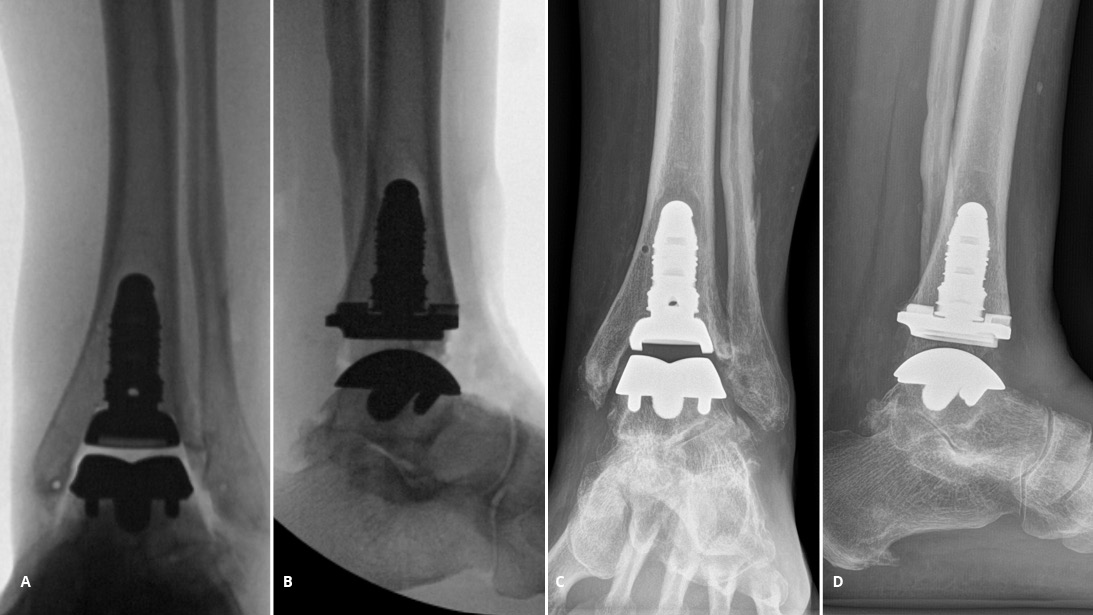
Figure 1.Total ankle arthroplasty (TAA) performed for end-stage ankle osteoarthritis. (A,B) Intraoperative fluoroscopic images demonstrating implant positioning during surgery. (C,D) Postoperative weight-bearing anteroposterior and lateral radiographs demonstrating the final reconstruction. TAA is among the surgical treatment options discussed in the new AAOS Clinical Practice Guideline for the Management of Ankle Osteoarthritis. Images
courtesy of Jeannie Huh, MD, FAAOS
Published 7/28/2026
At a Glance
- The AAOS Board approved a new Clinical Practice Guideline for ankle osteoarthritis and a new Appropriate Use Criteria document for rotator cuff pathology.
- The ankle osteoarthritis guideline recommends against intra-articular hyaluronic acid without concomitant corticosteroid and platelet-rich plasma injections because of limited demonstrated benefit.
- Additional actions included updates to two opioid stewardship information statements and endorsement of an external guideline on osteonecrosis of the femoral head.
Estimated read time: 4 minutes
During its June meeting, the AAOS Board of Directors approved a new Clinical Practice Guideline (CPG) for the Management of Ankle Osteoarthritis, new Appropriate Use Criteria (AUC) for the Management of Rotator Cuff Pathology, and updates to two AAOS Information Statements. Additionally, the Board approved endorsement of the Association Research Circulation Osseous (ARCO) Clinical Practice Guideline for the Management of Nontraumatic Osteonecrosis of the Femoral Head (ONFH).
Clinical Practice Guideline for the Management of Ankle Osteoarthritis
This CPG addresses a topic not previously covered by AAOS. Due to limited available evidence, the guideline includes only two evidence-based recommendations:
The first is a strong recommendation against the use of intra-articular hyaluronic acid alone for the treatment of symptomatic ankle osteoarthritis, due to a lack of demonstrated effectiveness.
However, when combined with a corticosteroid injection, it may provide short-term improvements in pain and function.
The guideline also includes a moderate recommendation against the use of intra-articular platelet-rich plasma (PRP) for the treatment of ankle osteoarthritis, as current evidence shows no benefit compared to placebo.
In addition, the guideline includes 11 consensus options and one limited-strength option developed in areas with minimal or no evidence.
The sole limited-strength option suggests that patients with mild to moderate symptomatic ankle osteoarthritis who wish to avoid surgical intervention may experience improvements in satisfaction, pain, and overall perceived outcomes through both group education and exercise programs, including home exercise.
---
Related Content
- Management of Rotator Cuff Injuries Clinical Practice Guideline (AAOS CPG)
- Clinical Practice Guidelines and Appropriate Use Criteria (AAOS CPG and AUC)
---
This guideline also produced 11 consensus options. These include:
- Intra-articular corticosteroid injections may provide short-term symptom relief.
- There is no reliable evidence supporting the use of intra-articular stem cell therapy for ankle osteoarthritis.
- Patients with mild to moderate symptomatic ankle osteoarthritis who wish to avoid surgery may benefit from skilled physical therapy. However, for patients who are undergoing surgical interventions, postoperative physical therapy may improve range of motion, return to work or activity, strength, and gait restoration.
- Prescription opioids should not be used for the management of ankle osteoarthritis, while NSAIDs and/or acetaminophen may provide symptomatic relief.
- Durable medical equipment and weight reduction may improve patient-reported outcomes.
For patients who have failed nonoperative care and desire joint preservation, the following surgical options may be considered:
- arthroscopic debridement;
- periarticular realignment osteotomy; and
- ankle arthrodesis or total ankle arthroplasty (TAA) (Figure 1).
Additionally, in patients with end-stage ankle osteoarthritis undergoing TAA, tranexamic acid may reduce blood loss and complications while improving patient-reported outcomes.Representatives from the American Orthopaedic Foot & Ankle Society and the American Physical Therapy Association assisted AAOS in the development of this guideline.
Please visit OrthoGuidelines to view the new CPG.
Appropriate Use Criteria for the Management of Rotator Cuff Pathology
Following approval of the updated 2025 CPG for the Management of Rotator Cuff Injuries, a new AUC was developed to reflect the revised evidence base. This AUC focuses on the appropriateness of management options for symptomatic full-thickness rotator cuff tears.
This AUC does not cover:
- rotator cuff retears or history of previous rotator cuff repair;
- partial-thickness tears or rotator cuff tendinitis/rotator cuff bursitis; and
- secondary diagnoses that the surgeon determines are more likely to be the relevant pathology creating pain, such as:
- glenohumeral arthrosis;
- calcific tendinitis;
- plexopathy, radiculopathy, or muscle weakness from SSN nerve compression; and
- isolated clinically symptomatic AC joint arthritis.
Indications for this AUC are:
- tear size;
- presentation;
- symptom severity;
- identifiable factors that negatively affect healing or outcomes;
- atrophy/fatty infiltration; and
- response to previous treatment.
Additionally, potential appropriate treatment options based on the indication profile are:
- physical therapy (formal or supervised home-based) with or without a single corticosteroid injection;
- repair;
- repair with graft or biologic scaffold;
- partial repair (with or without biceps anterior cable reconstruction, tenotomy, tenodesis, or debridement);
- reconstructive procedures, with or without repair, including balloon interposition, tuberoplasty, and tendon transfer; and
- arthroplasty.
Representatives from the Arthroscopy Association of North America, the American College of Sports Medicine, the American Shoulder and Elbow Surgeons, the American Orthopaedic Society for Sports Medicine, the American Academy of Family Physicians, and the American Physical Therapy Association assisted AAOS with the development of this AUC.
Please visit OrthoGuidelines to view this AUC.
AAOS Information Statements
The Board approved updates to two Information Statements:
- Information Statement 1045: Safe and Effective Alleviation of Pain and Optimal Opioid Stewardship; and
- Information Statement 1052: Appropriate Storage and Disposal of Prescription Opioid Medicines.
These updates were developed collaboratively by the Committee on Evidence-Based Quality and Value and the Committee on Healthcare Safety to reflect current best practices related to opioid stewardship, safe storage, and proper disposal.
Please view the updates to these statements here.
AAOS external endorsement approval
The AAOS Board of Directors approved the endorsement of ARCO’s Clinical Practice Guideline for the Management of Nontraumatic Osteonecrosis of the Femoral Head (ONFH).
This guideline addresses the diagnosis and treatment of adult patients with nontraumatic ONFH.