


Published 6/22/2026
In 2023, the American Orthopaedic Society for Sports Medicine (AOSSM) published an open letter signed by 29 organizations, addressing medical liability and expert testimony. Since then, the AAOS Board of Directors has prioritized medical liability reform.
AAOS believes broad reforms are necessary to compensate negligently injured patients promptly and equitably, enhance patient-physician communication, facilitate the improvement of patient safety and quality of care, reduce defensive medicine and wasteful spending, decrease liability costs, and improve patient access to care. The AAOS Office of Government Relations (OGR) leads advocacy efforts for this issue, asserting that the current medical liability system limits physicians’ abilityto provide the highest-quality care.
The AAOS Medical Liability Committee (MLC) leads these reform efforts. The committee’s mission is to develop and prioritize AAOS activities related to medical malpractice. The MLC’s charges include monitoring trends, developing strategies, educating the fellowship, and overseeing the AAOS medical liability reform campaign.
In the years since AOSSM published its open letter, new publications have underscored the liability burden orthopaedic surgeons face — as well as the need for proactive action. Orthopaedic surgeons remain under increased risk of malpractice lawsuits, and certain cases are more likely to result in plaintiff victories or settlements — often for an outsized percentage or likelihood.
For example, the 2025 article “Medical Malpractice Litigation in Orthopaedic Surgery in the United States: Risk Factors, Outcomes, and Strategies for Navigating Lawsuits, Prevention, and Reform,” published in The Journal of Bone and Joint Surgery, highlighted that orthopaedics remains one of the most litigated specialties. The article provides physicians with tools and strategies to lower the risk.
The article “Analysis of Reasons for Medical Malpractice Litigation Following Arthroscopic Surgery” from the Journal of the AAOS® examined legal claims around the word arthroscopic in two large medical legal databases to identify trends in physician malpractice claims related to arthroscopy.
The study found the “most common reasons for litigation [in order of commonality] were perioperative complications, delayed or denied treatment, poor postoperative management, inadequate informed consent, contraindicated procedure, and gross negligence.”
Researchers noted that more than 90% of the cases involved surgery focused on the knee or shoulder, with the majority of malpractice claims following arthroscopy. Cases involving the shoulder were significantly more likely to result in a plaintiff verdict or settlement compared to cases involving the knee. Also, 71.8% of cases ruled in favor of the defendant, while 9.8% resulted in an out-of-court settlement.
Legislative approach
AAOS supports federal and state-level legislative and advocacy solutions to reform the medical liability system. Many state legislatures have been working on medical liability legislation, and these efforts will serve as the basis for future legislation and advocacy in other states and potentially at the federal level as well.
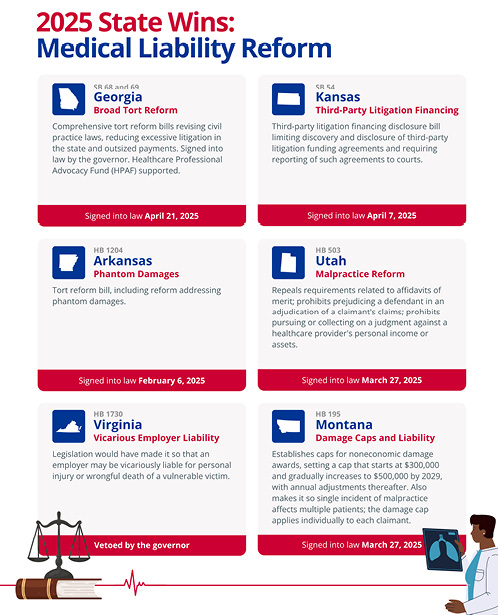
In 2025, there were various defensive legislative efforts and advocacy focused on caps on damages, certificate of merit, expert witness reform, phantom damages, and collateral source reform. Through the Board of Councilors State Legislative and Regulatory Issue (SLRI) Committee, AAOS supported advocacy and lobbying efforts for medical liability reform efforts, securing wins in Georgia in 2025 and New Mexico in 2026.
The Georgia Orthopaedic Society successfully advocated for the passage of two Senate bills implementing broad tort reform by revising civil practice laws, reducing excessive litigation in the state, and stopping outsized payments. These tort reform bills served as a landmark moment in 2025 for medical liability reform and a major victory for the Healthcare Professional Advocacy Fund, administered by SLRI.
Already this year, the New Mexico Orthopaedic Society used grant funding to secure a victory for its campaign to address the adversarial medical liability landscape in the state. Priority issues for the organization included frequent use of punitive damages to force early settlements by plaintiffs, low thresholds for pleading punitive damages, caps on punitive damages, ambiguity in defining “occurrence” and stacking of claims, and lump sum payments from the Patient Compensation Fund.
As a result of the lobbying campaign, House Bill 99 passed without significant changes and was signed into law on March 8. The bill achieved more than 90% of the orthopaedic society’s goals thanks to efforts from the New Mexico Orthopaedic Society, which contributed funds, participated in media and email campaigns, provided testimonies, and engaged with legislators.
“Orthopaedic surgeons nationwide are working under medical liability systems that serve as barriers between them and the patients they serve,” said AAOS President Wilford K. Gibson, MD, FAAOS. “Across the country, we are seeing both the consequences of inaction and the promise of meaningful reform. Advancements in medical liability reform illustrate the power of standing up, speaking out, and getting involved at the state and local level. As surgeons, we have the opportunity to directly shape the policies that impact our practices, our patients, and the future of surgery in our communities.”
AAOS will continue to advocate in favor of legislation to improve the medical liability landscape at the state and federal levels. If interested in getting involved with these efforts, please contact Lori Shoaf, JD, MA, vice president of OGR, at shoaf@aaos.org.