

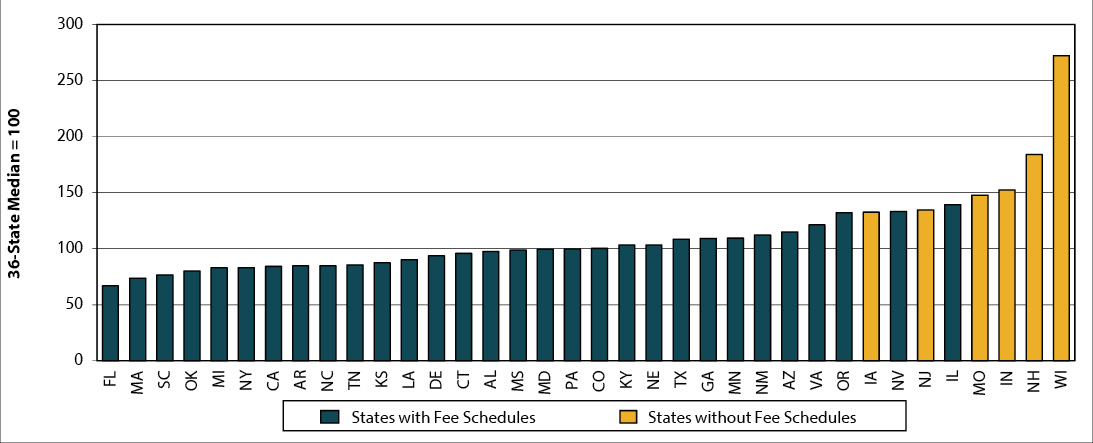
Figure 1: Interstate Comparison of Prices Paid for Professional Services, WCRI MPI-WC in 36 states, 2024*
* The 2024 numbers are preliminary results based on half-year data through June 30, 2024. Note that the half-year data likely provide a reasonable approximation for interstate ranking across states in 2024, based on results for earlier years from the prior editions of this study.
This study focuses on prices paid for professional services that are billed by physicians, physical therapists/occupational therapists, and chiropractors. Services billed by hospitals or ambulatory surgery centers and services billed for durable medical equipment as well as pharmaceuticals are excluded.
AZ, CO, MD, MO, NY, OK, OR: The data for each of these states are not necessarily representative because each state is missing data from a larger data source that is significant in that state. The results in AZ, CO, MD, NY, OK, and OR are unlikely to be significantly under- or overestimated, given that these states use fee schedules to regulate the payment for professional services, and it is unlikely that the prices paid for the missing data source in each state were materially different from other data sources included in this study from the same state. For MO, to the extent that prices paid may differ for the missing data source compared with other data sources in the state, this may lead to possible under- or overestimated in the results.
IA, IN, MO, NH, NJ, WI: These states had no workers’ compensation fee schedule for professional services in 2023 or 2024.
CT, KY, MN, OK: These states had fee schedule changes or updates within 2024 but after June 30, 2024, that are not reflected in the results.
* The 2024 numbers are preliminary results based on half-year data through June 30, 2024. Note that the half-year data likely provide a reasonable approximation for interstate ranking across states in 2024, based on results for earlier years from the prior editions of this study.
This study focuses on prices paid for professional services that are billed by physicians, physical therapists/occupational therapists, and chiropractors. Services billed by hospitals or ambulatory surgery centers and services billed for durable medical equipment as well as pharmaceuticals are excluded.
AZ, CO, MD, MO, NY, OK, OR: The data for each of these states are not necessarily representative because each state is missing data from a larger data source that is significant in that state. The results in AZ, CO, MD, NY, OK, and OR are unlikely to be significantly under- or overestimated, given that these states use fee schedules to regulate the payment for professional services, and it is unlikely that the prices paid for the missing data source in each state were materially different from other data sources included in this study from the same state. For MO, to the extent that prices paid may differ for the missing data source compared with other data sources in the state, this may lead to possible under- or overestimated in the results.
IA, IN, MO, NH, NJ, WI: These states had no workers’ compensation fee schedule for professional services in 2023 or 2024.
CT, KY, MN, OK: These states had fee schedule changes or updates within 2024 but after June 30, 2024, that are not reflected in the results.
Source: WCRI Medical Price Index for Workers’ Compensation, 17th Edition (MPI-WC)
Published 6/22/2026
|
Fraser Cobbe
Editor's note: To learn more about trends and best practices concerning workers' comp, consider registering for the Workers’ Compensation and Musculoskeletal Injuries Course, scheduled for Nov. 5-7. For more information about the course, read the "Live course tackles workers’ comp cases with precision" article.
The evidence is in, and it is great news all around for business owners, injured workers, and physicians in Florida.
Increases in physician reimbursement for any health plan or program are rare these days. However, news from Tallahassee may signal that with the right ingredients in place, significant investments in improving access to care through increased physician reimbursement can be achieved without any detrimental impact on insurance premiums.
Figure 1: Interstate Comparison of Prices Paid for Professional Services, WCRI MPI-WC in 36 states, 2024*
* The 2024 numbers are preliminary results based on half-year data through June 30, 2024. Note that the half-year data likely provide a reasonable approximation for interstate ranking across states in 2024, based on results for earlier years from the prior editions of this study.
This study focuses on prices paid for professional services that are billed by physicians, physical therapists/occupational therapists, and chiropractors. Services billed by hospitals or ambulatory surgery centers and services billed for durable medical equipment as well as pharmaceuticals are excluded.
AZ, CO, MD, MO, NY, OK, OR: The data for each of these states are not necessarily representative because each state is missing data from a larger data source that is significant in that state. The results in AZ, CO, MD, NY, OK, and OR are unlikely to be significantly under- or overestimated, given that these states use fee schedules to regulate the payment for professional services, and it is unlikely that the prices paid for the missing data source in each state were materially different from other data sources included in this study from the same state. For MO, to the extent that prices paid may differ for the missing data source compared with other data sources in the state, this may lead to possible under- or overestimated in the results.
IA, IN, MO, NH, NJ, WI: These states had no workers’ compensation fee schedule for professional services in 2023 or 2024.
CT, KY, MN, OK: These states had fee schedule changes or updates within 2024 but after June 30, 2024, that are not reflected in the results.
* The 2024 numbers are preliminary results based on half-year data through June 30, 2024. Note that the half-year data likely provide a reasonable approximation for interstate ranking across states in 2024, based on results for earlier years from the prior editions of this study.
This study focuses on prices paid for professional services that are billed by physicians, physical therapists/occupational therapists, and chiropractors. Services billed by hospitals or ambulatory surgery centers and services billed for durable medical equipment as well as pharmaceuticals are excluded.
AZ, CO, MD, MO, NY, OK, OR: The data for each of these states are not necessarily representative because each state is missing data from a larger data source that is significant in that state. The results in AZ, CO, MD, NY, OK, and OR are unlikely to be significantly under- or overestimated, given that these states use fee schedules to regulate the payment for professional services, and it is unlikely that the prices paid for the missing data source in each state were materially different from other data sources included in this study from the same state. For MO, to the extent that prices paid may differ for the missing data source compared with other data sources in the state, this may lead to possible under- or overestimated in the results.
IA, IN, MO, NH, NJ, WI: These states had no workers’ compensation fee schedule for professional services in 2023 or 2024.
CT, KY, MN, OK: These states had fee schedule changes or updates within 2024 but after June 30, 2024, that are not reflected in the results.
Source: WCRI Medical Price Index for Workers’ Compensation, 17th Edition (MPI-WC)
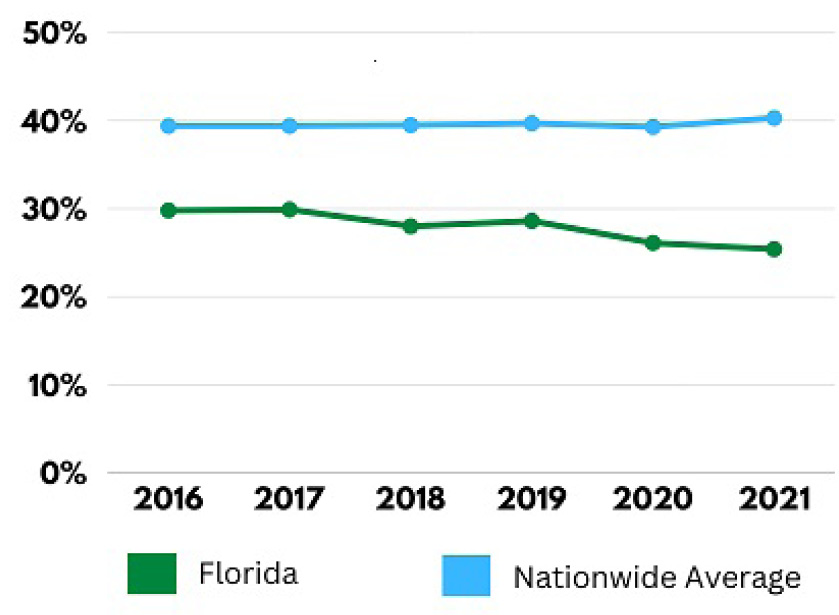
Figure 2: Physician costs as a total of overall workers’ compensation program costs: Florida vs. National Average
Courtesy of Fraser Cobbe using data available from the Florida Division of Workers’ Compensation.

Fraser Cobbe
As documented extensively by the Workers Compensation Research Institute (WCRI), for the past two decades, Florida has had some of the lowest reimbursement rates in the nation for physicians rendering care through the state-regulated workers’ compensation system (Figure 1).
Reimbursement had crept so low that, according to 2021 data from the Florida Division of Workers’ Compensation, physicians accounted for just 25.4% of the distributed medical costs in the system, which was well below the national average of 40%. Furthermore, the percentage attributed to physicians had decreased from 30% to 25% in just five years (Figure 2).
The reality of the situation was summarized by Jason Oberste, MD, with the Tallahassee Orthopaedic Clinic, during testimony provided to the Florida Legislature in 2024. “If one of our Georgia patients sustains a distal radial fracture, I am reimbursed $1,311 up there to fix that fracture. If that was a Florida worker, the fee schedule down here will pay me $602. That disparity exists throughout the services I provide my patients.”
The complexities and litigious nature of the workers’ compensation system, paired with this inadequate reimbursement, have led to a documented drain of physicians willing to treat injured workers.
In data published in 2019 by the National Council on Compensation Insurance (NCCI), the median wait time in days for an injured worker to have an initial appointment with an in-network orthopaedic surgeon was 24 days in Florida, the worst of the 35 states included in the study.
The neighboring states of Alabama and Georgia performed much better in the study, with median wait times of 10 days and 14 days, respectively, for in-network orthopaedic treatment. While a multitude of issues could affect timely referral to a specialist, physician participation levels in the workers’ compensation system were considered as one of the potential factors.
The situation was further highlighted in a 2019 report from the Florida Division of Financial Services, which concluded, “Data from the WCRI, NCCI, and the Division of Workers’ Compensation reflect Florida’s percentage of Medicare rates are at or near financial inadequacy for the purposes of reimbursing physicians for directly treating injured workers.”
Outside of deteriorating access to care for injured workers, however, the workers’ compensation insurance marketplace in Florida was doing extremely well. Annual reports from Florida’s Division of Workers’ Compensation showed a stable and competitive market; coupled with substantial legal reforms enacted by the Florida Legislature, the state was able to lower insurance premiums by almost 80% since 2003.
The Florida Orthopaedic Society and other advocates for addressing the access to care crisis argued this sustained decrease in insurance premiums provided a generational opportunity for the state to fund increases in physician reimbursement without having a detrimental impact on the cost for Florida’s business community.
In 2024, the Florida Legislature passed Senate Bill 362, Medical Treatment under the Workers’ Compensation Law, which took effect Jan. 1, 2025. The bill, supported by the Florida Orthopaedic Society, increased reimbursement relative to Medicare for physician services from 110% to 175%, and the reimbursement relative to Medicare for surgical procedures increased from 140% to 210%.
At the time the bill passed, NCCI, the state-approved cost estimating organization for the Division of Workers’ Compensation, estimated this bill would result in an increase of 5.6% on overall workers’ compensation system costs.
However, according to a recent announcement from Florida Insurance Commissioner Mike Yaworsky, workers’ compensation premiums have not risen — in fact, they decreased again in 2026. Just as importantly, throughout the public hearings and rate filing process, there was no mention of any detrimental impact on insurance premiums due to the significant increase in physician reimbursement.
“I am pleased to approve a substantial rate cut of 6.9% for Florida’s workers’ compensation policies this upcoming year. This rate decrease directly translates to reduced operating costs for businesses, encouraging investment and growth throughout Florida’s economy,” Yaworsky stated on Nov. 17, 2025. “This also marks the ninth consecutive year of rate decreases for workers’ compensation policies — more evidence of Florida’s success in managing risk and maintaining a competitive insurance environment.”
The impact of what is happening in Florida has been noticed by other states lingering at the bottom of the reimbursement scale for physicians treating injured workers.
Legislative efforts already taking place in South Carolina would provide regulators the opportunity to address physician reimbursement in the coming years.
While there is limited documented evidence of an impact on access to care for injured workers in Florida, there is anecdotal evidence, such as this quote from Julio Robla, MD, that the increased reimbursement has elevated enthusiasm within the physician community: “This is the best news we as physicians have had in years and for me, personally, since I started practice in 1994. Thanks to everyone who fought for us!”
Fraser Cobbe is executive director of the Florida Orthopaedic Society and the South Carolina Orthopaedic Association.