

Julie Samora, MD, PhD, MPH, FAAOS, speaks with Stuart Fischer, MD, FAAOS, a member of the AAOS Now Editorial Board.
Published 6/22/2026
|
Theresa Witham
Despite differences in subspecialty focus, orthopaedic surgeons face similar challenges, which is where the Board of Specialty Societies (BOS) comes in, said Julie Samora, MD, PhD, MPH, FAAOS, during a recent interview.
“The goal is to find common ground, and all of us have similar battles, whether it’s getting that MRI approved or getting that insurance company to agree to a surgery that is indicated for your patients and working together as a unit to really succeed as a group,” she said.
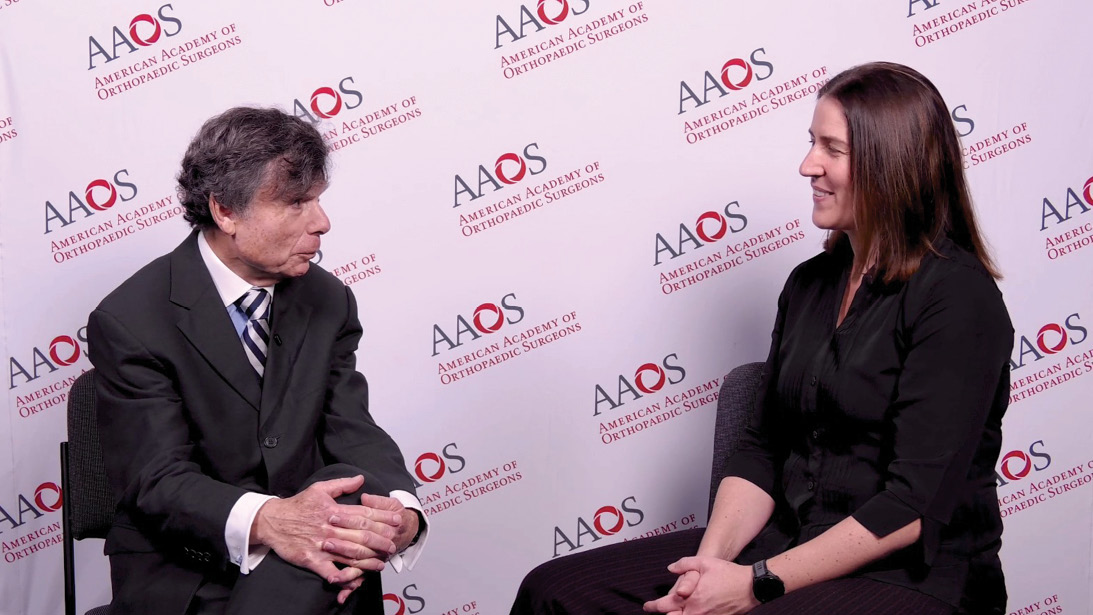
Julie Samora, MD, PhD, MPH, FAAOS, speaks with Stuart Fischer, MD, FAAOS, a member of the AAOS Now Editorial Board.
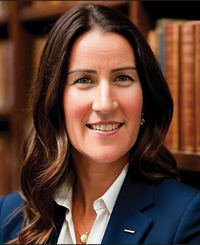
Julie Samora, MD, PhD, MPH, FAAOS
Dr. Samora, chair of the BOS and a member of the AAOS Board of Directors, recently sat down with Stuart Fischer, MD, FAAOS, of the AAOS Now Editorial Board, for a wide-ranging conversation about the role of the BOS, its impact on AAOS members, and its efforts to unite the diverse orthopaedic community.
Dr. Samora began by outlining the structure and purpose of the BOS. She explained the BOS is composed of representatives from 21 specialty societies. Each society has two physician representatives and an executive director, for a total of three members per society. According to Dr. Samora, the primary goal of the BOS is to “increase multidirectional communication between the specialty societies and [AAOS]” while focusing on shared objectives that benefit the broader orthopaedic community.
Dr. Samora traced her involvement with AAOS back to her time as a resident, when she served as a resident member on the former Publications Committee. This early experience introduced her to organized involvement within AAOS and helped shape her long-term engagement. She later participated as a Washington Health Policy Fellow, an experience she described as instrumental in helping her understand advocacy and health policy and its impact on the musculoskeletal environment.
From there, Dr. Samora continued to seek out opportunities to contribute. Over time, she served on the BOS as a representative for both the Ruth Jackson Orthopaedic Society (RJOS) and the Pediatric Orthopaedic Society of North America (POSNA), experiences that ultimately led to her current role as BOS chair. She also served as chair of the Committee on Healthcare Safety and, as part of that, served as a member on the Research and Quality Council. Dr. Samora emphasized her appreciation for AAOS’ mission and expressed enthusiasm for continued service.
Finding common ground across specialties
Dr. Fischer noted that Dr. Samora has represented multiple specialty societies, a role he characterized as somewhat unusual. Dr. Samora responded that with 21 subspecialty societies and other organizations, such as the RJOS and J. Robert Gladden Orthopaedic Society (JRGOS), there are many opportunities for involvement and leadership across the orthopaedic spectrum.
A recurring theme throughout the discussion was unity. The BOS, Dr. Samora said, aims to help specialty societies work together on shared issues to increase collective impact.
Advocacy at the forefront
As a pediatric hand surgeon, Dr. Samora acknowledged her highly specialized clinical focus, joking that she treats “right small fingers in a five-year-old.” Notwithstanding her narrow clinical interest, she stressed that advocacy, education, communication, and patient-centered care are priorities shared by all subspecialists.
“There’s a growing fragmentation in the orthopaedic world between specialists and generalists,” Dr. Fischer countered. “Given that you’re a super specialist, how can you help bring all those groups together?”
“I think that is the purpose of [AAOS],” Dr. Samora responded. “Everyone [who] has a specialty really gravitates toward their specialty society. But the beauty of [AAOS] is that it’s the ... organization that brings everybody together.”
Advocacy featured prominently in the conversation. Dr. Samora confirmed that the BOS works closely with the Office of Government Relations (OGR) and other advocacy arms of AAOS. She cited a recent advocacy success involving the partial restoration of funding for musculoskeletal research. Although research funding had initially been removed from the One Big Beautiful Bill, AAOS advocacy helped reinstate $20 million.
She also referenced ongoing challenges facing orthopaedists, including preauthorization requirements, surprise billing, scope-of-practice issues, and certificate-of-need regulations. These issues, she noted, require continuous advocacy efforts.
Dr. Samora shared her personal experiences participating in AAOS lobbying efforts, including early involvement as a third-year resident walking the halls of Capitol Hill with colleagues. She described these experiences as formative in understanding how advocacy works within organized medicine.
Communication, research, and collaboration
When discussing communication with members, Dr. Samora emphasized the importance of bidirectional dialogue. Having AAOS Fellows represent the specialty societies on the BOS allows AAOS to share information about its initiatives while also learning directly from specialty societies about their needs and priorities. It is helpful to get input from BOS members, she said, to determine “what does the Hand Society need or what does [the American Association of Hip and Knee Surgeons (AAHKS)] need and how can we work together to achieve that goal?”
On the research front, Dr. Samora highlighted a particular BOS initiative: grant funding is made available to BOS member organizations via the BOS Research Support Fund. These grants open each spring; BOS Member Organizations must apply through a special application process to be considered. She cited a recent project that was awarded funding and supported a multicenter prospective study on Patient-Reported Outcome Measure Information System (PROMIS) in sarcoma patients, describing it as “a great opportunity for [AAOS] to promote research and really promote interorganizational collaboration.”
Beyond advocacy and research, she described continuing efforts to strengthen communication among leadership. Meetings between the AAOS leadership and the leaders of individual specialty societies provide structured opportunities to discuss shared goals, challenges, and potential collaborations.
Dr. Samora also noted she actively encourages BOS members to participate in AAOS committees, reinforcing the idea that engagement across organizations strengthens the entire orthopaedic community.
Theresa Witham is managing editor of AAOS Now.