

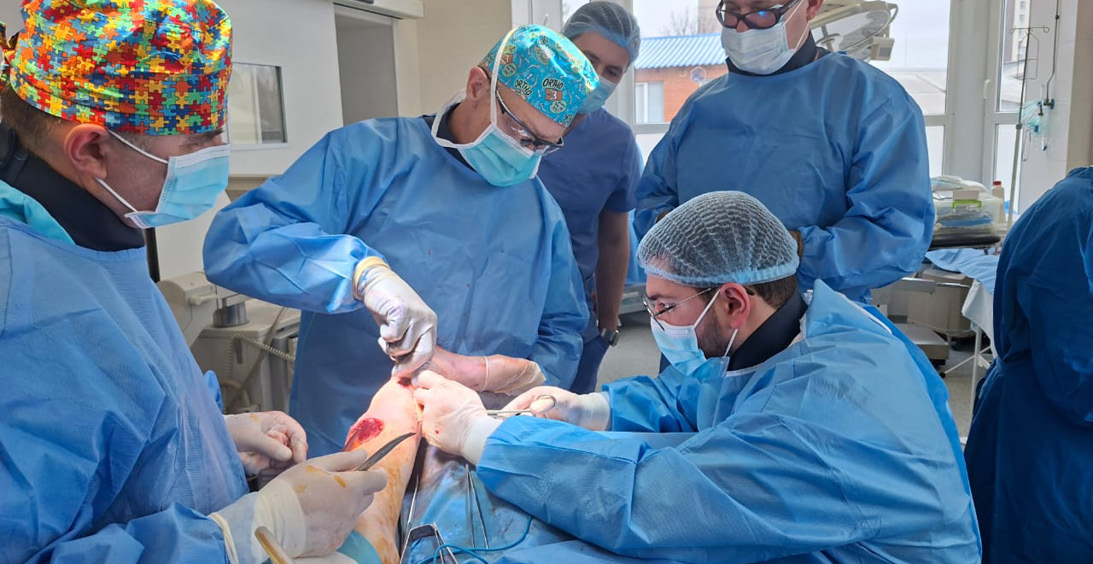
Douglas W. Lundy, MD, MBA, FACS, FAAOS, operates with Ukrainian surgeons.
Courtesy of Douglas W. Lundy, MD, MBA, FACS, FAAOS
Published 3/28/2026
|
Douglas W. Lundy, MD, MBA, FAAOS
Over the past 23 years, I have traveled multiple times into the developing world to help those in resource-challenging places. Samantha Power’s book “A Problem from Hell: America and the Age of Genocide” describes the sociopolitical events from World War II through the Balkan crisis. After my most recent trip, I understand the tribulations of war far more clearly than I ever imagined I would.
I am writing this article on a westbound train leaving Ukraine after serving in the busiest trauma center and a specialized surgical institute only 60 miles from the battlefront on the eastern side of the country. Though I have served on over 30 international mission trips, this experience has been the most dramatically impactful of them all.

DOUGLAS W. LUNDY, MD, MBA, FAAOS
Douglas W. Lundy, MD, MBA, FACS, FAAOS, operates with Ukrainian surgeons.
Courtesy of Douglas W. Lundy, MD, MBA, FACS, FAAOS
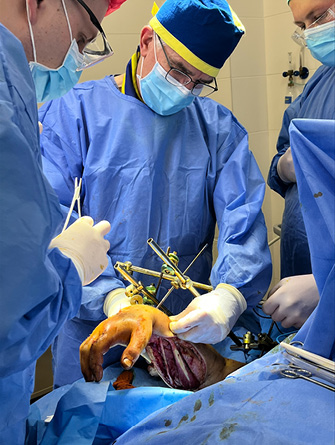
Roman Hayda, MD, FAAOS, explores a severe open forearm fracture.
Courtesy of Douglas W. Lundy, MD, MBA, FACS, FAAOS
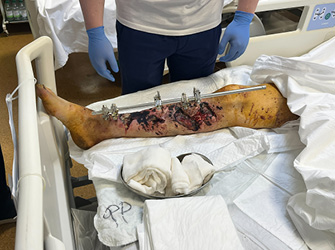
Clinical image of a soldier with a severe open tibial fracture from a mine blast.
Courtesy of Douglas W. Lundy, MD, MBA, FACS, FAAOS
The fourth anniversary of the Russian invasion of Ukraine was commemorated on Feb. 24, and the people of Ukraine have been suffering greatly but resolutely over these years. Though the war seems to have fallen from the American consciousness, the reality of crushing violence and continual threat to security is a grindstone wearing away at the resolve of these amazing people.
Orthopaedic trauma surgeon Roman Hayda, MD, FAAOS, at Brown University, has been coming to Ukraine for a long time. As a first-generation American-born citizen, he grew up speaking Ukrainian in his home and celebrating cultural events. Roman also served as an orthopaedic surgeon in the US Army for over 20 years, and he is no stranger to challenging circumstances. After hearing one of his presentations a year ago, I offered to go with him if he could use my help. He subsequently called me several months ago to inquire if I would like to join him, and after receiving wholehearted support from my wife, I eagerly told him I would come.
As with most of us, the ongoing events in the Russia-Ukraine war no longer held my daily attention. The nongovernmental organization that supported our trip (RAZOM) required that we download two apps to our phone to alert us in case of air attack and help rescuers find us in case of emergency. Within hours of activating the app on my iPhone, the wail of air raid sirens and the messages of “Attack Drones Overhead – Seek Shelter Immediately!” began to alert. This became an almost daily event, and I started to question the wisdom of our endeavor, but we proceeded, nonetheless.
In August 2023, US officials estimated that 70,000 Ukrainian soldiers had been killed and 120,000 had been injured since the war started. More recently, the nonprofit think tank Center for Strategic and International Studies estimated that 100,000 to 140,000 Ukrainian soldiers have been killed and that total Ukrainian military casualties — including killed, wounded, and missing—have reached between 500,000 and 600,000 as of January 2026. In contrast, the United States military has suffered 6,900 deaths in the war on terror (including Iraq and Afghanistan) since 2001.
After flying to Krakow, Poland, we took a 15-hour train ride to Dnipro, Ukraine, which is the largest city near the southern and eastern fronts. We found brave and beleaguered people strong in their resolve to maintain their freedom and independence while simultaneously exhausted from the constant threat of attack. The air attack alarms sounded the very first night we were in Dnipro, declaring that intermediate-range ballistic missiles were inbound to the city. In the dark, I could hear the whine of the missiles and the subsequent explosions as they destroyed a heating facility several miles away. The eeriness of this experience that is so common to the residents of Dnipro is difficult to describe.
Over the ensuing week, we worked alongside the orthopaedic trauma surgeons at the National Surgical Research Institute and Mechnikov Hospital, learning volumes from each other as we faced the never-ending onslaught of soldiers and civilians injured from combat action. Injuries from mine blasts, drone attacks and severe frostbite are as common as hip fractures in US hospitals. Though emotionally drained and physically exhausted from living and working under these conditions, I saw the look of despair and resolve that marked the soldiers’ faces.
Part of the reasonthere are so many combat-related deaths is that medical evacuation from the battlefield is incredibly hazardous due to the constant drone surveillance and often results in more casualties. The high intensity of drone attacks on the battle front makes helicopter medevac essentially impossible, and severely injured soldiers commonly remain in squalid combat conditions for more than a day before they can get to a first-line hospital.
As an orthopaedic surgeon leader in advocacy, I was always able to stay above politics and focus on how policy would help or hinder us from performing our professional work. The issues are so intertwined in this conflict that they cannot be easily separated. A peaceful but fair and sustainable solution must be attained before Ukraine’s greatest resource, its people, are decimated any further. Our surgical friends in Ukraine already have a lifetime of reconstructive orthopaedic work ahead of them, and what they need most is lasting peace.
Douglas W. Lundy, MD, MBA, FACS, FAAOS, is chair of orthopaedic surgery and chief of orthopaedic trauma surgery at St. Luke’s University Health Network, in Bethlehem, Pennsylvania. He is also the deputy editor of AAOS Now.
References
- Schmitt E, Cooper H. Troop deaths and injuries in Ukraine war near 500,000, U.S. officials say. The New York Times. Published August 18, 2023. Accessed March 13, 2026. https://www.nytimes.com/2023/08/18/us/politics/ukraine-russia-war-casualties.html
- Russia’s grinding war in Ukraine: massive losses and tiny gains for a declining power. Published January 27, 2026. Accessed March 16, 2026. https://www.csis.org/analysis/russias-grinding-war-ukraine
- U.S. Department of Defense. U.S. active-duty military deaths by year and manner, 1980–2022. Defense Casualty Analysis System. Published August 2023. Accessed March 13, 2026. https://dcas.dmdc.osd.mil/dcas/app/summaryData/deaths/byYearManner