

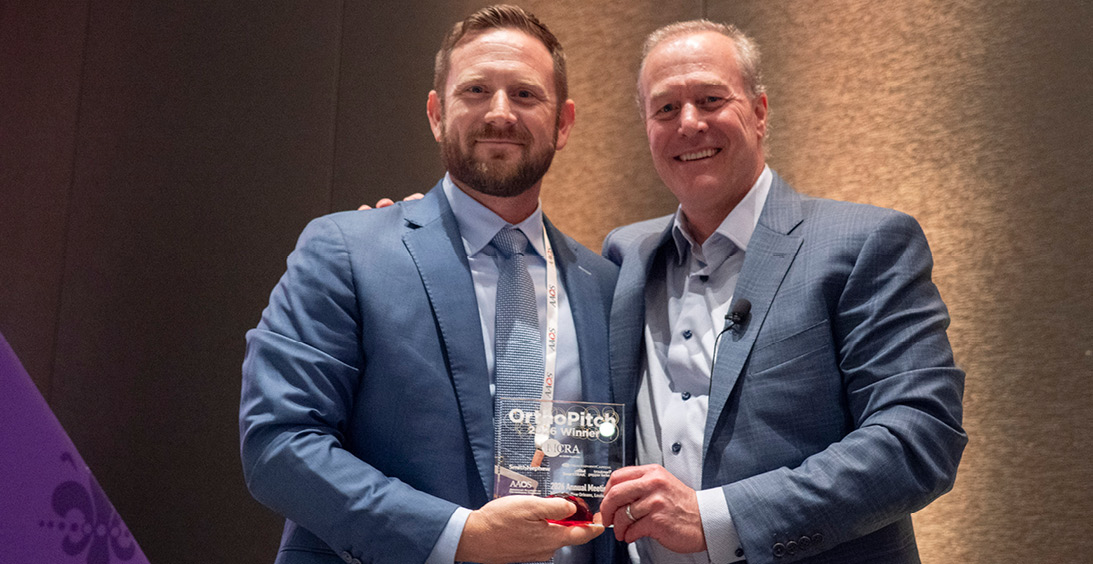
Jason L. Dragoo (right), MD, FAAOS, program emcee and chair of the Committee on Devices, Biologics, and Technology, passes the 2026 AAOS OrthoPitch Competition award to Andrew Morris, chief commercial officer of MY01.
Published 3/30/2026
|
Leah Lawrence
Backed by both the judges’ deliberation and audience votes, MY01 emerged as the winner of the 2026 OrthoPitch competition for its data-driven approach to improving compartment syndrome diagnosis.
OrthoPitch once again drew a packed crowd at the AAOS 2026 Annual Meeting, showcasing innovative technologies with the potential to transform orthopaedic care.
“This competition is always exciting and a lot of fun,” said event emcee Jason L. Dragoo, MD, FAAOS, chair of the AAOS Devices, Biologics and Technology Committee. “This is one of the reasons we go to the Academy, to learn what is new. The technologies being presented tonight are all pretty special.”
Each of the competition’s four finalists—CLARO Surgical, MY01, Sonogen, and StabilityIQ—made it through a rigorous application process that lasted six to eight months.
Live at OrthoPitch, one representative from each company presented a one-minute video about their product and gave a brief, live presentation to the audience before undergoing questioning by a panel of three judges: Mayank Shandil, global senior vice president of recon and robotics at Smith+Nephew; Dave McGurl, former FDA acting branch chief for the Orthopedic Joint Devices branch and current vice president of regulatory affairs at MCRA,; and Daniel Saris, MD, PhD, professor of Orthopedics & Regenerative Medicine at the Mayo Clinic.
CLARO Surgical
First to the stage was Moises Ramos, chief executive officer of CLARO Surgical, presenting its ORTHO-MR technology. ORTHO-MR is the first FDA-registered, AI-powered mixed-reality platform for orthopaedic surgery. Using real-time 3D holographic guidance, the mixed-reality technology is designed to make trauma procedures safer and faster by eliminating the need for intraoperative radiographs during critical locking steps in intramedullary nailing, percutaneous plating, and related procedures.
“A surgeon spends decades mastering techniques relying on fluoroscopy, their gut, and experience,” Ramos said. “We have accepted an excess of radiation as a standard of care. We have created CLARO Surgical to fix the problems we have experienced for decades, to finally deliver a real-time guidance platform for minimally invasive orthopaedic trauma.”
During the judges’ questions, McGurl asked what specifically the AI is doing.
“The AI is digitizing the whole OR in real time, so it can understand the location of the surgeon at all times,” Ramos said. “It recognizes the location of the patient and uses that as a point of reference. Then it tracks everything.”
MY01
The second presenter of the competition was Andrew Morris, chief commercial officer at MY01, who presented the company’s Continuous Perfusion Sensing Technology platform. Powered by a MEMS-based sensor, this platform provides real-time pressure data that is shared across the clinical care team and allows for earlier intervention and better outcomes related to compartment syndrome.
“Compartment syndrome is a completely preventable complication that occurs because of a lack of technology,” Morris said. “Clinicians are put in an impossible situation because they are relying on variable, highly subjective clinical exams.”
MY01 is designed to fill that gap, providing objective data that allows for earlier diagnosis of compartment syndrome, avoiding unnecessary surgery and eliminating catastrophic complications.
Shandil asked Morris about the potential applications for the data collection by this monitoring system.
“We have now captured over 15 million data points in 4,000 patients that we have monitored; we have the largest data set on compartment syndrome ever established,” Morris said. “What we are doing today is giving people five hours earlier to make a diagnosis. Where we are going is, we will be predictive. We are taking this data and putting it into models, and we will give surgeons a simple red, yellow, or green; they can rule it in or out with certainty.”
Sonogen
Next to the stage was Jason Winder, chief executive officer of Sonogen, who presented the company’s portable, radiation-free ultrasound device that can diagnose bone fractures and monitor the fracture healing process. This potentially revolutionary device can help to answer the questions: Is it broken and is it healing?
“X-ray is fantastic technology, but it is expensive, nonportable, requires experts to administer, delivers ionizing radiation, and cannot detect early stages of fracture healing,” Winder said.
Sonogen is a small hand-held device that that can be used anywhere.
Dr. Saris pushed Winder to define the market for the device, diagnosing fractures or tracking healing. “One is point of care, and one is point of injury,” Dr. Saris said.
“For the ‘is it broken’ part of the device, that is the point of injury capability. We are looking to deploy that with sports teams, medic bags, army medic kits,” Winder said. “At the point of ongoing care, it is at-home technology integrated with a bone growth stimulation device or as a standalone device. It is a completely user-friendly technology. No medical training required.”
StabilityIQ
The final presentation detailed start-up StabilityIQ’s Re-Kinesis device, which brings reliable gait and balance testing to the clinic, providing longitudinal, full-leg kinematic data to patients with gait-impacting pathologies without requiring access to a dedicated gait lab.
“The problem is pretty simple: Gait labs are fantastic, but to put it in context, there is one gait lab for NYC’s 8.5 million people,” said presenter Malcolm Hamilton-Hall, MD, an orthopaedic oncology fellow at Johns Hopkins University. “It also costs about $2 million to create a gait lab.”
In contrast, StabilityIQ’s Re-Kinesis device is a gait lab in a shoe. It is the only product that exists with kinematic gait pressure in a simple wearable format. It has 1,024 sensors firing at 1,000 times a second, combined with its patented data analysis program and data control system.
“Is it really that accurate? Yes. Within our first test we were within two degrees of the gait analysis system,” Dr. Hamilton-Hall said.
Winner
After the presentations, the judges deliberated and audience members used a QR code to enter their votes. The winner of AAOS’ 2026 OrthoPitch competition was MY01.
“MY01 has a very innovative device that does continuous pressure monitoring using real-time data and an AI-based algorithm to predict and help the decision-making process around compartment syndrome,” Dr. Saris told AAOS Now. “Compartment syndrome is currently in the public eye because of Lindsey Vonn’s accident at the Olympics. The idea of having a continuous pressure measurement device to help clinical management in acute patient care is very impressive, and I look forward to the progress they make in the future.”
Among the prizes for the winner were exposure to top seed and early-stage investors, physicians, strategists, and fellow industry members, a complimentary booth at the 2027 AAOS Annual Meeting, a one-year SmartTRAK subscription, and more.
Leah Lawrence is a freelance medical writer for AAOS Now.