

Published 5/28/2026
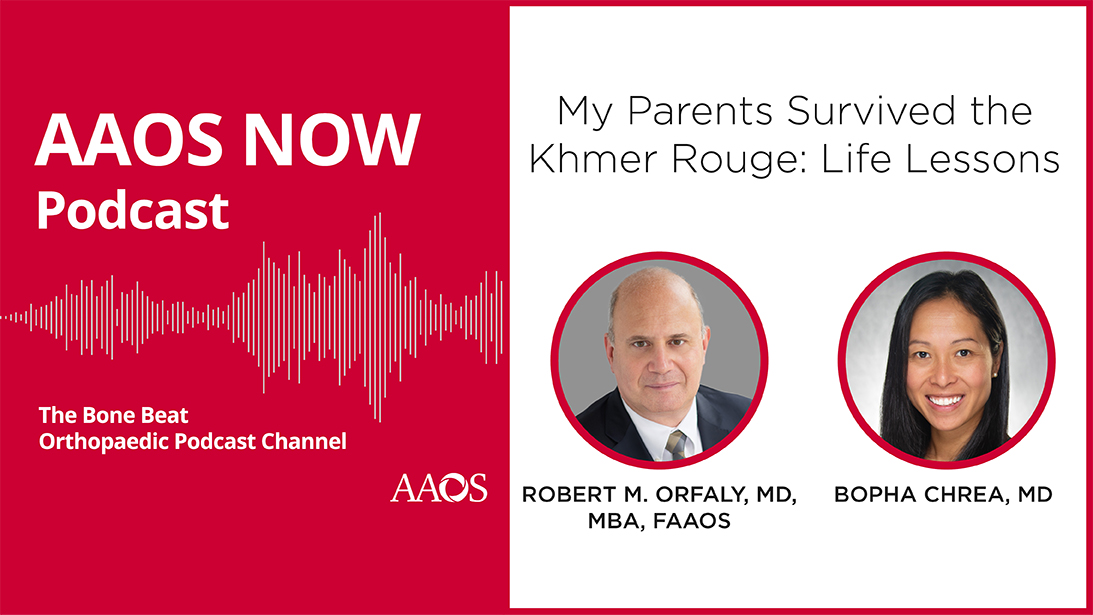
In a recent episode of the AAOS Now Podcast, Robert M. Orfaly, MD, MBA, FAAOS, invited Bopha Chrea, MD, assistant professor of orthopaedics and rehabilitation in the Carver College of Medicine at the University of Iowa, to share the haunting and inspiring family history that has profoundly shaped her perspectives on life and career.
Dr. Chrea recounted her parents’ survival of the Khmer Rouge regime in Cambodia during the 1970s. She described the profound losses her parents endured before eventually escaping the horrific Killing Fields, seeking refuge in Thailand and eventually emigrating to Canada.
Incredibly, Dr. Chrea said, what initially appeared to be misfortunes, such as the loss of her father’s glasses and her family’s possessions, ultimately helped them survive by making them appear uneducated and impoverished to a brutal regime that targeted intellectuals. Her reflection that “sometimes opportunities are disguised as misfortune” served as a theme for the episode.
Becoming comfortable with discomfort
Dr. Orfaly then asked Dr. Chrea to relate some of the key lessons she learned from her family’s journey to the practice of orthopaedics.
Dr. Chrea described the extraordinary risk her parents took in fleeing Cambodia with young children. They were repeatedly forced to navigate uncertainty, with no clear endpoint or guarantee of safety.
Residency training, she said, similarly requires doctors to endure prolonged uncertainty and discomfort while trusting in their ability to reach the end goal. She recalled advice she received from a chief resident early in her training when she questioned her adequacy as a surgeon. Their response was simple and resolute: “I’m going to be good. I’m going to make myself good.”
Dr. Chrea emphasized that maintaining clarity of vision matters more than knowing every detail of the path forward, noting growth inherently requires being comfortable with discomfort.
Guiding others and practicing gratitude
The conversation then shifted to mentorship and reflection. Dr. Chrea explained that when she worked as a mentor, she tailored her guidance to the individual’s needs. Some of her mentees required structured, tangible goals, while others benefited more from open-ended reflection and guided questioning. She underscored that progress often occurs through small, incremental achievements that build confidence over time rather than big leaps forward.
Practicing gratitude
Reflecting on her own career, Dr. Chrea said her parents’ sacrifices fostered deep gratitude in her daily life, which has shaped the mindset she has today.
She stated that “gratitude is a superpower” because it reframes adversity as opportunity. She shared her belief gratitude is one of the few aspects of life that remains fully controllable, even in the worst circumstances, and noted perspective can be intentionally cultivated. And she revealed gratitude has helped her navigate difficult professional periods, including residency and early practice.
While challenging moments are unavoidable, and it is normal to feel frustration or discouragement, Dr. Chrea emphasized the importance of consciously reframing those moments as opportunities to “develop a muscle I didn’t have before.” Intentional reflection and recognizing collective support, she said, reinforce resilience and purpose.
Dr. Chrea concluded the episode by crediting the many individuals who helped her during her journey and expressed a commitment to helping others. She closed the discussion with the powerful message that when met with gratitude and intention, adversity can become a force for growth rather than an obstacle.
Listen to the episode — and subscribe to catch future episodes of the AAOS Now Podcast, offering expert insights to help orthopaedic surgeons stay informed, enhance their practices, and provide the best possible care for their patients.