


Danny P. Goel, MD, MBS, MSc, FRCSC, clinical professor at the University of British Columbia Department of Orthopaedic Surgery, speaks at the AAOS/FDA Town Hall Symposium.
Published 5/28/2026
|
Jennifer Lefkowitz
Augmented reality (AR), virtual reality (VR), and robotics are rapidly transforming the way we train orthopaedic surgeons and provide care for patients. From real-time feedback and data-driven insights to immersive simulation training, these technologies are changing how future surgeons learn, plan, and perform procedures.
At the AAOS 2026 Annual Meeting, clinical experts, industry leaders, and regulators from the Food and Drug Administration (FDA) discussed the evolving role of these tools during the AAOS/FDA Town Hall Symposium, “Augmented Reality, Virtual Reality, and Robotics.” The conversation highlighted how technological innovation is enhancing surgical precision and expanding access to training opportunities worldwide and how regulatory pathways will ensure safety and efficacy.
Danny P. Goel, MD, MBS, MSc, FRCSC, clinical professor at the University of British Columbia Department of Orthopaedic Surgery, speaks at the AAOS/FDA Town Hall Symposium.
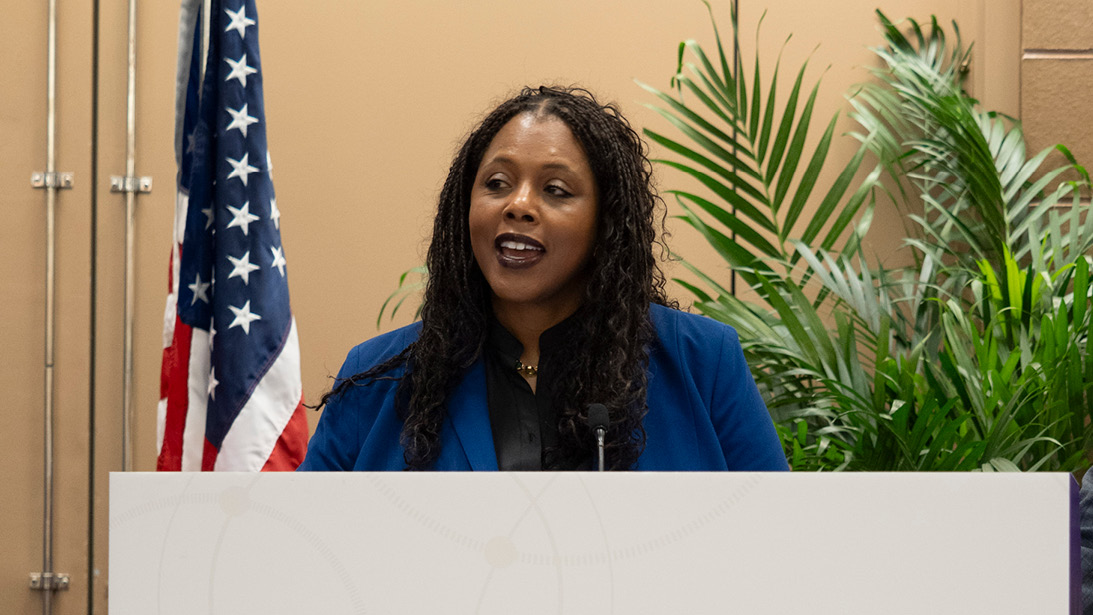
Michelle Tarver, MD, PhD, director for the FDA’s Center for Devices and Radiological Health, spoke about how the FDA evaluates evolving surgical technology at the AAOS/FDA Town Hall Symposium.
The session underscored AAOS’ commitment to educating surgeons, supporting research, and further exploring the impact and opportunities of AR, VR, and robotics on musculoskeletal care. “AAOS wants to be your collaborator and a leader in empowering the integration of new technologies. We want to work alongside you and support this new direction,” said Ned Amendola, MD, FAAOS, immediate past president of AAOS, who opened the symposium.
Although adoption varies across platforms, robotics has seen rapid growth in joint replacement. AR offers real-time intraoperative guidance, often with a smaller footprint in the operating room and lower cost. Meanwhile, VR is gaining traction as a powerful platform for simulation, training, and rehabilitation.
Across all applications, the speakers agreed that these technologies will support, not replace, the surgeon at the center of intraoperative decision making.
Virtual reality as a powerful training tool
Among the three technologies discussed, VR may have the most immediate impact on orthopaedic education.
“VR is probably one of the most important training tools we have ever seen,” said Viktor Krebs, MD, an orthopaedic surgeon at Cleveland Clinic. “It is a high-fidelity surgical simulation way beyond anything we have ever seen. This isn’t Sawbones; this is Sawbones on steroids.”
VR enables surgeons to rehearse procedures in immersive, risk-free environments, offering a level of repetition and feedback traditional training models cannot match. This becomes increasingly important as access to cadavers decreases. According to projections from the Cremation Association of North America, cremation in the United States will rise to nearly 80% in the next 10 years, reducing the number of cadavers available for medical training.
“What if we could provide every resident and fellow around the world with their own personalized cadaver lab?” asked Danny P. Goel, MD, MBS, MSc, FRCSC, clinical professor at the University of British Columbia Department of Orthopaedic Surgery. He noted that, in VR-based environments, trainees can work with virtual cadavers that provide objective feedback and performance analytics. These platforms allow users to repeat procedures indefinitely and compare their performance to expert benchmarks.
“Virtual cadaver labs provide an environment you cannot find in any other learning module,” Dr. Goel explained. “Through situated cognition, you feel like you are in an operating room, and you can measure outcomes we have never been able to analyze before. For example, which hand did you use? Where did you look and for how long? What about a surgical expert? Where did they look? Suddenly, these benchmarks become valuable to educate the future surgeons.”
With AI integration, VR systems can deliver tailored feedback at an individual level, Dr. Goel added. Based on performance data, trainees can receive specific recommendations that accelerate skill acquisition in a scalable, cost-effective way.
Enhancing precision through robotics and AR
One key advantage of robotics and AR rests in their ability to bring greater precision and consistency to orthopaedic procedures through improved implant positioning, alignment, and soft tissue balance, especially in total knee replacements, while providing real-time intraoperative feedback and kinematic assessment.
“Everyone is looking for robotic training,” Dr. Krebs noted. “If you’re not offering it, you’re not going to attract trainees. This is becoming the standard.”
AR is a promising complement to robotics. By overlaying digital guidance onto the surgeon’s surgical field of view, AR systems can assist with alignment and instrument positioning in real time. “As we move toward outpatient settings, this can help us deliver excellent care more efficiently,” Dr. Krebs added.
Beyond interoperative use, AR and simulation technologies may also streamline the regulatory process. By enabling preclinical testing through virtual models and computer-based simulations, developers could evaluate implants and techniques earlier in the process before advancing them for regulatory review.
The future of personalized care
New technologies make it easy to collect procedural data that can inform future cases. Over time, these data, combined with AI, may enable surgeons to better understand patient-specific variables and optimize outcomes.
“At some point, we will be able to phenotype a patient with a specific deformity,” Dr. Krebs explained. “Their information will be input into the AI, and it will make recommendations for surgical planning and techniques for the best possible outcomes. We also expect robots to be linked to registries and outcomes, removing the step of entering data into the registry platform. These features are currently expensive, but ideally, over the next five years, they will be more affordable,” he noted.
While that vision is within reach, Janardhan (JR) Ramachandran, president of global digital surgery and president of global robotics and enabling technologies at DePuy Synthes, emphasized that the current generation of orthopedic technology is just the beginning.
“We as an industry have to evolve the hardware, software, and data capabilities to keep pace with the expectations of our patients and stakeholders and what is happening in the broader environment and societies around us.”
Regulatory evolution and patient safety
Even as new technologies move quickly, they remain within a regulatory framework that prioritizes patient safety and system reliability.
Michelle Tarver, MD, PhD, director for the FDA’s Center for Devices and Radiological Health, joined with Rear Admiral (Lower Half) Raquel Peat, PhD, MPH, USPHS, of the U.S. Public Health Service, who serves as director of the Office of Orthopedic Devices within the Office of Product Evaluation and Quality at the FDA’s Center for Devices and Radiological Health, to explain how regulators are adapting to the changing technological landscape.
As the use of robotic surgery grows, FDA evaluations remain focused on ensuring the technology can safely and effectively perform its intended task, both panelists said.
Regulatory review focuses on key factors such as accurate recognition of anatomy, precise alignment, and imaging fidelity. Evaluation extends beyond clinical outcomes to include potential tissue damage, burns, bleeding, or device-related complications and other nonclinical risks that can be assessed through simulation and other preclinical testing.
“We’re not necessarily asking whether a robot can outperform a surgeon,” Dr. Tarver explained. “We’re asking whether it can accomplish what a surgeon alone can accomplish, safely and effectively.”
Clearances for AR and VR systems and supporting instruments have remained steady and continue to rise.
“Clinical evaluation is highly specialty-specific, with study design tailored to the procedure, anatomy, and intended use,” said Rear Admiral Peat. “For orthopaedic implants and joint replacement devices, studies may require two or more years of follow-up to fully assess safety and effectiveness. At the same time, surrogate endpoints, such as implant positioning accuracy, ligament balance, and device-related adverse events, can provide early indicators of clinical success.”
As these platforms become increasingly software-driven, cybersecurity has also emerged as a key priority. Because many devices connect directly to hospital infrastructure, vulnerabilities could disrupt not only individual procedures but also entire health systems. As a result, manufacturers must demonstrate robust safeguards against cyber threats as part of the approval process.
Notably, no fully autonomous orthopaedic robotic systems have been approved to date, reinforcing the continued role of the surgeon in the procedural workflow.
Looking ahead, both regulators emphasized the importance of collaboration. Surgeons play a critical role in advancing the field by identifying training gaps, reporting adverse events, and contributing outcomes data. Early engagement with the FDA through pre-submission pathways and collaboration to develop clinically relevant testing models will advance technology with an eye toward safety.
Jennifer Lefkowitz is a freelance writer for AAOS Now.