

Published 9/18/2026
|
Melina Khorrami, BS; Ali Rezazadeh Shirazi, BS; Pooya Hosseinzadeh, MD, FAAOS
At a Glance
- Obesity influences fracture risk differently across anatomic sites.
- Children with obesity experienced higher rates of postoperative complications.
- Vitamin D status and surgical risk warrant additional consideration.
Obesity is now among the most common chronic conditions of childhood, and its effects extend into the fracture clinic. Most surgeons recognize that children with obesity may sustain different fracture patterns and experience different healing trajectories, but demonstrating these differences has been challenging. Much of the existing evidence has come from single-institution studies with relatively modest sample sizes, and their conclusions have not always been consistent.
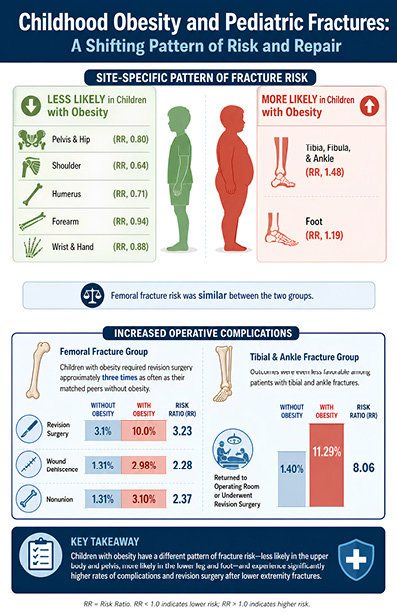
Childhood obesity is associated with distinct patterns of fracture risk and higher rates of postoperative complications, particularly following lower-extremity fractures.
Source: Data adapted from presentations at the 2026 AAOS Annual Meeting by Hosseinzadeh et al.
Two studies presented at the 2026 AAOS Annual Meeting bring national-scale data to this question. Their findings suggest obesity does not increase fracture risk uniformly across all anatomic sites and that children with obesity who require surgical treatment tend to experience a more complicated postoperative course.
A site-specific pattern of risk
The first study matched children with and without obesity using a national
database containing more than 1.1 million pediatric patients treated between 2003 and 2023. After matching, approximately 279,000 patients remained in each group, with six years of follow-up. The results did not demonstrate a uniform increase in fracture risk; instead, fracture risk varied by anatomic location.
Children with obesity were less likely to sustain fractures of the pelvis and hip (risk ratio [RR], 0.80), shoulder (RR, 0.64), humerus (RR, 0.71), forearm (RR, 0.94), and wrist and hand (RR, 0.88). In contrast, they were more likely to sustain fractures of the tibia, fibula, and ankle (RR, 1.48) as well as the foot (RR, 1.19). Femoral fracture risk was similar between the two groups.
Mechanical loading may explain much of this pattern. Excess body weight places greater loads on the lower extremities, which is where children with obesity experienced higher fracture rates: the leg, ankle, and foot. The upper-extremity findings are more difficult to explain, particularly because several earlier single-center studies reported a greater frequency of upper-extremity injuries in heavier children. Regardless, the principal takeaway is obesity appears to influence where fractures occur rather than simply increasing overall fracture frequency.
Why weight changes bone
The underlying biology is better understood than the clinical picture. Three factors appear to interact: skeletal development, the metabolic activity of adipose tissue, and mechanical loading.
The process begins with the bone itself. Children with obesity often have greater absolute bone mass, and their bone age may be advanced compared with that of their peers. However, greater bone mass does not necessarily translate into greater strength. Bone quantity increases with body size, but bone quality and geometry may not increase proportionally. As a result, the skeleton may be insufficiently adapted to the loads it must support. Bone strength may not keep pace with body size, and a fall may generate more force than the bone can withstand.
Adipose tissue is also not metabolically inert. It functions as an endocrine organ and contributes to a chronic, low-grade inflammatory state. Adipokines and inflammatory mediators affect the growth plate and bone-remodeling surfaces, where leptin signaling, receptor activator of nuclear factor kappa-B ligand (RANKL), and related cytokines may shift the balance from bone formation toward resorption while the skeleton is still developing. Excess adiposity may also direct marrow stem cells toward adipocyte differentiation rather than osteoblast formation, meaning greater fat accumulation may be accompanied by comparatively less active bone formation.
Vitamin D deficiency may further compound the problem. Vitamin D levels are low in many children with obesity, in part because the vitamin is sequestered in adipose tissue and is therefore less available in circulation. Vitamin D is essential for normal calcium metabolism and bone mineralization. This research group has previously demonstrated that low vitamin D levels are associated with more severe forearm fractures, including fractures requiring operative treatment.
Harder recoveries after surgery
The second study extended the investigation by examining postoperative outcomes. It included more than 41,000 pediatric patients who underwent surgery for femoral or tibial and ankle fractures. The investigators compared 840 matched patients in the femoral fracture group and 788 matched patients in the tibial and ankle fracture group over one year of follow-up.
The difference in complication rates was substantial. In the femoral fracture group, children with obesity required revision surgery approximately three times as often as their matched peers without obesity: 10.0% versus 3.1% (RR, 3.23). Rates of wound dehiscence were also higher Ñ 2.98% versus 1.31% Ñ as were rates of nonunion, at 3.10% versus 1.31%.
Outcomes were even less favorable among patients with tibial and ankle fractures. In this group, 11.29% of children with obesity returned to the operating room or underwent revision surgery, compared with 1.40% of children without obesity. This represented a more than eightfold difference. Wound dehiscence and nonunion were, again, more common in the obesity group. Infection rates were numerically higher among patients with obesity at both anatomic sites, although the differences did not reach statistical significance.
Limitations of these studies include the inability to evaluate important fracture-related details, including fracture pattern and severity, as well as the inability to assess radiographs to confirm fixation technique, fracture healing, malunion, and other radiographic outcomes. Most previous research in this area has come from single institutions, limiting the generalizability of the findings. These newer studies strengthen the literature by examining substantially larger populations. Obesity has already been associated with more complex fracture patterns, greater displacement, increased difficulty with casting and fixation, and a higher likelihood of operative treatment.
These two studies add national-scale data and clarify the second half of the clinical course: recovery. Their findings suggest the healing skeleton of a child with obesity may be less forgiving than that of a child of normal weight.
What it means at the bedside
Several practical implications follow for everyday clinical care. When a child with obesity requires surgery, the surgeon should anticipate an increased risk of wound complications, nonunion, and return to the operating room. These risks should be discussed with the family at the outset.
Vitamin D levels should also be evaluated and corrected when necessary, as vitamin D deficiency is both inexpensive to identify and potentially modifiable. Discussions with patients and families should remain focused on bone health, fracture healing, and surgical risk rather than on weight itself, given the sensitivity of this subject for children and their parents.
Childhood obesity is unlikely to diminish as a clinical concern in the near future. These studies provide data supporting what many surgeons have long suspected: fractures in children with obesity may behave differently. They identify the anatomic sites at which fracture risk is increased and, more importantly, help surgeons and families prepare for a potentially more challenging postoperative course. That is the type of evidence that can directly influence clinical practice.
Melina Khorrami is an incoming second-year medical student at Touro University California College of Osteopathic Medicine, where she serves as president of the Student American Osteopathic Academy of Orthopedics (SAOAO) chapter, the American Osteopathic Academy of Sports Medicine (AOASM) chapter, and the Orthopedic Surgery Journal Club.
Ali Rezazadeh Shirazi is an incoming third-year medical student and Clinical Anatomy Fellow at Kansas City University College of Osteopathic Medicine, where he assists in cadaveric lab instruction, lectures, and small-group teaching.
Pooya Hosseinzadeh, MD, FAAOS, is a pediatric orthopaedic surgeon in the Department of Orthopaedic Surgery at Washington University in St. Louis; he served as the senior supervising investigator on this work.
References
- Hosseinzadeh P, Momtaz DA, Jahn JJ, et al. Breaking points: fracture risks in obese versus nonobese children, a propensity matched national cohort analysis of 1,153,855 pediatric patients. Podium presentation at the 2026 Annual Meeting of the American Academy of Orthopaedic Surgeons; March 2 to 6, 2026; New Orleans, LA.
- Hosseinzadeh P, Momtaz DA, Ehlen QT, et al. Impact of obesity on surgical outcomes in pediatric lower extremity fractures: a propensity matched cohort study. Podium presentation at the 2026 Annual Meeting of the American Academy of Orthopaedic Surgeons; March 2 to 6, 2026; New Orleans, LA.
- Nowicki P, Kemppainen J, Maskill L, Cassidy J. The role of obesity in pediatric orthopaedics. JAAOS Glob Res Rev. 2019;3(5):e036.
- Kreutzer A, McMichael J, Nowicki P. The role of bone health in low velocity fractures and the effects of obesity on the growing skeleton. J Pediatr Soc North Am. 2024;7:100053.
- Hosseinzadeh P, Mohseni M, Minaie A, Kiebzak GM. Vitamin D status in children with forearm fractures: incidence and risk factors. JAAOS Glob Res Rev. 2020;4(8):e20.00150.
- Fintini D, Cianfarani S, Cofini M, Andreoletti A, Ubertini GM, Cappa M. The bones of children with obesity. Front Endocrinol (Lausanne). 2020;11:200.
- Fornari ED, Suszter M, Roocroft J, Bastrom T, Edmonds EW, Schlechter J. Childhood obesity as a risk factor for lateral condyle fractures over supracondylar humerus fractures. Clin Orthop Relat Res. 2013;471(4):1193-1198.
- Kessler J, Koebnick C, Smith N, Adams A. Childhood obesity is associated with increased risk of most lower extremity fractures. Clin Orthop Relat Res. 2013;471(4):1199-1207.
- Seeley MA, Gagnier JJ, Srinivasan RC. Obesity and its effects on pediatric supracondylar humeral fractures. J Bone Joint Surg Am. 2014;96(3):e18.
- Li NY, Kalagara S, Hersey A, Eltorai AEM, Daniels AH, Cruz AI Jr. Impact of obesity on operative treatment and inpatient outcomes of paediatric limb fractures. Bone Joint J. 2019;101B:491-496.
- Lazar-Antman MA, Leet AI. Effects of obesity on pediatric fracture care and management. J Bone Joint Surg Am. 2012;94(9):855-861.