

GLP-1 receptor agonist use was associated with higher rates of several tendon ruptures and select bone metabolism disorders in large retrospective cohort analyses.
courtesy of Jad Lawand, MS, and Joseph A. Abboud, MD, FAAOS
Published 9/18/2026
|
Jad Lawand, MS; Joseph Abboud, MD
At a Glance
- GLP-1 RA use was associated with higher rates of several tendon ruptures.
- Increased rates of osteoporosis, osteomalacia, and gout were also observed.
- Rotator cuff, Achilles, pectoralis major, quadriceps, and peroneal ruptures showed higher risk.
Estimated read time: 4 minutes
The use of GLP-1 receptor agonist (GLP-1 RA) medications has rapidly increased, with randomized controlled studies reporting reductions in major adverse cardiovascular events and diabetic kidney disease progression. Because patients with underlying conditions of diabetes and/or obesity are at increased risk for musculoskeletal (MSK) conditions, it might be expected that GLP-1 RA medications would help reduce such effects. The use of these medications, however, has outpaced understanding of their impact on bone and connective tissue over time. Two retrospective, propensity-matched cohort studies drawn from a national federated electronic health record network have begun to close that knowledge gap.
GLP-1 RA use linked to tendon rupture risk
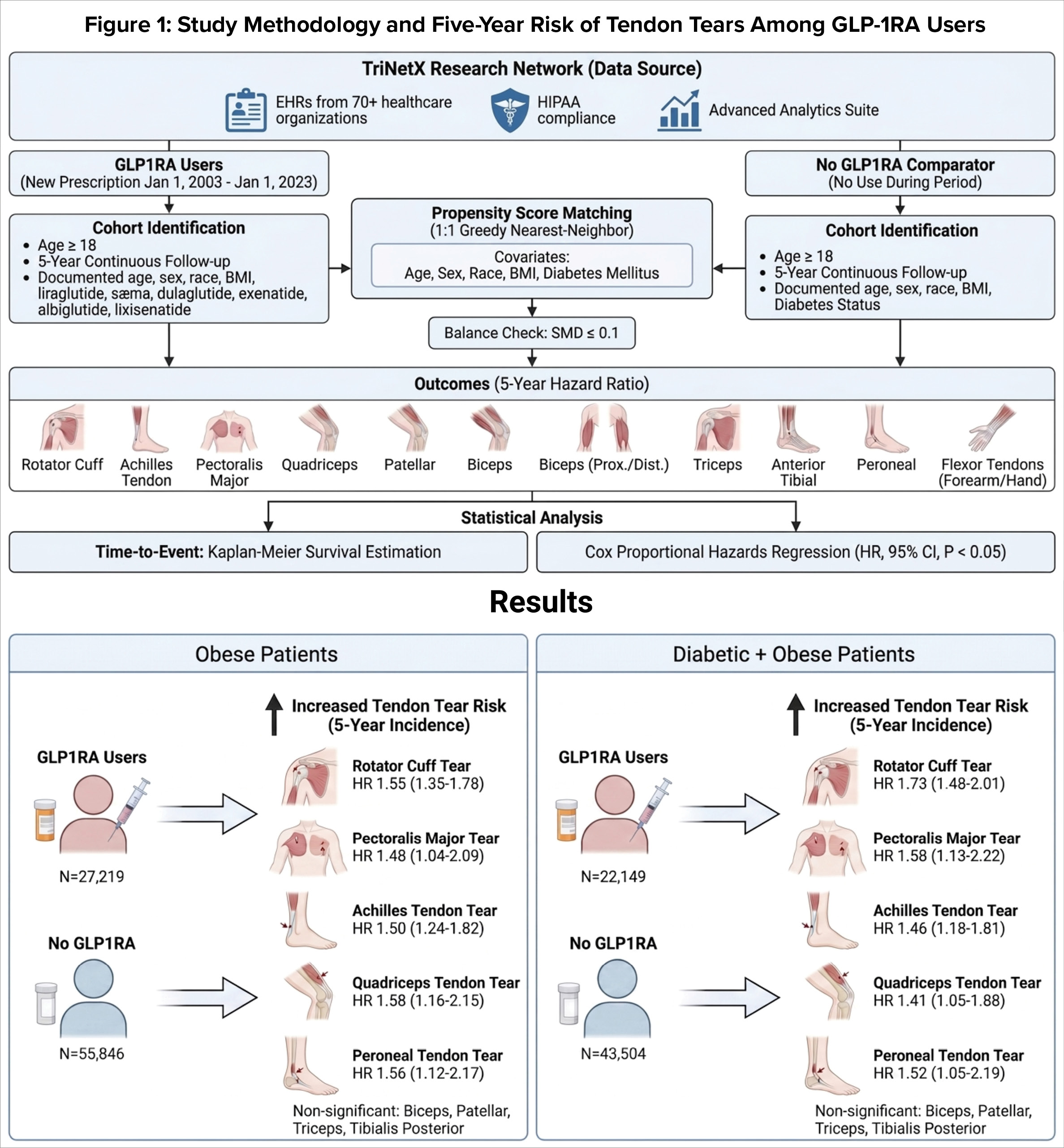
In a matched analysis, 78,590 patients prescribed GLP-1 RAs were matched with nonusers using propensity score matching on age, sex, BMI, race, diabetes status, statin use, and hypercholesterolemia. Separate analyses were performed for patients with obesity and those with type 2 diabetes plus obesity. Incidence and hazard ratios (HR) over five years were calculated. In both the obesity and the obesity plus diabetes groups, GLP-1 RA prescription was associated with statistically significant higher risk of rupture in five of these categories: rotator cuff tear (RCT) (2.4% versus 1.5%; HR 1.55 in obesity, 1.48 in obesity + diabetes); Achilles rupture (HR 1.49 obesity; 1.53 obesity + diabetes); pectoralis major rupture (HR 1.46 in both groups); quadriceps (HR 1.53; 1.44 obesity + diabetes); and peroneal ruptures (HR 1.89; 1.33 obesity + diabetes) (Figure 1).
The tendons that failed are the ones under the greatest mechanical demand, a distribution unlikely to be random. One possible explanation is loss of lean muscle mass. Rapid GLP-1 RA-driven weight reduction sheds muscle alongside fat, potentially leaving high-demand tendons mechanically unsupported at exactly the insertions that already fail in overhead athletes and middle-aged lifters. GLP-1 receptors are expressed in skeletal muscle and connective tissue, which offers a plausible direct route as well.
Few assessments of the relationship of GLP-1 RA use and tendon rupture have been published. One recent scoping study by Duru et al. summarized rotator cuff studies, identifying an association between GLP-1 RA use and higher incidence of atraumatic RCT.
Further MSK impact: Osteoporosis, osteomalacia, and gout
Multiple studies have assessed the impact of this class of medications on bone and fracture risk. In a study parallel to the tendon analysis, the authors performed another retrospective cohort study matching patients with concurrent type 2 diabetes and obesity with controls (73,483 per cohort). Higher five-year incidence of three skeletal outcomes was identified: osteoporosis (4.1% versus 3.2%; relative risk [RR] 1.29), gout (7.4 % versus 6.6%; RR 1.12), and osteomalacia (0.2% versus 0.1%; RR 2.55). Osteomalacia was rare but carried the largest relative effect, and it is arguably the one most likely to matter in the operating room, where bone quality drives fixation strategy.
These findings are in some tension with earlier reports that liraglutide and lixisenatide may lower fracture risk through increased osteoblast activity and suppressed resorption. Direct effects on bone, decreased inflammatory state, and improved management of diabetes alongside frequently lower doses in the treatment of diabetes (versus weight loss) may contribute to the protective effect on bone health and fracture risk. GLP-1 RA is a class, not a molecule, and agent-level effects may diverge as the newer medications in the class are studied. Lastly, at least one randomized clinical trial with GLP-1 RA use demonstrated that negative effects on bone mineral density with obesity treatment can be mitigated by pairing with resistance training.
Study limitations
With these population studies, limitations must be recognized. These studies report association, not causation. Presence of a prescription does not assure use of the medication. Prospective studies incorporating imaging, clinical assessment, and longitudinal follow-up are needed.
The absolute risks are modest. For most endpoints, the risk difference is under one percentage point. The studies also carry the limitations inherent in using aggregate data with reliance on diagnostic coding, no measure of adherence, no imaging confirmation, and residual confounding by indication. Diabetes on its own is associated with a roughly fourfold higher tendinopathy risk and fivefold higher rupture risk, driven by advanced glycation end-products accumulating in the collagen matrix. Separating drug effect from disease effect in a retrospective cohort is challenging.
Even so, the cohorts are large, the direction is consistent across two independent outcome sets, and the precedent is well established. Fluoroquinolones, corticosteroids, aromatase inhibitors, and statins are all recognized tendon-toxic agents, several of them acting through matrix metalloproteinase activation and type I collagen degradation.
It is reasonable to keep GLP-1 RA exposure on the differential when a patient presents with an atraumatic or low-energy tendon rupture and rapid weight loss.
What this changes in clinic
The practical message is anticipatory rather than prohibitive. A patient on a GLP-1 RA who presents with insidious shoulder pain, a palpable pectoralis defect after a bench press, or a positive Thompson test deserves a low threshold for imaging, particularly if that patient is physically active or has ruptured a tendon before. Preoperatively, awareness of osteoporosis and osteomalacia findings argue for attention to bone quality when planning fixation in this population.
The therapeutic value of these drugs is not in question. However, given the prevalence of use, their musculoskeletal footprint deserves consideration in the preoperative conversation.
Jad Lawand is a fourth-year medical student at the University of Texas Medical Branch with a research focus in shoulder and elbow surgery.
Joseph A. Abboud, MD, FAAOS, is the chief medical officer at Rothman Orthopaedic Institute and a professor of orthopaedic surgery at the Sidney Kimmel Medical College of Thomas Jefferson University, Philadelphia, Pennsylvania, specializing in shoulder and elbow surgery.
References
- Duru DO, Zhou AK, Lee DKR, Carroll PJ, Elmaraghy A. Glucagon-like peptide-1 receptor agonists and rotator cuff disease: a scoping review. BMC Musculoskelet Disord. 2026 Jun 15;27(1):532. doi: 10.1186/s12891-026-10092-9. PMID: 42298552; PMCID: PMC13295517.
- Su B, Sheng H, Zhang M, et al. Risk of bone fractures associated with glucagon-like peptide-1 receptor agonists' treatment: a meta-analysis of randomized controlled trials. Endocrine. 2015;48(1):107-115.
- Cheng L, Hu Y, Li YY, et al. Glucagon-like peptide-1 receptor agonists and risk of bone fracture in patients with type 2 diabetes: a meta-analysis of randomized controlled trials. Diabetes Metab Res Rev. 2019;35(7):e3168.
- Ma X, Meng J, Jia M, et al. Exendin-4, a glucagon-like peptide-1 receptor agonist, prevents osteopenia by promoting bone formation and suppressing bone resorption in aged ovariectomized rats. J Bone Miner Res. 2013;28(7):1641-1652
- Meng J, Ma X, Wang N, et al. Activation of GLP-1 receptor promotes bone marrow stromal cell osteogenic differentiation through β-catenin. Stem Cell Reports. 2016;6(4):579-591.
- Wu L, Zhou M, Li T, et al. GLP-1 regulates exercise endurance and skeletal muscle remodeling via GLP-1R/AMPK pathway. Biochim Biophys Acta Mol Cell Res. 2022;1869(9):119300.
- Jensen SBK, Sørensen V, Sandsdal RM, et al. Bone health after exercise alone, GLP-1 receptor agonist treatment, or combination treatment: a secondary analysis of a randomized clinical trial. JAMA Netw Open. 2024;7(6):e2416775. doi:10.1001/jamanetworkopen.2024.16775.