

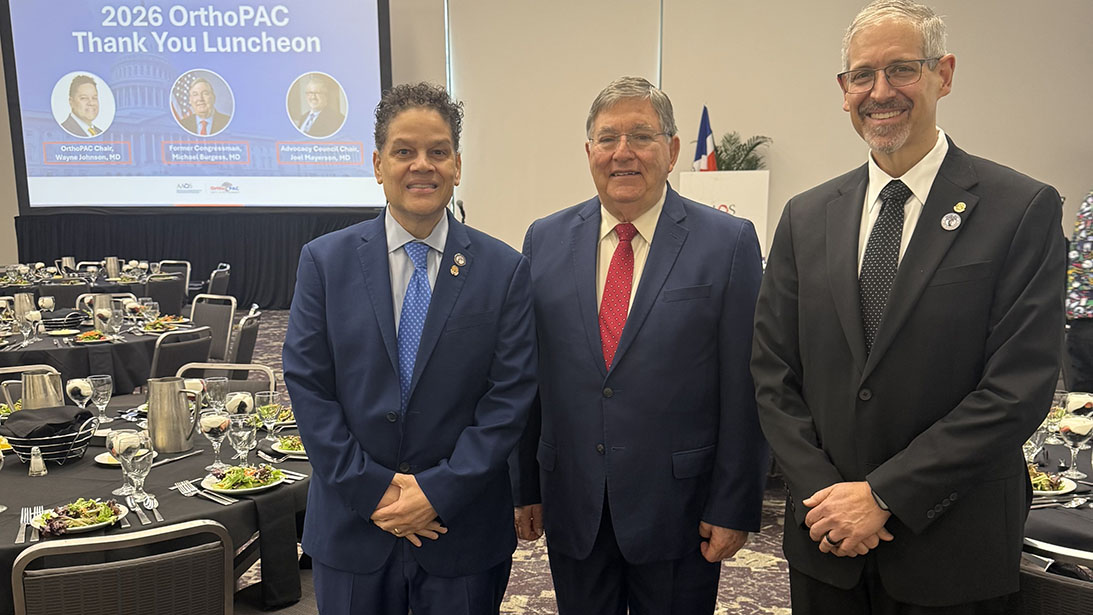
Left to right: OrthoPAC Chair Wayne A. Johnson, MD, FAAOS, FACS, Michael C. Burgess, MD, and Advocacy Council Chair Joel L. Mayerson, MD, FAAOS, FACS, at the OrthoPAC donor appreciation luncheon.
Published 3/4/2026
|
Hannah Leve
How can orthopaedic surgeons secure meaningful involvement in shaping health policy decisions? This year’s OrthoPAC donor appreciation luncheon featured a fireside chat with former Congressman and OBGYN Michael C. Burgess, MD, for an inside look at the policies impacting musculoskeletal care today. During his time in the House of Representatives, he led the GOP Doctors Caucus, one of healthcare’s strongest proponents on Capitol Hill.
Burgess’ decades of clinical practice were critical in his approach to health policy as a member of Congress. During his two decades in the House of Representatives, he introduced more medical legislation than any other member of Congress, past or present. Notably, Dr. Burgess authored the Medicare Access and CHIP Reauthorization Act (MACRA), a landmark piece of legislation that modernized Medicare physician payment. MACRA also established the Merit-based Incentive Payment System (MIPS) as a part of its Quality Payment Program, which helped streamline Medicare quality reporting.
Before MACRA, physicians were subject to regular payment cuts based on the sustainable growth rate (SGR). As Burgess noted, these policies don’t exist in a vacuum. “Each cut actually was a draw against something in the future. Every year that you didn’t fix [the program] completely, the next year got more expensive.” Without permanent policies enshrined into law, physicians were at the mercy of often-changing federal agencies like CMS. “If there’s no legislative authority coming out of the legislative branch, the agency gets to decide what happens,” he said.
While MACRA played an important role in the transition to value-based care, many physicians know this has been a slow and arduous process. Over the past several years, AAOS has fought for a permanent solution to Medicare payment instability that ties conversion factors to a measure of inflation. Last month, AAOS led the introduction of the Efficiency Adjustment Delay Act, which would pause CMS’ new and highly problematic 2.5% cut to non-time-based surgical codes.
Medicare payment reform is just one of several priority issues affecting orthopaedic surgeons, practices, and patients. Recently, regulatory changes have introduced AI models in prior authorization, and the Centers for Medicare and Medicaid Innovation (CMMI) has promised to add a gold carding program later in the year. Dr. Burgess, was a strong advocate for prior authorization reform.
Dr. Burgess, along with AAOS OrthoPAC Chair Wayne Johnson, MD, FAAOS, FAC, and Advocacy Council Chair Joel L. Mayerson, MD, FAAOS, FACS, also discussed physician-owned hospitals, protecting federal research, and the expansion of value-based care models. Spring marks a critical time in the legislative process as Congress finalizes its budget for the year ahead. The AAOS Office of Government Relations is closely tracking appropriations for the Peer Reviewed Orthopaedic Research Program (PRORP), which was cut entirely in Fiscal Year (FY) 2025. As physician advocates, protecting federal research programs like PRORP is essential. As Burgess said, “someone will come after dollars they perceive as being spent in excess” unless leaders see the value of this research. Following months of advocating and collaborating, PRORP was awarded $20 million to fund cutting-edge orthopaedic research for warfighters and veterans. AAOS has been on Capitol Hill fighting for full restoration of the program in FY27.
How can today’s physicians ensure a sustainable profession for the next generation? According to Burgess, the key is relationship building. He highlighted the importance of fly-ins like the National Orthopaedic Leadership Conference in the fall but also stressed the significance of getting to know local legislator and their healthcare staff. “Don’t just bring complaints, bring solutions,” Dr. Burgess emphasized. “If you can take a patient or two, do it. Take more patients than doctors.” By amplifying real-world experiences, orthopaedic surgeons can deepen their relationships with legislators and bring musculoskeletal care to the forefront.
Physicians are inherently tapped into issues in patient care and understand their impact on the broader healthcare system. “We don’t work for hospitals or insurers. We are the advocate for the patient. No one else is going to do what we can do,” Dr. Burgess said.
The AAOS Office of Government Relations is here to support orthopaedic surgeons in being their own best advocates, from residency and throughout their careers. Members interested in getting involved are invited to visit the Advocacy Action Center at aaos.quorum.us and connect with AAOS Advocacy on X and LinkedIn.
The Political Action Committee of the American Association of Orthopaedic Surgeons (OrthoPAC) is affiliated with and connected to the 501(c)(6) Association. OrthoPAC is not connected to or affiliated with the American Academy of Orthopaedic Surgeons, which is a 501(c)(3) organization. For more information on all OrthoPAC efforts, visit aaos.org/advocacy/pac.
Hannah Leve is a member of the office of AAOS government relations.