

Published 12/17/2025
|
Jennifer Lefkowitz
In 2025, the AAOS Registry Program surpassed 5.5 million procedures collected — a milestone that reflects both growth and innovation. Over the past year, the program was enhanced to increase the efficiency, consistency, and accuracy of captured procedures, all with the goal of improving patient outcomes in musculoskeletal care.
New tools and initiatives launched over the past year provided Registry participants with streamlined and modernized data-collection processes and enhancements. These include the Master Data Dictionary (MDD) for the American Joint Replacement Registry (AJRR) and Musculoskeletal Tumor Registry (MsTR); standardized input across sites; a risk-adjusted revision-rate measure to give surgeons more equitable feedback on revision rates for total hip and total knee arthroplasty; and the launch of a metastatic bone-disease module to help advance data collection related to musculoskeletal cancers.

“Our registries serve as a nationally representative dataset that encompasses a wide spectrum of orthopaedic care across diverse healthcare settings,” said Bryan D. Springer, MD, FAAOS, AAOS Registry Oversight Committee co-chair and AJRR Steering Committee member. “While registries were once seen primarily as research databases, participants now receive practice-changing data and meaningful benchmarks. Broad participation only strengthens this approach.”
In August, AJRR introduced a new risk-adjusted revision-rate measure, designed to ensure more accurate comparisons by accounting for factors such as patient demographics, comorbidities, health history, and surgical setting. Available on RegistryInsights©, this new measure provides orthopaedic surgeons and quality officers with more equitable and meaningful feedback on revision rates for total hip and total knee arthroplasty.
“This enhancement has been a long time coming,” said Steven D. Glassman, MD, FAAOS, AAOS Registry Oversight Committee co-chair and the American Spine Registry (ASR) Executive Committee co-chair. “The fact that the Registry Program has reached a volume threshold of procedures reflects the strength of our data and allows us to risk-stratify results with confidence — not only for large patient groups but also for smaller populations.”
Expanding data access with Epic
AAOS will further modernize data collection by adopting Epic’s cloud-based Community Registries for data collection and insights for AJRR in 2026. This collaboration is expected to ease the technical burden that hospitals and health systems have faced in contributing data.
“One of the biggest challenges has been that even when partner hospitals and health systems use the same electronic medical record, the relevant data can be stored in different places, requiring each participating site to build its own IT infrastructure for data pulls,” explained Dr. Glassman. “With Epic’s Community Registries, that process will be centralized. The system will extract the right data regardless of how it is structured at the site level, making participation more feasible for a broader range of participants.”
Master Data Dictionary
A consolidated MDD for AJRR and MsTR was launched in May. The MDD’s purpose is to streamline data input and management, eliminate inconsistencies across modules and registries, and enhance accuracy. These changes are expected to reduce participant burden and improve the onboarding process. The MDD launch also included the new metastatic bone disease module in addition to the existing module for sarcoma.
Along with simplifying data management, MDD introduces standard language related to participation tiers.
- Standard participation: Basic data submission for core analysis (mainly abstracted from electronic health records); a minimum dataset that ensures all required elements are being collected for meaningful quality improvement
- Enhanced participation: Includes more clinical and patient-reported data for advanced analytics
- Alternative entry pathway (MsTR only): Simplified submission method for sarcoma data collection designed to reduce barriers to entry
American Spine Registry growth
ASR, a collaboration between the American Association of Neurological Surgeons and AAOS, reached 500,000 procedures in 2025. Dr. Glassman identifies this as a significant milestone that demonstrates the flexibility of the registry platform to extend beyond joint-replacement procedures.
“While procedures captured in AJRR and the Shoulder & Elbow Registry (SER) can provide a relatively straightforward metric like revision, spine surgery involves a far more complex landscape with numerous diagnoses, procedures, and outcomes,” Dr. Glassman explained. “Capturing a meaningful volume of spine cases highlights the platform’s ability to handle this complexity and reflects a major accomplishment not only for ASR but for the Registry Program as a whole. It also lays the groundwork for collecting richer, more nuanced data, such as complications and patient-reported outcomes, beyond whether an implant simply stayed in place. This represents a critical step forward in advancing quality improvement and research in spine care.”
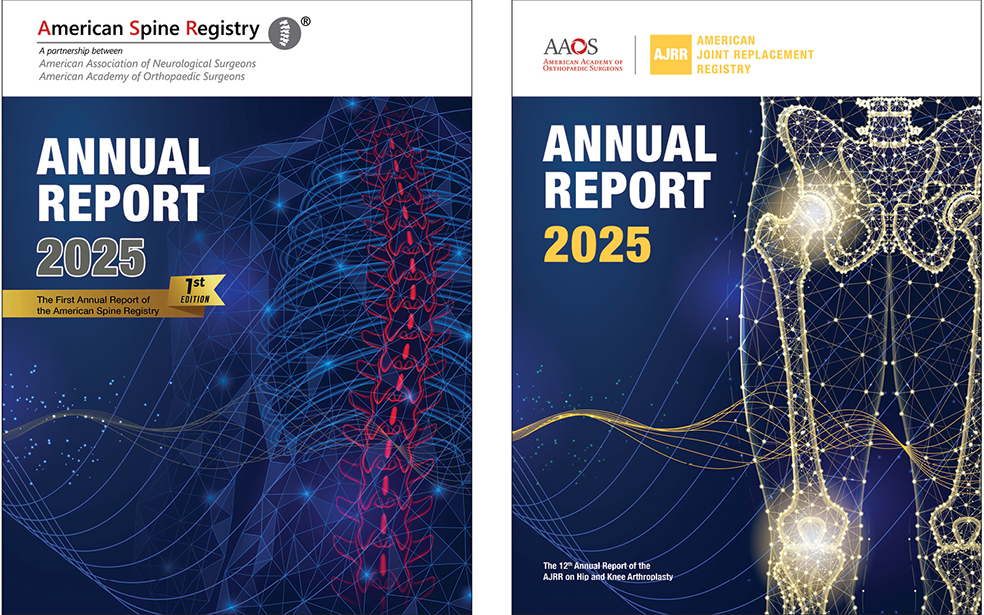
ASR also released its first Annual Report for 2025 in conjunction with the 2025 Spine Summit in February. The report, which reviewed procedures performed between 2015 and 2023, provides trends to guide physicians and patient decision-making, aiming to improve spine care.
Fracture & Trauma Registry transition
Beginning Jan. 1, 2026, key fracture data from the Fracture & Trauma Registry will be integrated into AJRR and SER, enabling broader clinical impact and enhanced participation. Under the new model, hip fracture data will transition to the AJRR, and proximal humerus fracture data will be incorporated into SER.
Although access to all data submitted to the Fracture & Trauma Registry will be available through the end of 2025, the distal femur, distal radius, and ankle fracture data will be securely archived for future use.
“As we look toward 2026, we will continue to harness the power of technology to automate the registries where possible,” Dr. Springer said. “Streamlining data collection with natural language processing and [artificial intelligence] will continue to reduce the manual steps necessary to submit data. In addition, the use of large language models to interpret data will become increasingly more impactful.”
To learn more about the AAOS Registry Program, visit aaos.org/registries.
RAI advances orthopaedics with data
The AAOS Registry Analytics Institute® (RAI) is a resource for the scientific community, created to enhance orthopaedic and musculoskeletal care by providing access to data analyses. Investigators can submit hypotheses about information in AAOS registries. AAOS committees provide a peer-review process and oversight of which proposals are approved. Data analysis will be completed by AAOS Registry Analytics team members for all approved proposals.
Jennifer Lefkowitz is a freelance writer for AAOS Now.
RAI by the numbers
In 2025, there were:
- 136 RAI proposals
- 12 approved RAI proposals
- 17 peer-reviewed publications
Jennifer Lefkowitz is a freelance writer for AAOS Now.