

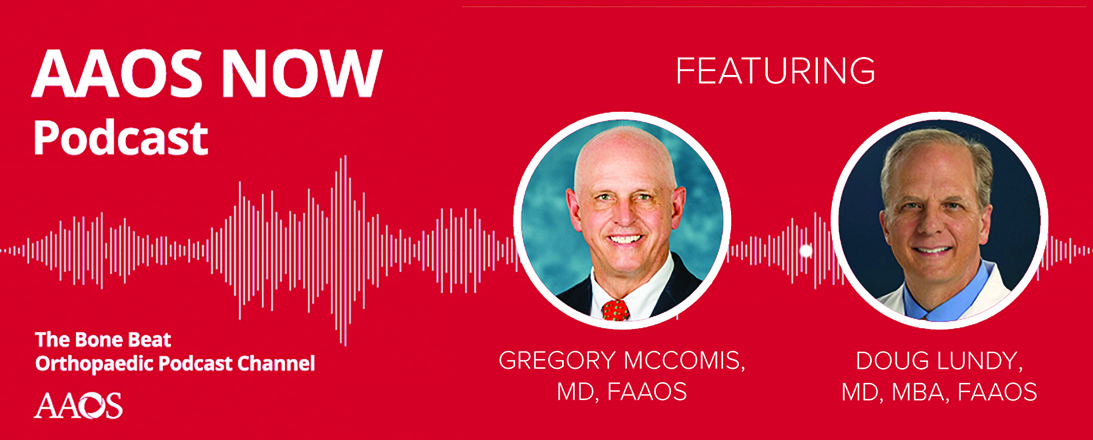
In the latest episode of the AAOS Now Podcast, special guest Gregory McComis, MD, FAAOS, director of ABOS and chair of the ABOS Maintenance of Certification (MOC) Committee, discusses recent changes to the MOC program.
Published 11/20/2025
In the latest episode of the AAOS Now Podcast, Douglas Lundy, MD, FAAOS, a member of the AAOS Now Editorial Board and former director of the American Board of Orthopaedic Surgery (ABOS), welcomed special guest Gregory McComis, MD, FAAOS, director of ABOS and chair of the ABOS Maintenance of Certification (MOC) Committee, for an important conversation on recent changes to the MOC program.
Dr. Lundy began the conversation by asking about the difference between MOC and initial board certification. Dr. McComis explained that MOC is a continuation of the certification process, allowing orthopaedic surgeons to maintain a knowledge base over the course of their careers and keep up with emerging technologies to help them provide the best care for their patients. “We want to practice the best science-based orthopaedic surgery we possibly can, and that’s what MOC helps us do,” he said.
Dr. McComis then briefly highlighted the four program concepts that are evaluated for MOC: licensure, lifelong learning, cognitive expertise, and evidence of performance and practice.
Key changes to MOC
Dr. McComis highlighted the following changes to the MOC program that orthopaedic surgeons should be aware of:
- The program name is changing from “Maintenance of Certification” to “Continuing Certification” in 2026.
- Diplomates may apply to recertify as early as year 7. This recertification goes into effect at the end of their current 10-year certification, so the diplomate is not penalized for reapplying early.
- For diplomates who are recertifying in 2031 and beyond, the recertification process is split into two five-year periods. During each five-year period, diplomates must obtain 120 CME credits and 20 self-assessment examination (SAE) credits, which should spread out education evenly across the entire 10-year cycle to avoid front- or back-loading of credits.
What to know about the WLA pathway
The conversation also touched on the ABOS Web-Based Longitudinal Assessment (WLA) pathway, which diplomates can use to fulfill the cognitive expertise requirement. Established in 2019, the ABOS WLA pathway allows diplomates to answer questions relevant to their everyday practice at a time that works for them, using their own computer, in whatever location they prefer. Diplomates must choose 15 knowledge sources — such as journal articles, practice guidelines, and Appropriate Use Criteria — to study in-depth and be tested on. If a diplomate scores 80% or higher for their knowledge sources, they achieve one quality year; diplomates must achieve five quality years in an eight-year period to maintain ABOS certification. Due to positive feedback, ABOS will sunset some traditional exams, and ABOS will continue to make improvements in the coming years.
Dr. Lundy and Dr. McComis also discussed how AAOS can help diplomates track their CME and SAE progress, organize their documentation, obtain SAE credits through the Orthopaedic In-Training Examination® and Orthopaedic Knowledge Update packages, and earn CME credits with a variety of activities during the AAOS Annual Meeting. Dr. McComis advised using AAOS tools “to chip away at those CME and SAE requirements.”
Finally, for anyone who feels overwhelmed or confused by the MOC process, Dr. McComis shared the following advice:
- First and foremost, make sure ABOS has your current email address so they can send reminders about key MOC milestones.
- Diplomates should use the ABOS dashboard to keep track of what they still need to do.
- Do not hesitate to contact ABOS for guidance from certification specialists.
Dr. McComis ended the episode on a humorous note by reminding Diplomates not to procrastinate when it comes to recertification: “Don’t try to gobble this up in one big bite. … [There is] no sense to pull an all-nighter when you’re 40, 50, 60 years old.”